
The ocean is full of animals that look like they belong in a science-fiction movie. Two of the most fascinating are the octopus and squid—both soft-bodied, highly intelligent cephalopods with impressive abilities that make them unlike almost anything on land.
But what’s the difference between an octopus and a squid? Although they belong to the same animal group, they have some major differences in body structure, movement, habitat, behavior, and hunting strategies.
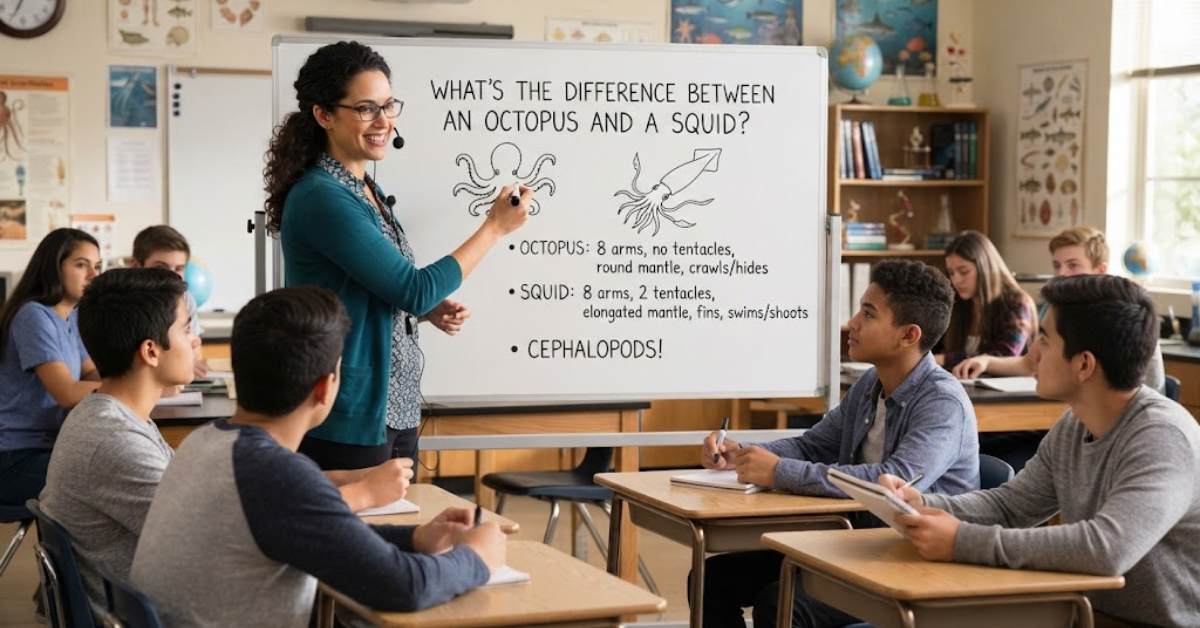
The easiest way to tell them apart is to look at their appendages and body shape: octopuses have eight arms and generally have a rounded body, while squid have eight arms, two longer tentacles, and a more streamlined body with fins.
Let’s take a closer look at squid vs octopus so you can quickly understand what makes these two remarkable animals different.
Are Squid and Octopus the Same?
No. Squid and octopuses are not the same animal, although they are closely related.
Both belong to the class Cephalopoda, a group of marine mollusks that also includes cuttlefish and nautiluses. They share several characteristics, including soft bodies, sophisticated nervous systems, and the ability to change their appearance.
But millions of years of evolution have taken them in different directions.
Think of them as distant relatives rather than two versions of the same animal.
Octopus vs Squid: The Quick Comparison
If you’re looking for the basic answer to octopus vs squid, here’s the easiest comparison:
| Octopus | Squid | |
| Arms | 8 arms | 8 arms + 2 longer tentacles |
| Body shape | Rounded or bulb-like | Long and streamlined |
| Fins | Generally absent | Usually has fins |
| Skeleton | No internal shell | Has an internal structure called a pen |
| Movement | Often crawls; can jet through water | Primarily adapted for swimming |
| Habitat | Often associated with the seafloor | Commonly found swimming in open water |
| Defense | Ink, camouflage, hiding, jet propulsion | Ink, camouflage, speed, jet propulsion |
| Lifestyle | Many species are relatively solitary | Many species are more social |
| Hunting style | Often stalks or ambushes prey | Frequently pursues prey in open water |
There are exceptions to some of these generalizations because cephalopods are an incredibly diverse group. Still, these differences provide a useful starting point.
What’s the Difference Between an Octopus and a Squid?
The biggest differences become obvious when you compare their anatomy.
1. Arms and Tentacles
This is probably the easiest way to distinguish them.
An octopus has eight arms, and each arm is typically lined with suckers.
A squid has eight arms plus two longer tentacles. Those two tentacles are usually specialized for capturing prey and can be considerably longer than the arms.
So if you see eight shorter appendages plus two long ones, you’re probably looking at a squid.
2. Body Shape
Octopuses tend to have a rounded, bulb-like body known as the mantle.
Squid generally have a more elongated, streamlined body designed for efficient swimming.
Their body shapes reflect their different lifestyles.
An octopus often spends considerable time near the seafloor, moving among rocks, reefs, crevices, or other structures. Squid are generally much more adapted to moving through open water.
3. Fins
Many squid have fins on their mantle.
These fins help them maneuver and control their movement through the water.
Most octopuses don’t have the prominent paired fins that are characteristic of many squid species. There are exceptions among unusual deep-sea octopuses, but fins are not a typical octopus feature.
4. Internal Support Structure
Another major difference is hidden inside the body.
Octopuses don’t have a hard internal skeleton. Their bodies are remarkably flexible, allowing many species to squeeze through surprisingly small openings.
Squid have a flexible internal structure called a pen, sometimes known as a gladius. It provides support while still allowing the body to remain relatively flexible.
This internal structure is one of the clearest anatomical differences between the two animals.
Squid vs Octopus: How Do They Move?
Their movement is another fascinating point of comparison.
Both animals can use jet propulsion. They draw water into their mantle cavity and force it out through a structure called a siphon or funnel, creating thrust.
But they don’t rely on this method in exactly the same way.
How octopuses move
Octopuses can crawl along the seafloor using their arms. They can also swim by jetting water through their siphon when they need to move quickly.
Some species can even use their arms and body posture to move in remarkably controlled ways.
How squid move
Squid are built more specifically for swimming.
Their streamlined bodies, fins, and powerful jet propulsion system allow them to move efficiently through the water column.
Many squid can move quickly when pursuing prey or escaping predators.
Octopus vs Squid: Where Do They Live?
Habitat is another useful clue when comparing octopus vs squid.
Octopuses are often associated with the seafloor. Depending on the species, they may live around coral reefs, rocky habitats, sandy bottoms, or deep-sea environments.
They frequently use their surroundings as shelter.
Squid are often more closely associated with the open water, although some species live near the seafloor or in coastal environments.
Some squid species travel through the ocean in groups, while others are more solitary.
The deep ocean also contains some extraordinary species of both animals, showing just how adaptable cephalopods can be.
How Do Octopuses and Squid Hunt?
Both animals are predators, but their hunting strategies can differ considerably.
Octopus hunting
Many octopuses are ambush predators.
They may hide among rocks, coral, sand, or other structures and wait for prey to come within reach.
Their arms and suckers give them excellent control when grabbing prey.
Depending on the species, octopuses may eat animals such as:
- Crabs
- Shrimp
- Fish
- Mollusks
- Other small marine animals
Their ability to change color and texture can make them extremely difficult for prey—and predators—to detect.
Squid hunting
Squid are often active hunters.
Their streamlined bodies allow them to pursue prey through the water, while their two longer tentacles can rapidly extend to capture animals.
Squid commonly eat fish, crustaceans, and other marine organisms.
Some species are also important prey for larger animals such as whales, seals, seabirds, and large fish.
Which Is More Intelligent: Squid or Octopus?
Cephalopods are widely regarded as some of the most behaviorally sophisticated invertebrates.
Octopuses are especially famous for their problem-solving abilities. Researchers have documented behaviors involving exploration, learning, memory, manipulation of objects, and complex interactions with their environments.
Squid also have sophisticated nervous systems and demonstrate complex behaviors, particularly in communication, hunting, schooling, and responses to their surroundings.
It’s difficult to reduce intelligence to a simple “winner,” especially when comparing animals adapted to very different lifestyles.
The important point is that both octopuses and squid have unusually advanced nervous systems for invertebrates.
How Do Octopuses and Squid Defend Themselves?
Neither animal is particularly interested in becoming an easy meal.
Both have developed impressive defenses.
Camouflage
Octopuses are famous for their ability to change skin color and patterns. Some species can also alter the texture of their skin, helping them blend into rocks, sand, coral, and other surroundings.
Squid can also change their coloration and patterns.
These changes can serve multiple purposes, including camouflage, communication, and signaling.
Ink
Both squid and many octopus species can release ink.
The ink can create a dark cloud that interferes with a predator’s ability to see or track the escaping animal.
The exact composition and function of ink can vary among species, but it is an important defensive tool for many cephalopods.
Speed
Squid have a major advantage when it comes to open-water speed and maneuverability.
Their streamlined bodies and powerful swimming abilities can help them escape predators quickly.
Octopuses can also move rapidly when necessary, especially using jet propulsion, but many species rely heavily on camouflage and hiding.
Do Octopuses and Squid Have Bones?
Neither animal has bones like those found in mammals, birds, or fish.
Octopuses are particularly soft-bodied and lack a rigid internal skeleton.
Squid, however, have the pen, a lightweight internal structure that supports the body. It isn’t a bone, but it provides some structural support.
This difference helps explain why an octopus can be so remarkably flexible while a squid generally maintains a more streamlined body shape.
Are Octopus and Squid Related?
Yes.
Both are cephalopods and belong to the phylum Mollusca, the same broad animal group that includes snails, clams, oysters, and other mollusks.
That may seem surprising because a squid looks nothing like a garden snail.
But evolution has produced an extraordinary range of body forms within the mollusks.
Octopuses and squid share several important characteristics, including:
- Soft bodies
- Tentacle or arm-like appendages
- A mantle
- A siphon
- Complex nervous systems
- Specialized eyes
- The ability to change skin coloration
- Jet propulsion
Their similarities reveal their shared ancestry, while their differences reflect adaptations to different ecological niches.
Squid vs Octopus: Which Is Bigger?
Size varies enormously among species, so there isn’t a simple answer.
Some octopus species are relatively small, while others can become quite large.
Squid also range from tiny species to enormous animals.
The giant squid and colossal squid are among the largest known living invertebrates, although much about these deep-sea animals remains difficult to observe directly.
So if you’re comparing the average octopus with the average squid, size isn’t a reliable identification method.
Body shape and the presence of two longer tentacles are much more useful clues.
Can an Octopus and Squid Live Together?
They can occupy overlapping marine environments, and both may be found in the same broad ocean regions.
However, they don’t necessarily use the environment in the same way.
An octopus may spend much of its time near the seafloor or sheltering in a den, while many squid spend more time swimming through the water column.
Their diets can also overlap, meaning that they may sometimes compete for similar prey.
Still, the ocean is large and diverse, and different species often occupy different ecological niches.
Common Misconceptions About Octopuses and Squid
“An octopus has tentacles.”
In everyday conversation, people often use “tentacle” for any cephalopod appendage. Biologically, however, octopuses have arms, while squid have eight arms plus two specialized tentacles.
“Squid have eight legs.”
They’re not legs. Squid have eight arms and two tentacles.
“Octopuses are basically underwater squid.”
Not at all. They’re related cephalopods, but their anatomy, behavior, movement, and lifestyles differ significantly.
“All octopuses live on the ocean floor.”
Many do, but not all. Some unusual species have adapted to life in the open water or deep ocean.
“Squid are always found in huge groups.”
Some squid form schools, but social behavior varies considerably between species.
Frequently Asked Questions
What’s the difference between an octopus and a squid?
An octopus has eight arms and generally has a rounded, soft body without an internal shell. A squid has eight arms, two longer tentacles, a streamlined body, fins, and an internal structure called a pen.
Are squid and octopus the same?
No. Squid and octopuses are different types of cephalopods, although they are closely related and share many characteristics.
What’s the main difference between squid vs octopus?
The most obvious difference is their body structure. Octopuses have eight arms and rounded bodies, while squid have eight arms, two longer tentacles, and generally more streamlined bodies with fins.
Which is smarter, an octopus or a squid?
Octopuses are particularly well known for complex problem-solving and learning abilities, but squid also display sophisticated behaviors. Comparing intelligence directly between very different animals is difficult.
Do squid and octopus both have ink?
Many squid and octopus species can release ink as a defense mechanism. However, not every cephalopod species uses ink in exactly the same way.
Do octopuses and squid have bones?
Neither has bones like vertebrates. Octopuses lack a rigid internal skeleton, while squid have a flexible internal structure called a pen that supports the body.
Which is faster, an octopus or a squid?
Squid are generally better adapted for fast swimming through open water. Octopuses can also use jet propulsion for rapid movement but often rely more on crawling, camouflage, and hiding.
Can octopuses change color like squid?
Yes. Both can change their skin coloration and patterns. Octopuses are particularly famous for their sophisticated camouflage abilities, and some can also change skin texture.
Final Takeaway: Octopus vs Squid
So, what’s the difference between an octopus and a squid? Although they’re closely related members of the cephalopod family, they’re built for different ways of life.
An octopus has eight arms, a rounded body, and remarkable flexibility, while a squid has eight arms, two longer tentacles, a streamlined body, fins, and an internal pen. Octopuses are often associated with the seafloor and hiding, while many squid are active swimmers that spend much of their lives in open water.
Once you know what to look for, the squid vs octopus comparison becomes much easier. The next time you see one of these remarkable animals, check the appendages, body shape, and swimming style—you’ll have a much better idea of which cephalopod you’re looking at.