
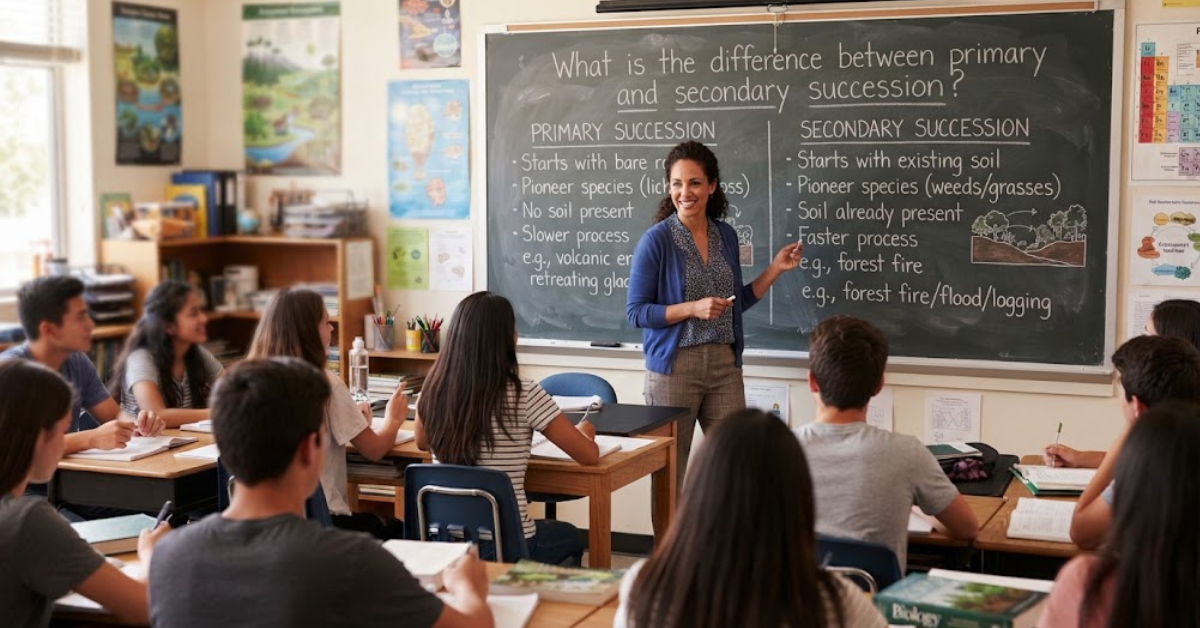
A forest can disappear after a wildfire, while an entirely new landscape can emerge when a glacier retreats. In both situations, life gradually returns and the community changes over time—but the process doesn’t always begin from the same starting point.
So, what is the difference between primary and secondary succession?
The key difference is what exists at the beginning of the process. Primary succession begins on newly exposed or newly formed surfaces where soil and a previous biological community are absent or essentially absent. Secondary succession occurs after a disturbance in an area that was previously inhabited and where soil, organic matter, seeds, roots, or other biological remnants may remain.
That starting point has a major effect on how quickly an ecosystem can recover and which organisms appear first.
Let’s look at both types of ecological succession, how they work, and why the distinction matters.
What Is Ecological Succession?
Before comparing primary and secondary succession, it helps to understand ecological succession itself.
Ecological succession is the gradual change in the species composition and structure of an ecological community over time. As environmental conditions change, some species become established, others decline, and new species may take their place.
Succession isn’t necessarily a sudden event. It can unfold over decades, centuries, or, particularly in primary succession, much longer periods.
A simplified sequence might look like this:
Bare or disturbed area → pioneer species → grasses and small plants → shrubs → larger plants → more developed community
The exact sequence varies depending on climate, soil, disturbance, available species, and other environmental conditions.
The two major forms discussed in introductory ecology are primary succession and secondary succession.
What Is Primary Succession?
Primary succession is ecological succession that begins on newly exposed or newly formed land where there is little or no developed soil and no established biological community.
Think of a landscape that has essentially been reset to bare mineral material.
Examples can include:
- Newly cooled volcanic rock
- Land exposed by retreating glaciers
- Newly exposed bare rock
- Certain newly formed surfaces with no established soil
In these situations, organisms have to colonize the area from the beginning.
That’s why primary succession is generally a slow process.
How Primary Succession Begins
Imagine a glacier retreating and exposing bare rock.
At first, there may be little soil available to support larger plants. Organisms capable of surviving these harsh conditions begin to establish themselves.
These early colonizers are called pioneer species.
Lichens are a classic example often used to explain primary succession because they can colonize exposed rock and contribute to processes that help create conditions suitable for later organisms. Other hardy organisms may also establish themselves depending on the environment.
As organisms grow, die, and decompose, organic material accumulates. Weathering also breaks down mineral surfaces.
Gradually, a developing soil layer can support more demanding plants.
Primary Succession Example: Volcanic Rock
A volcanic eruption provides one of the clearest examples of primary succession.
When lava cools and forms new rock, the surface may initially have no developed soil or established community. Over time, organisms begin to colonize the new substrate.
A simplified sequence might be:
- Bare volcanic rock
- Pioneer organisms
- Early plants and microorganisms
- Accumulation of organic matter
- Development of soil
- Grasses and other plants
- Shrubs and larger plants
- A more developed ecological community
The exact species and sequence depend on local environmental conditions.
OpenStax describes new volcanic land as an example of primary succession and notes that pioneer organisms help contribute to the development of soil, allowing other species to establish later.
Primary Succession After Glacier Retreat
Glaciers provide another useful example.
As a glacier moves across a landscape, it can remove existing soil and vegetation. When the glacier retreats, it can expose bare rock or relatively undeveloped substrate.
That exposed surface becomes available for colonization.
Over time, pioneer organisms establish themselves, organic material accumulates, and conditions become increasingly suitable for other organisms.
This is one reason glacial retreat is frequently used as an example when teaching primary succession.
What Is Secondary Succession?
Secondary succession occurs when an existing ecological community is disturbed but the area retains enough soil, organic material, seeds, roots, microorganisms, or other remnants to support recolonization.
In other words, the ecosystem has been disrupted, but it isn’t starting completely from scratch.
Common examples include areas affected by:
- Wildfires
- Storms
- Flooding
- Logging
- Abandoned agriculture
- Other disturbances that remove much of the existing vegetation without completely removing the underlying soil
The precise outcome depends on how severe the disturbance is and what remains afterward.
Secondary Succession Example: A Forest Fire
Imagine a mature forest experiencing a wildfire.
The fire may destroy large amounts of vegetation, but the soil can remain. Nutrients from burned vegetation can also return to the ground as ash, while seeds, roots, microorganisms, and other organisms may survive depending on the fire’s intensity.
Once conditions become suitable, plants begin to recolonize the area.
A simplified sequence might be:
Disturbed forest → grasses and herbaceous plants → shrubs → young trees → developing forest
Over time, the community can become increasingly complex again. OpenStax uses oak-hickory forests following wildfire as a classic example of secondary succession.
Secondary Succession on Abandoned Farmland
Abandoned farmland is another useful example.
Suppose agricultural land is no longer cultivated.
The soil is already present, so plants don’t need to spend centuries creating an entirely new soil layer from bare rock. Seeds can arrive from surrounding areas, and some seeds or roots may already be present in the soil.
Early colonizers can therefore establish relatively quickly.
Grasses and herbaceous plants may appear first, followed by shrubs and eventually trees in suitable environments.
The exact sequence varies with climate, soil conditions, land-use history, and the species available to colonize the site.
Primary vs Secondary Succession: Key Differences
The easiest way to understand the difference is to compare their starting conditions.
| Feature | Primary Succession | Secondary Succession |
|---|---|---|
| Starting point | Newly exposed or newly formed substrate | Previously inhabited ecosystem |
| Soil | Little or no developed soil initially | Soil generally remains |
| Previous community | No established community at the starting point | Previous community existed before disturbance |
| Pioneer species | Often essential for initial colonization | Colonization can begin with species that take advantage of existing soil and remnants |
| Speed | Generally slower | Generally faster |
| Typical examples | New volcanic rock, freshly exposed glacial rock | Wildfire, abandoned farmland, some logged or disturbed areas |
| Organic matter | Initially scarce | Often remains |
| Seeds/roots/microbes | Usually absent or very limited initially | May survive the disturbance |
| Soil formation | Major part of the early process | Soil is already present |
| Starting conditions | Harsh and relatively undeveloped | Usually more biologically supportive |
The most important distinction is therefore not simply whether a disturbance happened.
It’s whether the area begins with a previously developed ecological foundation.
Why Is Primary Succession Slower?
Primary succession generally takes longer because organisms must help create the conditions needed for later communities.
Imagine trying to build a garden on solid rock.
Before you can grow many plants, you need some combination of weathered material, organic matter, nutrients, moisture, and suitable physical conditions.
Early organisms contribute to this developing environment.
As organic material accumulates and the substrate changes, more species can establish themselves.
This is why primary succession can take hundreds, thousands, or even longer periods depending on the environment and the definition of the endpoint being considered.
Why Is Secondary Succession Faster?
Secondary succession generally has a head start.
After a disturbance, the area may still have:
- Soil
- Nutrients
- Organic matter
- Microorganisms
- Seeds
- Roots
- Buried plant structures
- Nearby sources of colonizing organisms
That existing biological and physical foundation makes recolonization easier.
For example, a burned forest doesn’t necessarily have to recreate its soil from bare rock. Some organisms may survive, while others can arrive from surrounding areas.
As a result, secondary succession can proceed considerably faster than primary succession.
Pioneer Species in Primary and Secondary Succession
The term pioneer species refers to organisms that are among the first to establish themselves in a newly available or disturbed environment.
In primary succession, pioneer organisms have an especially important challenge: they must survive where soil and resources are initially limited.
Lichens and hardy plants are commonly used as textbook examples.
In secondary succession, the first colonizers can take advantage of the soil and other resources that remain after the disturbance. Grasses, herbaceous plants, and other fast-growing species can become important early colonizers depending on the ecosystem.
The identity of pioneer species isn’t universal. Different environments favor different organisms.
Stages of Ecological Succession
Although succession doesn’t follow one identical script everywhere, it can be useful to visualize it as a series of broad stages.
1. Disturbance or New Habitat Formation
For primary succession, a new or previously uncolonized substrate becomes available.
For secondary succession, an existing ecosystem is disturbed.
2. Colonization
Organisms arrive from nearby habitats or other sources.
The earliest organisms must be capable of surviving the conditions present at that time.
3. Establishment
Some organisms successfully reproduce and become established.
Their presence can change the physical environment.
4. Community Development
As organisms interact with their surroundings, conditions may become more suitable for additional species.
Competition also becomes increasingly important.
5. Species Replacement
Some species become less competitive as environmental conditions change, while others become more successful.
The community therefore changes over time.
6. A More Mature Community
Eventually, the ecosystem may develop into a relatively stable community for the environmental conditions present.
However, modern ecology emphasizes that ecosystems remain dynamic. A community isn’t necessarily locked into one permanent final state.
Does Succession Always End in a “Climax Community”?
You may have learned that ecological succession always ends with a climax community.
That’s a useful traditional concept, but it’s worth adding some nuance.
A climax community was historically described as a relatively stable endpoint of succession under particular environmental conditions. Introductory biology textbooks still use the term when explaining classic succession examples.
Modern ecological thinking recognizes that ecosystems can remain dynamic. Species composition can change because of climate, disturbances, competition, invasive species, herbivory, disease, and other factors.
So it’s better to think of succession as a process of community change rather than a guaranteed march toward one permanently fixed endpoint.
Similarities Between Primary and Secondary Succession
Despite their different starting points, primary and secondary succession share several characteristics.
Both involve changes in ecological communities over time.
Both can involve:
- Colonization by new organisms
- Pioneer species
- Competition
- Changes in vegetation
- Changes in animal communities
- Changes in nutrient availability
- Changes in habitat structure
- Gradual development of a more complex community
In both cases, organisms can also influence the environment around them, creating conditions that affect which species can establish next.
Primary and Secondary Succession Examples
Here’s a quick way to remember the most common examples.
Examples of Primary Succession
- New land created by volcanic activity
- Bare rock exposed after glacier retreat
- Newly exposed surfaces with little or no developed soil
- Certain newly formed habitats that have not previously supported an established community
Examples of Secondary Succession
- Forest recovering after wildfire
- Vegetation returning after some types of flooding
- Abandoned agricultural fields
- Forest regeneration after logging
- Ecosystems recovering after certain storms or other disturbances
The exact classification depends on what remains after the disturbance. A severe disturbance that removes soil can create conditions more characteristic of primary succession, while a disturbance that leaves soil and biological remnants usually allows secondary succession.
Primary vs Secondary Succession: An Easy Memory Trick
Having trouble remembering which is which?
Try this:
Primary = Starting From Bare Ground
Think primary = first.
The ecosystem is beginning on a newly exposed or newly formed substrate with little or no developed soil.
Primary → pioneer species → soil development → later communities
Secondary = Starting Again
Think secondary = second chance.
An ecosystem already existed, but a disturbance changed or damaged it.
Disturbance → remaining soil/resources → recolonization → community recovery
That simple distinction can help you answer many ecology questions correctly.
Why Ecological Succession Matters
Succession isn’t just something found in biology textbooks.
It helps explain how ecosystems respond to disturbance and how landscapes change over time.
Understanding succession can help scientists and land managers study:
- Forest recovery
- Habitat restoration
- Conservation
- Land management
- Soil development
- Biodiversity
- Effects of natural disturbances
- Ecosystem resilience
For example, after a wildfire, knowing how vegetation typically recovers can help researchers understand which species are likely to appear at different stages and how habitat conditions may change over time.
Succession also demonstrates an important ecological principle: organisms don’t simply respond to their environment; they can also change it.
Early colonizers can alter soil, nutrients, shade, moisture, and habitat conditions, influencing which organisms arrive later.
Primary vs Secondary Succession in One Example
Imagine two landscapes.
Landscape A: Fresh Volcanic Rock
A volcanic eruption creates a new rocky surface.
There is little or no developed soil.
Organisms must colonize the surface, and soil formation becomes an important part of the early process.
This is primary succession.
Landscape B: Burned Forest
A wildfire destroys much of a forest’s vegetation.
But the soil remains, along with some seeds, roots, microorganisms, nutrients, and nearby sources of colonization.
Plants begin growing again.
This is secondary succession.
The simplest question to ask is:
Is there already a developed ecological foundation left behind?
If the answer is largely no, you’re looking at primary succession.
If the answer is yes, secondary succession is more likely.
Frequently Asked Questions
What is the difference between primary and secondary succession?
Primary succession begins on newly exposed or newly formed surfaces with little or no developed soil and no established community. Secondary succession follows a disturbance in an area that was previously inhabited and retains soil or other biological remnants.
What is an example of primary succession?
A classic example is the colonization of newly formed volcanic rock. Another is the establishment of organisms on bare rock exposed after a glacier retreats.
What is an example of secondary succession?
Forest recovery after a wildfire is a classic example. Abandoned farmland is another commonly cited example because soil and other resources remain after cultivation stops.
Which is faster, primary or secondary succession?
Secondary succession is generally faster because soil and other remnants of the previous ecosystem are already present. Primary succession has to begin with much less biological infrastructure, so development is typically slower.
Does primary succession start with soil?
Typically, no developed soil is present at the beginning of primary succession. Soil develops gradually through weathering, accumulation of organic matter, and the activities of organisms.
Does secondary succession have soil?
Generally, yes. The defining feature of secondary succession is that the area was previously occupied and retains some ecological foundation after the disturbance, commonly including soil.
What are pioneer species?
Pioneer species are among the first organisms to establish themselves in a newly available or disturbed environment. In primary succession, lichens and other hardy organisms are commonly discussed as pioneer colonizers, while grasses and herbaceous plants can be important early colonizers during secondary succession.
Is a wildfire primary or secondary succession?
A wildfire is usually associated with secondary succession when it leaves soil and other parts of the previous ecosystem intact. The severity of the fire matters, however. If a disturbance completely removes soil and the ecological foundation, the situation can become more similar to primary succession.
Is a glacier retreat primary succession?
It can be. When a retreating glacier exposes bare rock with little or no developed soil, organisms colonizing that surface represent a classic example of primary succession.
Why does primary succession take so long?
Primary succession generally takes longer because the ecosystem starts with very limited soil, organic matter, and biological resources. Early colonizers must help create conditions that can support additional species.
Can humans cause secondary succession?
Yes. Human activities such as agriculture, logging, and land clearing can disturb ecosystems. When the area retains soil and can be recolonized, subsequent ecosystem development can involve secondary succession.
Conclusion: What Is the Difference Between Primary and Secondary Succession?
So, what is the difference between primary and secondary succession?
The answer comes down to the starting conditions.
Primary succession begins on newly exposed or newly formed surfaces where developed soil and an established biological community are absent. Pioneer organisms colonize the area, and over time they contribute to the development of conditions that can support increasingly complex communities.
Secondary succession, in contrast, occurs after an existing ecosystem has been disturbed. Because soil, nutrients, seeds, roots, microorganisms, or other remnants may remain, the ecosystem usually has a significant head start.
A simple way to remember it is:
Primary succession starts from a relatively bare foundation. Secondary succession starts with something left behind.
Once you understand that difference, the examples—volcanic rock, glacier retreat, wildfire, abandoned farmland, and forest recovery—become much easier to classify.
For a deeper understanding of ecology, the next useful step is to explore food chains, trophic levels, ecological communities, and ecosystem energy flow. Together, these concepts show how individual organisms become part of the larger systems that make ecosystems work.