Words can do much more than simply describe something. A good writer can make you see, hear, or even feel an idea by comparing it to something familiar. That is where similes and metaphors come in—and understanding the difference between simile and metaphor can make both your writing and reading much easier.
At first glance, these two figures of speech can seem almost identical. Both compare one thing with another to create a stronger image or express an idea in a more interesting way. The main difference is how the comparison is made.
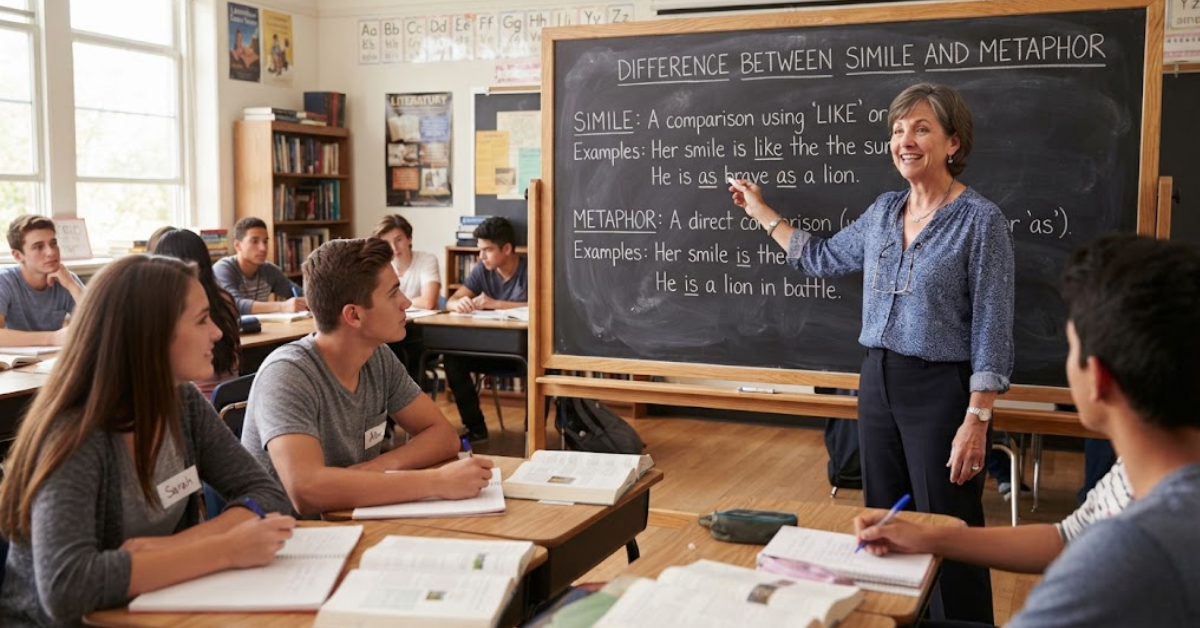
A simile makes a comparison using words such as “like” or “as,” while a metaphor makes a direct comparison by saying that one thing is another.
Let’s take a closer look at how these two literary devices work, how to recognize them, and how to use them effectively.
What Is a Simile?
A simile is a figure of speech that compares two different things using a word such as “like” or “as.”
The purpose is usually to help the reader understand or visualize something more clearly. Instead of describing something in a plain way, the writer connects it to something familiar.
For example:
Her smile was like sunshine.
The person’s smile isn’t literally sunshine. The writer is comparing the smile to sunshine to suggest that it is bright, warm, cheerful, or uplifting.
Common Simile Examples
Here are some familiar examples of similes:
- He runs like the wind.
- She is as busy as a bee.
- The baby’s skin was as soft as silk.
- The water was as cold as ice.
- His voice sounded like thunder.
- The child slept like a log.
- The car moved as fast as a rocket.
Notice the comparison words. Most of these examples contain like or as, which makes them relatively easy to identify.
How Similes Work
A simile generally follows a structure such as:
A is like B.
Or:
A is as [quality] as B.
For instance:
- The classroom was like a zoo.
- He was as quiet as a mouse.
- The moon looked like a silver coin.
The comparison doesn’t mean that the two things are literally the same. Instead, they share a particular characteristic.
What Is a Metaphor?
A metaphor is also a figure of speech that compares two unlike things, but it does so more directly.
Rather than saying that something is like another thing, a metaphor says that one thing is another.
For example:
Her smile was sunshine.
The smile isn’t actually sunshine. However, describing it as sunshine suggests warmth, happiness, brightness, or comfort.
That direct comparison is what separates a metaphor from a simile.
Common Metaphor Examples
Here are several examples:
- Time is a thief.
- The classroom was a zoo.
- He has a heart of stone.
- The world is a stage.
- Her voice is music to my ears.
- My brother is a walking dictionary.
- The city was a jungle.
These statements aren’t meant to be understood literally. They create a mental picture by transferring characteristics from one thing to another.
For example, when someone says “Time is a thief,” time isn’t literally stealing anything. The metaphor suggests that time takes moments away from us, often before we realize how quickly they have passed.
Difference Between Simile and Metaphor
The simplest way to remember the difference between simile and metaphor is to look at the type of comparison being made.
| Feature | Simile | Metaphor |
| Comparison | Indirect comparison | Direct comparison |
| Common words | Like, as | Often uses “is” or “are” |
| Example | Her eyes shine like stars. | Her eyes are stars. |
| Meaning | One thing resembles another | One thing is presented as another |
| Effect | Often makes a comparison clearer | Often makes the comparison stronger or more imaginative |
Consider these two sentences:
Simile:
The boy was as brave as a lion.
Metaphor:
The boy was a lion.
Both sentences communicate bravery. However, the simile openly tells us that the boy resembles a lion, while the metaphor makes the comparison directly.
Simile vs. Metaphor: What’s the Main Difference?
The key distinction comes down to comparison language.
A simile typically signals the comparison with like or as:
The lake was like a mirror.
A metaphor doesn’t need those comparison words:
The lake was a mirror.
Neither statement means the lake literally became a household mirror. Both create an image of a smooth, reflective surface. The metaphor simply makes the comparison more direct.
A Simple Memory Trick
If you’re trying to remember the difference, ask yourself:
Does the sentence use “like” or “as” to compare two things?
If yes, it is probably a simile.
If the writer directly identifies one thing with another, it is probably a metaphor.
For example:
- Simile: The snow was like a blanket.
- Metaphor: The snow was a blanket.
This trick works for many basic examples, although not every sentence containing “like” or “as” is automatically a simile.
Simile and Metaphor Examples Side by Side
Seeing the two forms together makes the distinction easier.
Example 1: Person and Lion
Simile:
Marcus is as strong as a lion.
Metaphor:
Marcus is a lion.
The simile says Marcus has a quality associated with a lion. The metaphor presents Marcus as a lion to create a more forceful image.
Example 2: Eyes and Stars
Simile:
Her eyes sparkled like stars.
Metaphor:
Her eyes were stars.
Both suggest that her eyes were bright or beautiful, but they construct the comparison differently.
Example 3: Classroom and Zoo
Simile:
The classroom was like a zoo.
Metaphor:
The classroom was a zoo.
In both cases, the writer is suggesting that the classroom was noisy, chaotic, or difficult to control.
Why Do Writers Use Similes and Metaphors?
Both literary devices make language more vivid.
Imagine writing:
The boy was very nervous.
That’s perfectly understandable, but it doesn’t create a particularly strong image.
Now compare it with:
The boy was as nervous as a cat in a room full of dogs.
The second sentence gives the reader something concrete to imagine.
A metaphor can be even more direct:
Nervousness was a storm inside him.
Suddenly, the emotion has an image attached to it.
Writers use figurative language for several reasons:
- To create vivid mental pictures
- To make abstract ideas easier to understand
- To express emotions
- To make descriptions more memorable
- To add personality to writing
- To make stories more engaging
- To communicate complex ideas in simple ways
Simile vs. Metaphor in Everyday Language
You don’t have to be reading poetry or studying literature to encounter similes and metaphors.
People use both forms of figurative language in everyday conversation.
You might hear someone say:
I’m as hungry as a horse.
That’s a simile.
Someone might also say:
I’m starving. My stomach is a bottomless pit.
That’s a metaphor.
Advertising, journalism, music, movies, speeches, social media, and casual conversation all use figurative comparisons.
For example, someone might describe a difficult workday by saying:
Today was a marathon.
That’s a metaphor. The person probably didn’t literally run 26.2 miles; the comparison communicates that the day was long and exhausting.
How to Identify a Simile
When reading a sentence, use these steps:
- Look for a comparison.
Ask whether the writer is comparing two different things. - Check for “like” or “as.”
These words often signal a simile. - Ask what quality is being compared.
Is the writer comparing speed, appearance, strength, sound, emotion, or another characteristic? - Decide whether the comparison is literal.
If it isn’t literal and uses a comparison such as “like” or “as,” you probably have a simile.
Simile Identification Example
The baby’s cheeks were as soft as clouds.
The baby doesn’t literally have clouds for cheeks. The sentence compares the softness of the baby’s cheeks with the imagined softness of clouds.
Therefore, it is a simile.
How to Identify a Metaphor
Identifying a metaphor requires looking for a more direct comparison.
Try these steps:
- Look for two different things being connected.
- Ask whether one thing is being described as another.
- Check whether the comparison is meant figuratively rather than literally.
- Think about the shared quality or idea.
For example:
The internet is an information highway.
The internet isn’t literally a highway. The metaphor compares the movement of information online with the movement of vehicles along a highway.
Can a Sentence Be Both a Simile and a Metaphor?
A single comparison can sometimes be expressed in either form, but the specific sentence will generally function as either a simile or a metaphor based on how the comparison is constructed.
Compare:
He fights like a tiger.
This is a simile.
He is a tiger in the ring.
This is a metaphor.
The underlying idea is similar, but the grammatical construction changes the figure of speech.
Writers may also combine different types of figurative language in a larger passage. In those cases, it’s important to identify each comparison separately rather than labeling the entire passage as one device.
Simile and Metaphor in Literature
Authors have relied on comparisons for centuries because they allow readers to experience ideas rather than simply receive information.
A simile can gently guide the reader toward a particular image:
The leaves danced like tiny green flags.
A metaphor can make the image feel more immediate:
The leaves were tiny green flags.
The choice depends on the writer’s purpose and style.
In poetry, metaphors can carry several layers of meaning. Fiction, similes can make descriptions feel conversational and visual. In essays and speeches, either device can make an abstract argument easier to grasp.
Other Types of Figurative Language
Similes and metaphors are not the only forms of figurative language.
Understanding a few related terms can make literary analysis much easier.
Personification
Personification gives human qualities to something nonhuman.
Example:
The wind whispered through the trees.
Wind cannot literally whisper in the human sense, so the writer gives it a human action.
Hyperbole
Hyperbole is an intentional exaggeration used for emphasis.
Example:
I’ve told you a million times.
The speaker probably hasn’t literally said it one million times.
Idiom
An idiom is a familiar expression whose overall meaning isn’t necessarily predictable from its individual words.
Example:
It’s raining cats and dogs.
This means it is raining heavily, not that animals are falling from the sky.
Analogy
An analogy explains or illustrates an idea by comparing it with something similar.
For example, someone might compare learning a language to building a house: both require a foundation before more complex parts can be added.
Common Mistakes With Similes and Metaphors
One common mistake is assuming that every comparison containing “like” is a simile.
For example:
She looks like her mother.
This is normally a literal comparison, not necessarily a literary simile. The sentence simply says that the person’s appearance resembles her mother’s.
Another mistake is assuming every metaphor must use the word “is.”
That’s not true.
Consider:
The storm swallowed the coastline.
This can function metaphorically even though it doesn’t use “is.” The storm isn’t literally swallowing anything like a person would.
The important question is whether the language creates a figurative comparison.
Simile or Metaphor: Which Should You Use?
Neither is automatically better.
The right choice depends on what you want the reader to experience.
Use a Simile When You Want To:
- Make an unfamiliar idea easier to understand
- Create a clear visual comparison
- Sound conversational
- Emphasize resemblance
- Give readers a specific image
Use a Metaphor When You Want To:
- Make a comparison more direct
- Create a stronger image
- Express an abstract idea creatively
- Give a description more emotional weight
- Make a phrase memorable
For example, if you’re describing someone’s speed, you could write:
Simile:
She ran like lightning.
Metaphor:
She was lightning on the track.
The second version feels more dramatic because the comparison is presented directly.
A Quick Simile and Metaphor Test
If you’re still unsure, try this three-question test:
Question 1: Are two different things being compared?
If not, you probably don’t have either a simile or metaphor.
Question 2: Does the comparison use “like” or “as” in a figurative way?
If yes, it’s likely a simile.
Question 3: Is one thing being presented as another without a literal meaning?
If yes, it’s likely a metaphor.
Here’s a quick practice set:
- The boy was as quiet as a mouse.
→ Simile - The boy was a mouse in the crowded room.
→ Metaphor - The clouds looked like cotton balls.
→ Simile - The clouds were cotton balls floating across the sky.
→ Metaphor
Frequently Asked Questions
What is the difference between a simile and a metaphor?
A simile compares two things using words such as “like” or “as,” while a metaphor makes a direct figurative comparison. For example, “She is like a rose” is a simile, while “She is a rose” is a metaphor.
What is an easy way to remember simile vs. metaphor?
Remember that a simile commonly uses like or as to show a comparison. A metaphor makes the comparison directly, often by saying one thing is another.
Is “as busy as a bee” a simile?
Yes. “As busy as a bee” is a simile because it compares a person’s busyness with a bee’s activity using the word “as.”
Is “time is a thief” a metaphor?
Yes. “Time is a thief” is a metaphor. Time isn’t literally a thief, but the expression compares time with a thief because time seems to take moments away from us.
Are similes and metaphors types of figurative language?
Yes. Both are common forms of figurative language. They allow writers and speakers to communicate ideas through comparisons rather than purely literal descriptions.
Can a simile use words other than “like” and “as”?
Yes. Although like and as are the most common signals, a simile is defined by the nature of the comparison rather than simply by the presence of one particular word.
Why are similes and metaphors important in writing?
They make language more vivid, memorable, and expressive. They can also help readers understand abstract emotions and complicated ideas by connecting them to familiar experiences.
Conclusion: Understanding Simile vs. Metaphor
The difference between simile and metaphor becomes much easier to understand once you focus on how the comparison is constructed.
A simile makes a comparison using language such as “like” or “as.” A metaphor makes the comparison more directly, presenting one thing as another in a figurative sense.
Remember these two examples:
Simile: Her voice was like music.
Metaphor: Her voice was music.
Both create a similar image, but they do it in different ways.
Once you learn to spot these patterns, you’ll start noticing similes and metaphors everywhere—from novels and poems to advertisements, conversations, movies, and everyday expressions. Try identifying a few in something you read today, then experiment with using both forms in your own writing.