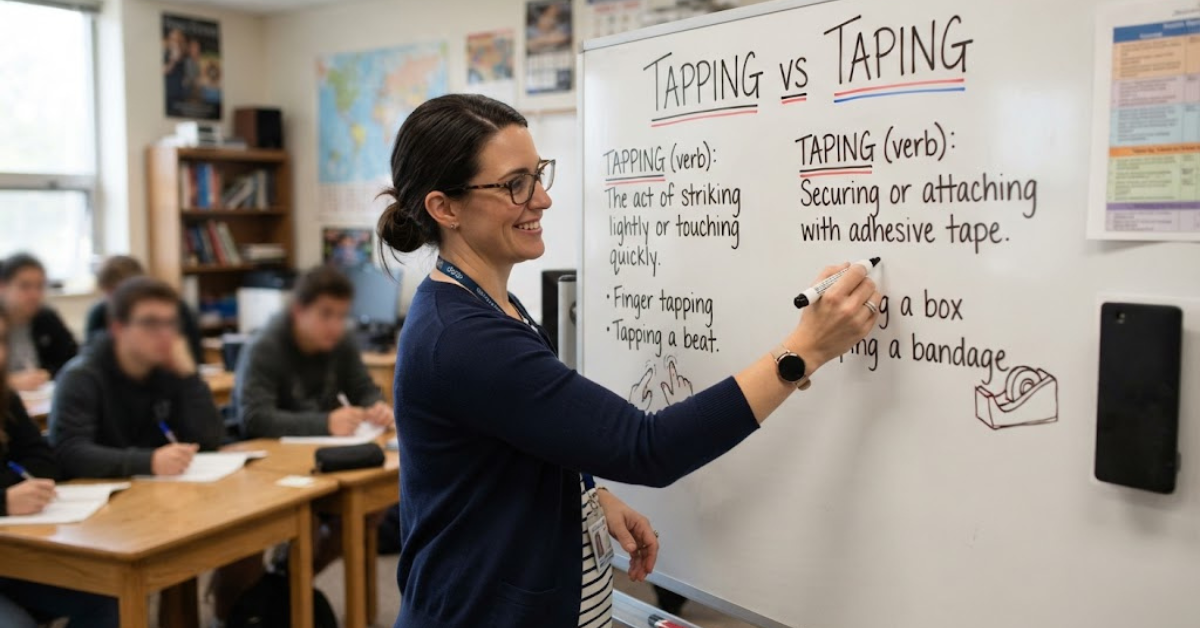
One extra p can completely change the meaning of a word. That’s exactly what happens with tapping vs taping. Although they look almost identical, tapping and taping come from different verbs and describe two very different actions.
Tapping comes from tap, while taping comes from tape. You might be tapping your phone screen, tapping someone on the shoulder, or tapping a rhythm with your fingers. On the other hand, you might be taping a package, taping a note to the wall, or taping an injured finger.
Once you know which base verb each word comes from, the difference becomes much easier to remember.
Tapping vs Taping: What’s the Difference?
The simplest distinction is this:
- Tapping = the present participle or gerund of tap, meaning to touch, strike, or hit lightly.
- Taping = the present participle or gerund of tape, meaning to attach, cover, secure, or record something using tape.
| Word | Base verb | Meaning | Example |
| tapping | tap | Touching or striking lightly | She is tapping the screen. |
| taping | tape | Attaching or securing with tape | He is taping the box shut. |
So if you’re touching something lightly, you’re probably tapping it.
If you’re using tape, you’re taping it.
What Does “Tapping” Mean?
Tapping comes from the verb tap.
To tap generally means to touch or strike something lightly, often with a finger, hand, foot, or another object.
For example:
She was tapping her fingers on the desk.
Here, the person is repeatedly touching or lightly striking the desk with her fingers.
The word can also describe a single light touch:
He was tapping me on the shoulder.
Common Uses of Tapping
You might use tapping when talking about:
- touching a phone screen
- knocking lightly on a surface
- touching someone lightly
- making a rhythmic sound
- tapping your foot to music
- tapping a keyboard or button
- extracting liquid from a tree
- accessing a resource or supply
For example:
I’m tapping the screen to open the app.
She kept tapping her foot during the song.
Someone was tapping on the window.
These all involve the action of tap rather than tape.
What Does “Taping” Mean?
Taping comes from the verb tape.
To tape something generally means to attach, hold, cover, or secure it with tape.
For example:
He is taping the package before shipping it.
The person is using tape to seal the package.
Common Uses of Taping
You might use taping when talking about:
- sealing boxes
- attaching paper to a wall
- repairing something with tape
- securing cables
- covering a surface
- recording a program
- applying athletic or medical tape
Examples include:
She is taping a poster to the wall.
We’re taping the edges before painting.
He spent the afternoon taping the package.
The trainer was taping the athlete’s ankle.
The key idea is that taping involves tape.
Why Is It “Tapping” With Two Ps?
This is where English spelling rules come into play.
The base verb is:
tap
When you add -ing, the final consonant is doubled:
tap + ing = tapping
Why?
For many short, one-syllable verbs ending in a single consonant after a short vowel, the final consonant is doubled before adding -ing.
Examples include:
- run → running
- sit → sitting
- stop → stopping
- get → getting
- swim → swimming
- tap → tapping
So tapping needs two p’s.
Writing taping when you mean the action of tapping is therefore incorrect.
Why Is It “Taping” With One P?
The base verb here is completely different:
tape
When you add -ing, you don’t double the final e. Instead, the silent e is removed before adding -ing.
So:
tape → taping
The spelling process is:
tape + ing → taping
Compare the two forms:
tap → tapping
tape → taping
That single difference in the base verb creates two different words.
Tapping vs Taping Spelling Rule
A useful way to remember the distinction is to start with the base word.
Tap + -ing
Remove nothing and double the final consonant:
tap → tapping
Tape + -ing
Drop the silent e and add -ing:
tape → taping
This is why the spelling difference isn’t random.
The words are built from different verbs.
Tapping vs Taping Examples
Let’s look at some sentences side by side.
Tapping
She was tapping on the glass.
She’s lightly striking the glass.
Taping
She was taping a picture to the glass.
She’s using adhesive tape to attach the picture.
Tapping
He kept tapping his foot.
He’s repeatedly moving his foot against a surface.
Taping
He was taping his injured foot.
He’s applying tape to his foot.
Tapping
I’m tapping the button on my phone.
I’m touching the button.
Taping
I’m taping the label to the box.
I’m attaching the label using tape.
These examples show why the spelling matters. Changing one letter can change the action being described.
Tapping on a Phone vs Taping a Phone
Technology provides an especially useful example.
If you’re touching your phone screen:
I’m tapping my phone.
If you’re using adhesive tape on your phone:
I’m taping my phone.
The first involves touching.
The second involves tape.
This distinction is particularly useful because both actions are possible in the same situation.
For example:
I was tapping the screen while taping the cracked case.
Two completely different verbs are being used.
Tapping vs Taping in Sports and Fitness
Both words are common in sports, but they describe different things.
Tapping
An athlete might be:
- tapping a ball
- tapping their foot
- tapping a teammate
- tapping a button on equipment
For example:
The player kept tapping the ball with his foot.
Taping
An athlete might also be:
- taping an ankle
- taping a wrist
- taping a knee
- taping fingers
- taping equipment
For example:
The trainer was taping the player’s ankle before the game.
So in sports, confusing tapping and taping can produce a very different meaning.
Tapping vs Taping in Recording and Media
There’s another interesting use of taping.
Historically, taping can mean recording audio or video, particularly onto tape.
For example:
The band was taping its rehearsal.
Today, digital recording has largely replaced physical recording tape in everyday technology, but the word taping can still be used informally for recording a program, event, or performance.
For example:
The show is taping in front of a live audience.
This use comes from tape, not tap.
Is “Taping” Ever Related to Tapping?
No. Although the words look similar, taping isn’t a spelling variation of tapping.
They are derived from different base verbs:
tap → tapping
tape → taping
Their meanings are also different.
This is an important distinction when proofreading because a spell checker may not always catch the error. Both tapping and taping are legitimate English words, so software may consider either one correctly spelled even if you’ve chosen the wrong word for the sentence.
Common Mistakes With Tapping and Taping
Because both words are real words, context matters.
Mistake 1: “Taping” a Screen
If you mean touching a screen:
I was taping the screen.
I was tapping the screen.
Unless you’re literally putting tape on the screen, tapping is the correct choice.
Mistake 2: “Tapping” an Injury
If you’re applying athletic tape:
The trainer was tapping his ankle.
The trainer was taping his ankle.
Here, the action involves tape.
Mistake 3: “Taping” on the Door
If someone is making a light knocking sound:
Someone is taping on the door.
Someone is tapping on the door.
The intended verb is tap.
Mistake 4: “Tapping” a Box Shut
If you’re sealing a box with adhesive tape:
She is tapping the box shut.
She is taping the box shut.
Again, the presence of tape points to taping.
Tapping vs Taping Pronunciation
The two words are pronounced differently.
Tapping is approximately:
TAP-ing
Taping is approximately:
TAY-ping
The vowel sound is the easiest clue.
- tap has the short a sound
- tape has the long a sound
So if you’re saying TAP-ing, you’re talking about tapping.
If you’re saying TAY-ping, you’re talking about taping.
However, when writing, it’s better to rely on the meaning and base verb rather than pronunciation alone.
Tap, Tapped, Tapping
Understanding the complete verb family can make the spelling easier.
| Form | Word | Example |
| Base | tap | Please tap the screen. |
| Third person | taps | She taps the screen. |
| Past | tapped | He tapped the glass. |
| Present participle | tapping | She is tapping the table. |
Notice that the p doubles in tapped and tapping.
The same spelling pattern applies to the short vowel and final consonant structure of the base word.
Tape, Taped, Taping
Now compare the verb tape.
| Form | Word | Example |
| Base | tape | Tape the box. |
| Third person | tapes | She tapes the label down. |
| Past | taped | He taped the package. |
| Present participle | taping | She is taping the package. |
Notice what happens when -ing is added:
tape → taping
The final e disappears.
That’s why tapping and taping don’t follow the same spelling pattern.
A Quick Memory Trick for Tapping vs Taping
Here’s a simple trick that works well:
If there’s a “tap,” double the P.
tap → tapping
Think:
Tap has two Ps when it’s tapping.
If there’s “tape,” drop the E.
tape → taping
Think:
Tape loses its E before -ing.
So you get:
TAP → TAPPING
TAPE → TAPING
This small distinction can prevent a surprisingly common spelling mistake.
Tapping vs Taping: Quick Comparison
| Feature | Tapping | Taping |
| Base verb | tap | tape |
| Meaning | Touching or striking lightly | Using tape to attach, secure, cover, or record |
| Spelling | Double p | One p |
| Pronunciation | TAP-ing | TAY-ping |
| Example | She is tapping the screen. | She is taping the box. |
How to Choose Between Tapping and Taping
When you’re unsure which spelling to use, don’t focus on the number of letters. Instead, ask yourself one simple question:
What is the person actually doing?
If they’re touching or lightly striking something:
→ tapping
If they’re using tape:
→ taping
You can also trace the word back to its base form:
- Is the base verb tap?
- Or is the base verb tape?
- Add -ing according to the spelling rule.
- Check whether the meaning fits the sentence.
This approach works better than simply memorizing isolated spellings.
Frequently Asked Questions About Tapping vs Taping
Is it tapping or taping?
Both are correct words, but they have different meanings. Tapping comes from tap and means touching or striking lightly. Taping comes from tape and means using tape to attach, secure, cover, or record something.
Is “taping” a correct word?
Yes. Taping is the correct -ing form of tape.
For example:
She is taping the package shut.
Is “tapping” a correct word?
Yes. Tapping is the correct -ing form of tap.
For example:
He is tapping his fingers on the table.
Why does tapping have two Ps?
The base verb is tap, a short one-syllable verb ending in a consonant after a short vowel. When -ing is added, the final consonant is doubled:
tap → tapping
Why doesn’t taping have two Ps?
Because taping comes from tape, not tap. The final silent e is dropped before -ing:
tape → taping
Is it “tapping on the door” or “taping on the door”?
If you mean lightly knocking on the door, the correct expression is tapping on the door.
Someone was tapping on the door.
Is it “tapping your ankle” or “taping your ankle”?
If you mean applying athletic or medical tape, use taping.
The trainer was taping his ankle.
If you mean lightly touching or striking the ankle, use tapping.
Is it “tapping the screen” or “taping the screen”?
If you’re touching a touchscreen with your finger, it’s tapping the screen.
Tap the screen to continue.
Is “taping” the same as “recording”?
It can be used that way, especially when referring to recording a program, performance, or event. The usage comes from the historical association between recording and magnetic tape.
What is the difference between tapped and taped?
Tapped is the past tense of tap:
She tapped on the window.
Taped is the past tense of tape:
She taped the note to the window.
How can I remember tapping vs taping?
Remember the base verbs:
tap → tapping
tape → taping
If you’re touching something, think tap. If you’re using tape, think tape.
Conclusion: Tapping vs Taping
The difference between tapping vs taping becomes simple once you look at the base verbs.
Tapping comes from tap and describes touching, striking, or knocking lightly. That’s why you tap a screen, tap your foot, or tap on a door.
Taping comes from tape and describes using tape to attach, secure, cover, or sometimes record something. That’s why you tape a box, tape a poster to a wall, or tape an athlete’s ankle.
The easiest rule to remember is:
tap → tapping
tape → taping
Both words are spelled correctly, but using the wrong one can change the meaning of your sentence. When in doubt, identify the base verb first, and the correct spelling usually becomes obvious.