
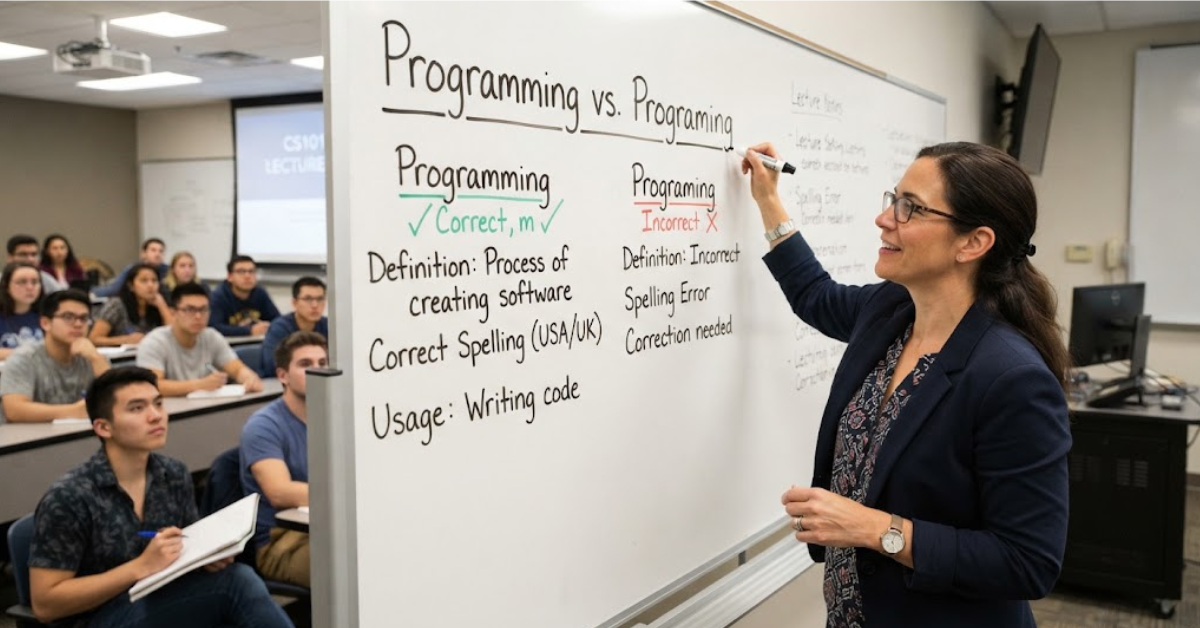
Have you ever typed programing into a document and wondered whether you had missed a letter? You’re not alone. The spelling programming vs. programing can be confusing because English sometimes doubles a final consonant when adding -ing to a word, but not always.
The good news is that there is a clear answer for most situations: programming, with two m’s, is the standard spelling in modern English, especially when referring to computer programming, software development, or the process of creating programs. Programing, with one m, is a less common variant that appears occasionally, but it is not the usual choice.
Let’s look at why the spellings differ, which version to use, and how the same rule applies to other words.
Programming vs Programing: What’s the Difference?
The main difference is the number of m’s. Programming has two consecutive m’s, while programing has only one.
| Spelling | Status | Typical usage |
| Programming | Standard and widely preferred | Computer programming, software development, scheduling |
| Programing | Rare variant | Occasional use, generally best avoided in standard writing |
In contemporary English, programming is the spelling you will see in most technical documentation, educational materials, job titles, and software-development resources.
For example:
- Correct and standard: “She is learning programming in Python.”
- Unusual: “She is learning programing in Python.”
The second spelling may be encountered, but it can look like a typo to many readers. If you want your writing to follow common modern usage, choose programming.
What Does Programming Mean?
Programming is the act or process of creating instructions that a computer or other system can execute. It can also refer to planning or scheduling activities, broadcasts, or events.
The meaning depends on the context.
1. Programming in Computer Science
In computing, programming involves writing, testing, debugging, and maintaining code using languages such as Python, JavaScript, Java, and C++.
Examples:
- “I’m studying programming to prepare for a software development career.”
- “Computer programming requires logical thinking and problem-solving.”
- “The team spent three weeks programming the new application.”
In this context, programming is the standard spelling.
2. Programming as Planning or Scheduling
The word can also describe arranging activities or determining what a system will do.
Examples:
- “The television network is programming its evening schedule.”
- “The technician is programming the thermostat.”
- “The event coordinator is programming a series of workshops.”
These uses also take the standard spelling programming.
Why Does Programming Have Two M’s?
The spelling follows a common English rule: when a one-syllable word ends in a consonant-vowel-consonant pattern, the final consonant is often doubled before adding a suffix that begins with a vowel, such as -ing.
The word program ends in the consonant m. When -ing is added, the final m is doubled:
- Program + ing = programming
- Run + ing = running
- Sit + ing = sitting
- Plan + ing = planning
The doubled consonant helps preserve the short vowel sound in the original word.
However, this spelling rule has conditions and exceptions. It is not a universal rule that every word ending in a consonant should double that consonant before -ing. The number of syllables, the position of the stress, and the word’s spelling pattern can affect the result.
For example:
- Open → opening
- Visit → visiting
- Develop → developing
These words do not double the final consonant in their standard forms.
For program, the conventional spelling is programming, and that is the form you should generally use.
Is Programing Ever Correct?
Programing is recorded as a spelling variant, so it is not simply an impossible combination of letters. However, it is uncommon compared with programming and is generally not recommended for standard contemporary writing.
If you see programing in a document, it may reflect an uncommon spelling preference, a typographical error, or an attempt to apply a spelling rule inconsistently.
For schoolwork, professional writing, technical documentation, résumés, and online articles, use programming unless you have a specific style guide that directs you otherwise.
Examples of the Preferred Spelling
- “Computer programming is an important skill in software development.”
- “He enjoys programming games in his free time.”
- “The course introduces students to the basics of programming.”
- “She is programming a microcontroller for a robotics project.”
In each sentence, the spelling with two m’s is the conventional choice.
Programming in American and British English
One reason this word can be confusing is that program has a regional spelling variant: programme.
In American English, program is the standard noun and verb for most meanings. In British English, programme is traditionally used for many non-computing meanings, such as a television programme or an event programme. However, program is also standard in British English for computing.
The spelling of the -ing form depends on which base word is being used.
| Meaning | American English | British English |
|---|---|---|
| Writing computer code | Programming | Programming |
| Arranging a computer or device | Programming | Programming |
| Planning a television broadcast schedule | Programming | Programming |
| Planning an event or series of activities | Programming is used as a verb form | Programming is also used as a verb form |
Notice that the last column does not require programmeing. The usual verb is program, even in British English, particularly in computing and when describing the act of scheduling or arranging something.
The important point is that programming is standard in both American and British English when used as the -ing form of program.
Programming vs Programing in Computer Science
If you’re writing about software development, the choice is especially straightforward: use programming.
The term appears in many common expressions, including:
- Computer programming
- Programming languages
- Programming skills
- Programming courses
- Programming logic
- Object-oriented programming
- Programming tools
- Programming tutorials
For example:
“Learning programming can help beginners understand how software works and how to solve problems using code.”
Writing programing language instead of programming language may look like a spelling error in technical content, even if the intended meaning is clear.
If you’re preparing a coding tutorial, a university assignment, a technical report, or a résumé, the standard spelling is the best choice.
Common Words That Follow the Same Spelling Pattern
Looking at related examples can make the spelling rule easier to remember.
| Base word | Correct -ing form | Incorrect or nonstandard form |
| Program | Programming | Programing (rare variant) |
| Run | Running | Runing |
| Plan | Planning | Planing, when the intended meaning is making plans |
| Sit | Sitting | Siting, which has a different meaning |
| Stop | Stopping | Stoping |
| Begin | Beginning | Begining |
| Write | Writing | Writting |
A few of these examples require care because removing or doubling a consonant can create another valid word with a different meaning.
For example, planing is a real word in woodworking and other contexts. It means smoothing a surface with a plane. But if you mean arranging or preparing something, the correct form is planning.
Likewise, siting means choosing or occupying a site, while sitting refers to the act of sitting down.
The lesson is not simply to double every final consonant. Instead, learn the conventional spelling of each word and use the rule as a helpful guide.
How to Remember Programming vs Programing
If you frequently confuse the two spellings, try these simple tips.
1. Remember the Base Word
Start with program. When you add -ing, the standard spelling doubles the final m:
program + ing = programming
2. Connect It With Other Doubled-Consonant Words
Think of running, planning, and stopping. These familiar words can remind you that consonant doubling is common when adding -ing to certain words.
3. Think About Common Technical Terms
If you’re writing about software, remember these standard expressions:
- Programming language
- Computer programming
- Programming course
- Programming skills
Seeing the correct spelling in familiar phrases can help it become automatic.
4. Use Spell-Check, but Review the Context
A spell-checker can catch many spelling mistakes, but it may not always flag a rare variant or explain why one form is preferred. When writing for a formal or technical audience, use programming and review your document before submitting it.
Frequently Asked Questions
1. Is it programming or programing?
Programming is the standard and widely preferred spelling. Programing is a rare variant, but it is generally best avoided in modern standard English.
2. Why does programming have two M’s?
The final m in program is doubled when adding -ing, producing programming. This follows the conventional spelling pattern used with certain words ending in a consonant-vowel-consonant sequence.
3. Is programing a misspelling?
It is recorded as a spelling variant, but it is much less common than programming. In most school, business, technical, and general writing, programming is the recommended form.
4. Is programming spelled differently in British English?
No. Programming is the standard spelling in both American and British English. British English traditionally uses programme for many non-computing nouns, but the computing term is programming.
5. Is it programming language or programing language?
The standard phrase is programming language. Examples include Python, Java, JavaScript, and C++.
6. What is the difference between program and programming?
Program can be a noun referring to a set of instructions or a planned series of activities. As a verb, it means to create instructions or arrange something according to a plan. Programming is the -ing form of the verb and can also refer to the activity itself.
Examples:
- “I wrote a program to organize the data.”
- “I enjoy programming in Python.”
7. Is it programmed or programed?
Programmed is the standard and widely preferred spelling, with two m’s. Programed is a rare variant. In British English, programmed is also used for computing, although programmed and programming retain their usual doubled-m spellings.
8. What is the plural of program?
The plural is programs in American English and in computing contexts generally. British English traditionally uses programmes for many non-computing meanings, such as television programmes or event programmes.
Conclusion: Programming vs Programing
When comparing programming vs. programing, the practical answer is clear: programming, with two m’s, is the standard spelling you should use in almost every ordinary writing situation. Although programing appears as a rare variant, it is not the usual form readers expect.
Remember the spelling rule, pay attention to familiar phrases such as computer programming and programming language, and keep regional differences in mind when using program and programme.
Whether you’re writing a coding tutorial, completing an assignment, updating your résumé, or preparing a professional article, choosing the conventional spelling helps your writing look polished and clear. For more useful guidance, explore other commonly confused words and English spelling rules.