
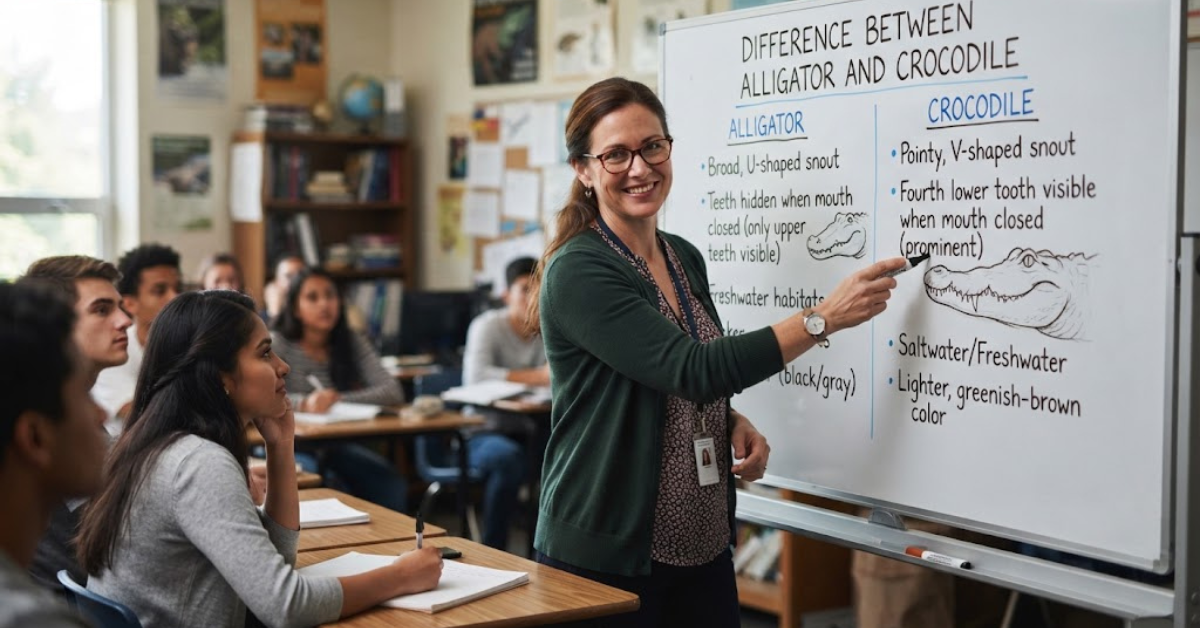
At a glance, an alligator and a crocodile can look almost identical: long bodies, powerful jaws, armored skin, and a reputation for being formidable predators. But look a little closer, and the difference between alligator and crocodile becomes surprisingly easy to spot.
Both belong to the order Crocodylia, but they aren’t the same animal. Their snout shape, teeth, habitat, coloration, behavior, and geographic distribution can help you tell them apart.
Whether you’re curious about wildlife or simply want to know how to distinguish an alligator from a crocodile, a few visual clues will usually give you the answer.
Alligator vs. Crocodile at a Glance
The easiest way to compare alligator vs crocodile is to look at their physical features and where they live.
| Feature | Alligator | Crocodile |
|---|---|---|
| Snout | Usually broad and U-shaped | Usually narrower and V-shaped |
| Lower teeth when mouth is closed | Mostly hidden | Some lower teeth remain visible |
| Typical color | Darker gray, blackish | Often lighter olive, brown, or gray |
| Salt tolerance | Lower | Generally higher |
| Geographic range | Mainly southeastern United States and parts of China | Found across parts of Africa, Asia, the Americas, and Australia |
| Temperament | Often less aggressive toward humans | Some species can be highly aggressive |
| Number of species | Fewer | More diverse group |
These are useful generalizations, but individual species can vary. The most reliable clues are usually the animal’s snout, teeth, and location.
What Is an Alligator?
An alligator is a crocodilian belonging to the family Alligatoridae.
The best-known species is the American alligator (Alligator mississippiensis), which is found primarily in the southeastern United States. Another living species, the Chinese alligator, is native to parts of eastern China.
Alligators generally have broad, rounded snouts that create a distinctive U-shaped appearance when viewed from above.
Their darker coloration can also help them blend into swampy water and vegetation.
Where Do Alligators Live?
American alligators are strongly associated with freshwater environments such as:
- Swamps
- Marshes
- Lakes
- Rivers
- Wetlands
- Slow-moving waterways
They can tolerate some brackish water, but they are not as well adapted to prolonged exposure to saltwater as many crocodile species.
What Is a Crocodile?
A crocodile is a crocodilian belonging to the family Crocodylidae.
Crocodiles are distributed across several regions, including parts of Africa, Asia, Australia, and the Americas. Different species have adapted to a wide range of aquatic environments.
Compared with most alligators, crocodiles tend to have longer, narrower, more pointed snouts.
Their appearance can vary considerably depending on the species.
Where Do Crocodiles Live?
Crocodiles can inhabit:
- Rivers
- Lakes
- Wetlands
- Estuaries
- Mangrove areas
- Coastal waters
One of their notable advantages is their greater ability to tolerate saltwater compared with alligators. Specialized glands help crocodiles deal with salt, allowing some species to travel through and live around coastal environments.
Difference Between Alligator and Crocodile: The Snout
The snout is one of the quickest ways to identify these animals.
Alligator Snout
Alligators generally have a wide, rounded, U-shaped snout.
The broader shape gives the head a somewhat shorter and wider appearance.
Crocodile Snout
Crocodiles generally have a longer, narrower, V-shaped snout.
The difference isn’t absolute because crocodile species vary, but it is a useful identification clue.
A simple memory trick is:
Alligator = broad U-shaped snout
Crocodile = narrower V-shaped snout
Difference Between Crocodile and Alligator: Their Teeth
Their teeth provide another excellent clue.
When an alligator closes its mouth, its upper jaw is wider than the lower jaw. As a result, the lower teeth generally fit inside the upper jaw and aren’t prominently visible.
Crocodiles have a different jaw structure. When their mouths are closed, several lower teeth—especially the prominent fourth lower tooth on each side—can remain visible.
This creates the classic “toothy grin” associated with crocodiles.
Why Are Crocodile Teeth More Visible?
The lower and upper jaws of crocodiles are more similar in width. This allows certain lower teeth to remain exposed when the mouth is closed.
By contrast, an alligator’s broader upper jaw tends to conceal most of its lower teeth.
Alligator vs. Crocodile: Color
Color can also help, although it shouldn’t be your only identification method.
American alligators are commonly very dark gray, blackish, or dark olive, particularly as adults.
Crocodiles are often lighter, with shades of olive, brown, gray, or tan depending on the species and environment.
But there’s an important catch: color can change depending on lighting, water quality, age, and habitat.
So if you are trying to identify a crocodilian, look at the snout and teeth before relying on color.
Crocodiles vs. Alligators: Habitat and Saltwater
Habitat is another major part of the difference between alligator and crocodile.
Alligators are strongly associated with freshwater ecosystems. Crocodiles, on the other hand, include species capable of living in brackish and saltwater environments.
Crocodiles possess functional salt glands that allow some species to remove excess salt. This helps explain why certain crocodiles can live in coastal areas and travel between islands.
Alligators can tolerate some saltwater for limited periods, but they generally don’t have the same level of saltwater adaptation.
Alligator vs. Crocodile: Geographic Range
Where you encounter the animal can provide an immediate clue.
American alligators naturally occur in the southeastern United States, including areas around the Gulf Coast and southeastern Atlantic Coast. Chinese alligators have a much smaller natural range in China.
Crocodiles have a much broader global distribution, with species found in regions of:
- Africa
- Southeast Asia
- South Asia
- Northern Australia
- Central and South America
- Parts of the Caribbean
This means that location can sometimes identify the animal before you even get a close look at it.
Which Is Bigger: Alligator or Crocodile?
There isn’t a single answer because size varies by species, sex, age, and individual animal.
However, the largest crocodile species can become substantially larger than American alligators.
The saltwater crocodile (Crocodylus porosus) is particularly famous for its enormous size and is considered the largest living crocodilian species.
American alligators can also become very large, with exceptional individuals reaching impressive lengths, but they generally don’t match the maximum size of the largest crocodiles.
Are Crocodiles More Aggressive Than Alligators?
This is another area where the difference between the two animals is often exaggerated.
Some crocodile species are known for being highly dangerous to humans, particularly in areas where people regularly share waterways with them. Saltwater crocodiles and Nile crocodiles, for example, have reputations for serious attacks.
American alligators can also attack humans, and they should never be treated as harmless. However, their typical behavior toward people is generally less aggressive than that of some of the crocodile species known for frequent human conflict.
The safest approach with either animal is simple: keep your distance and never feed or approach a wild crocodilian.
Are Alligators and Crocodiles Related?
Yes.
Alligators and crocodiles are both crocodilians, a group of large semi-aquatic reptiles.
They share many characteristics, including:
- Powerful jaws
- Armored skin
- Long tails
- Strong swimming abilities
- Excellent underwater adaptations
- A semi-aquatic lifestyle
- Similar reproductive behaviors
But they belong to different families within Crocodylia.
Alligators belong to Alligatoridae, while true crocodiles belong to Crocodylidae.
Caimans are also members of Alligatoridae, while gharials belong to a separate crocodilian family.
Alligator vs. Crocodile: Behavior
Both animals are ambush predators.
They can remain remarkably still in water, waiting for an opportunity to strike. Their powerful tails provide propulsion, while their jaws are adapted for capturing and holding prey.
Their diets can include fish, birds, turtles, mammals, and other animals, depending on the species and its habitat.
Behavior varies considerably between species, so it’s inaccurate to assume every crocodile or every alligator behaves exactly the same way.
How to Tell an Alligator From a Crocodile
If you’re trying to identify one quickly, use this checklist:
1. Look at the snout
- Wide and rounded → likely an alligator
- Long and pointed → likely a crocodile
2. Check the teeth
- Lower teeth mostly hidden → likely an alligator
- Some lower teeth visible when the mouth is closed → likely a crocodile
3. Consider the location
- Southeastern United States → American alligator is likely
- Tropical regions of Africa, Asia, Australia, or the Americas → crocodile may be more likely
4. Look at the environment
- Freshwater swamp or lake → alligator is more likely
- Estuary or coastal saltwater habitat → crocodile is more likely
5. Don’t rely entirely on color
Color varies too much between species and environments to be a definitive test.
Common Misconceptions About Alligators and Crocodiles
A few myths make the alligators and crocodiles comparison more confusing than it needs to be.
Myth 1: All crocodilians are crocodiles
Not true. Crocodilians include alligators, crocodiles, caimans, and gharials.
Myth 2: Alligators are harmless
Definitely not. Large alligators are powerful wild predators and can seriously injure or kill people.
Myth 3: Crocodiles always have visible teeth
Many crocodiles show prominent lower teeth when the mouth is closed, but exact appearance varies by species.
Myth 4: You can always identify one by color
Color can help, but it isn’t reliable enough by itself.
Myth 5: Alligators and crocodiles live in exactly the same places
Their geographic ranges overlap in some regions, but they have significant differences in distribution and habitat preferences.
Frequently Asked Questions
What is the difference between an alligator and a crocodile?
Alligators generally have broader U-shaped snouts, darker coloration, and lower teeth that are mostly hidden when the mouth is closed. Crocodiles usually have narrower V-shaped snouts and some visible lower teeth.
Which is bigger, an alligator or a crocodile?
The largest crocodile species can grow considerably larger than American alligators. The saltwater crocodile is the largest living crocodilian species.
Which is more dangerous, an alligator or a crocodile?
Danger varies by species and circumstances. Some crocodile species, particularly Nile and saltwater crocodiles, are responsible for serious attacks on humans. Alligators can also be dangerous and should never be approached.
Can alligators live in saltwater?
Alligators can tolerate some saltwater for limited periods, but they are primarily freshwater animals and are less adapted to saltwater than many crocodile species.
Can crocodiles live in freshwater?
Yes. Many crocodiles live in freshwater rivers, lakes, and wetlands. Some species also use brackish and coastal environments.
Are alligators and crocodiles the same animal?
No. They are related crocodilians but belong to different taxonomic families.
How can you tell a crocodile from an alligator?
Look at the snout and teeth. A broad U-shaped snout and mostly hidden lower teeth suggest an alligator, while a narrower V-shaped snout and visible lower teeth suggest a crocodile.
Do alligators and crocodiles eat the same things?
Their diets overlap considerably. Both can eat fish, birds, reptiles, and mammals, although the exact diet depends on the species, size, and habitat.
Conclusion: Alligator vs. Crocodile
The difference between alligator and crocodile becomes much easier to remember once you focus on a few key features.
Alligators generally have broader, U-shaped snouts, darker coloration, and fewer visible lower teeth when their mouths are closed. Crocodiles typically have narrower, V-shaped snouts, more visible lower teeth, and greater tolerance for saltwater.
In the simplest terms:
Alligator = broad snout, mostly hidden lower teeth, freshwater preference.
Crocodile = narrow snout, visible lower teeth, greater saltwater tolerance.
These differences are useful for identifying them, but both animals deserve the same level of respect. Whether you’re looking at an alligator in a swamp or a crocodile near a river, observing from a safe distance is always the best way to appreciate these remarkable reptiles.