
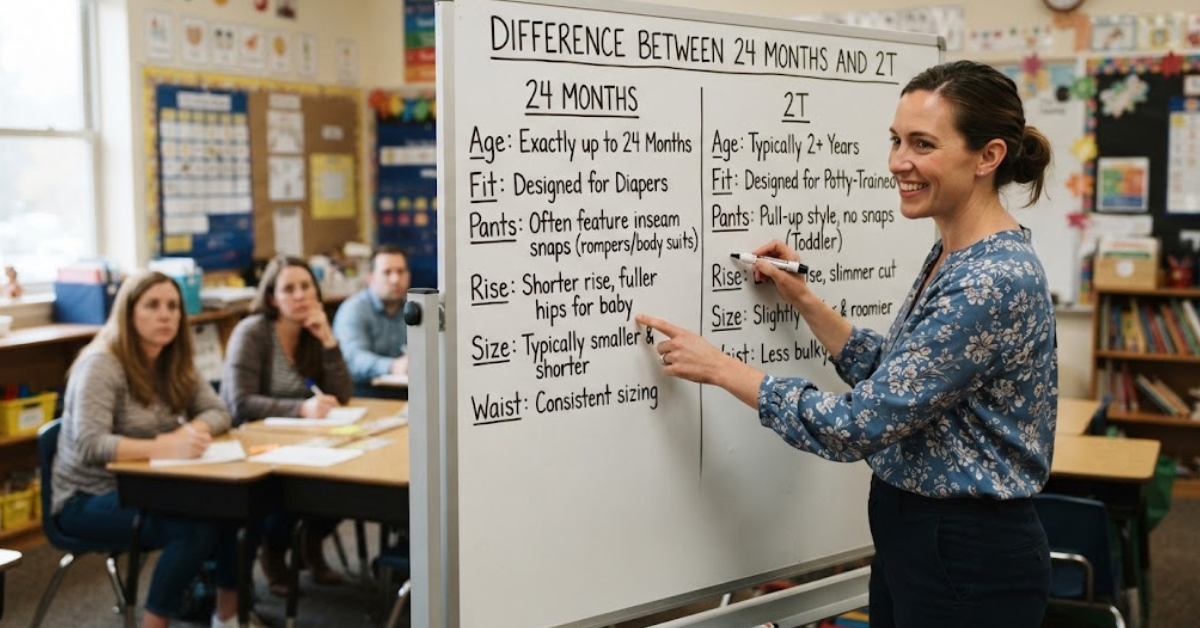
Buying clothes for a toddler can be surprisingly confusing. A tag might say 24 months, while another says 2T, and both can appear to describe a child around the same age. So, what is the difference between 24 months and 2T?
The two sizes are close, but they are not always identical. In general, 24-month clothing is designed around a younger toddler’s proportions, while 2T is designed for toddlers who are moving into a more traditional toddler fit.
The exact measurements vary between brands, so the label is only a starting point. Understanding the difference between the two can make shopping much easier and help you choose clothes that fit comfortably rather than simply matching your child’s age.
What Is the Difference Between 24 Months and 2T?
The biggest difference between 24 months and 2T is the way the clothing is designed to fit.
A 24-month size is generally intended for children around 18–24 months, although some brands use the size for a slightly broader age range. These clothes may allow extra room around the body, particularly because younger toddlers may still wear diapers.
A 2T size is generally intended for toddlers around age 2 and is often cut with a slightly different shape. It may have a longer body, longer sleeves or legs, and a little more room for a child who is becoming more independent and may be transitioning away from diapers.
However, there is no universal sizing standard across every clothing brand.
Quick comparison
| Feature | 24 Months | 2T |
| General age range | Around 18–24 months | Around 2 years |
| Intended wearer | Younger toddler | Toddler |
| Fit | Often roomier through the body | Often slightly slimmer or longer |
| Diaper accommodation | May provide more room | May provide less room |
| Length | Usually shorter | Often slightly longer |
| Potty-training considerations | More diaper-friendly | Often designed with toddler proportions |
| Brand consistency | Varies | Varies |
These are general patterns rather than strict rules. Always check the individual brand’s size chart when possible.
Why Do 24 Months and 2T Exist as Separate Sizes?
At first, the distinction can seem unnecessary. After all, a child who is 24 months old is two years old.
The reason is that children’s clothing is not designed solely around age. Body proportions, diaper use, height, weight, and developmental stage can all influence how clothing is cut.
A 24-month garment may be designed with a younger toddler’s body in mind, while 2T may assume a child is beginning to have more typical toddler proportions.
That’s why two garments with similar age labels can fit noticeably differently.
24 Months vs 2T Size Difference
When comparing the difference between 24 months and 2T size, the distinction is usually more noticeable in proportions than in the number printed on the label.
A 24-month outfit may have:
- More room around the waist and bottom
- A shorter overall length
- Extra space for a diaper
- A slightly roomier torso
A 2T outfit may have:
- A longer torso
- Longer sleeves or pant legs
- A slimmer overall cut
- Less room specifically intended for a diaper
These differences aren’t universal. One brand’s 24-month shirt might fit almost exactly like another brand’s 2T shirt.
24 Months vs 2T Clothes: Is One Bigger?
It’s tempting to say that 2T is simply the next size after 24 months, but that isn’t always accurate.
In some brands, 2T may be slightly larger or longer than 24 months. In others, the measurements can overlap significantly.
The key distinction is often fit rather than raw size.
For example, a 24-month pair of pants might have enough room in the seat for a diaper but be shorter in the legs. A 2T pair might have a longer leg and a narrower waist because it is designed around a toddler who is becoming less diaper-dependent.
What’s the Difference Between 24 Months and 2T Clothes?
The difference between 24 months and 2T clothes is often related to proportions and intended use.
24-month clothing
24-month clothing may work particularly well for a child who:
- Is still wearing diapers
- Has a rounder toddler build
- Needs more room around the waist or seat
- Is shorter or has shorter legs
- Is between infant and toddler sizing
2T clothing
2T may be a better fit for a child who:
- Is around two years old
- Has a longer or leaner body
- Is becoming more independent with dressing
- Is transitioning away from diapers
- Needs additional length in shirts, sleeves, or pants
Again, these are general tendencies rather than guarantees.
Does 24 Months Fit the Same as 2T?
Not necessarily.
This is one of the most common reasons parents become frustrated with toddler sizing. Two garments can carry similar age labels but fit completely differently.
Clothing manufacturers create their own measurement charts, and some brands have more generous or slimmer cuts than others.
For the best fit, compare your child’s:
- Height
- Weight
- Chest measurement
- Waist measurement
- Hip measurement
- Inseam, when available
Then compare those measurements with the manufacturer’s size chart.
Is 24 Months Smaller Than 2T?
Often, 2T may be slightly longer or differently proportioned than 24 months, but it isn’t safe to assume that 2T is always larger.
For example, one brand could make its 24-month clothes relatively generous, while another could make its 2T clothing quite slim.
If your child is between sizes, length and body proportions may tell you more than the age label.
What Size Comes After 24 Months?
This depends on the brand.
Some children’s clothing ranges move from 24 months into 2T, while others use a different progression. Once children reach toddler sizing, brands may increasingly use labels such as:
- 2T
- 3T
- 4T
- 5T
The “T” generally stands for toddler.
However, a child does not automatically need 2T clothing immediately after turning two. Growth doesn’t happen according to clothing-label schedules.
24 Months vs 2T for Diaper-Wearing Toddlers
Diaper fit can be an important consideration when choosing between the two.
A 24-month garment may have additional room around the seat and waist to accommodate a diaper. A 2T garment may have a more traditional toddler cut and therefore feel different on a child who still wears diapers.
If your toddler is still wearing diapers and a 2T outfit feels tight around the waist or seat, a 24-month version may be more comfortable if the brand offers it.
On the other hand, if your child is tall or long-legged, 2T may provide useful additional length.
Which Is Better for a 2-Year-Old?
There isn’t one correct answer.
A two-year-old who is shorter and still wears diapers may fit comfortably into 24-month clothing. Another two-year-old who is tall or lean may fit better in 2T.
Instead of asking only, “How old is my child?” consider:
- How tall is the child?
- What is their body shape?
- Are they still wearing diapers?
- Do they need extra length?
- How does the brand’s size chart compare with their measurements?
This approach is much more reliable than buying solely based on age.
How to Choose Between 24 Months and 2T
If you’re standing in a store comparing the two labels, use this simple process.
Step 1: Check the brand’s size chart
Don’t assume every company follows the same measurements.
Step 2: Measure your child
Height is particularly useful for determining whether you need additional length.
Step 3: Consider the fit
Think about whether your child needs more room around the waist and seat or more length through the torso and legs.
Step 4: Consider diaper use
If your child wears diapers, compare the garment’s seat and waist construction.
Step 5: Think about future growth
If your child is close to the upper end of a size, buying the next toddler size may provide more useful wear time—as long as the clothing isn’t excessively loose or unsafe.
Common Mistakes When Comparing 24 Months and 2T
Mistake 1: Assuming 2T always means bigger
The labels describe different toddler sizing conventions, not a universal measurement system.
Mistake 2: Ignoring the brand
A 2T from one company can fit differently from a 2T from another.
Mistake 3: Looking only at age
Children the same age can have very different heights and body proportions.
Mistake 4: Forgetting about diapers
Diaper bulk can affect how pants, shorts, and bodysuits fit.
Mistake 5: Buying too large for future growth
Some extra room is useful, but clothing that is excessively oversized can be uncomfortable and impractical.
Frequently Asked Questions
What is the difference between 24 months and 2T?
The main difference is the intended fit. 24-month clothing is generally designed for younger toddlers and may provide more room around the body and diaper area, while 2T clothing often uses longer, more traditional toddler proportions.
What’s the difference between 24 months and 2T?
Although both sizes are associated with children around age two, they can differ in length, body proportions, and diaper accommodation. The exact difference depends on the clothing brand.
What is the difference between 24 months and 2T size?
The size difference is often subtle. In many brands, 2T may be somewhat longer or differently shaped than 24 months, but the measurements can overlap.
What’s the difference between 24 months and 2T clothes?
24-month clothes may offer more room through the seat and torso, while 2T clothes may be cut longer or slimmer. These are general trends rather than universal rules.
Is there a difference between 24 months and 2T?
Yes, there can be. The labels are not always interchangeable because they may reflect different proportions and intended stages of toddler clothing.
Is 24 months the same as 2T?
Not necessarily. Some brands make the two sizes very similar, while others have noticeable differences in length and fit.
Is 2T bigger than 24 months?
Sometimes, but not always. The most reliable way to answer the question is to compare the specific brand’s measurement chart.
Can a 2-year-old wear 24-month clothes?
Absolutely. If the clothes fit comfortably, there is no problem with a two-year-old wearing 24-month clothing.
Should I buy 24 months or 2T?
Choose based on your child’s measurements and proportions rather than age alone. If your child needs more room for a diaper, 24 months may be more comfortable; if they need additional length, 2T may work better.
What size comes after 24 months?
In many toddler clothing lines, 2T follows 24 months, but sizing systems differ between brands.
Conclusion: 24 Months vs 2T
The difference between 24 months and 2T is less about a child’s exact age and more about how the clothing is designed to fit.
24-month clothes often accommodate younger toddler proportions and may provide additional room for diapers. 2T clothing may be longer or slimmer and is generally designed around toddler proportions.
If you’re deciding between the two, don’t rely on the label alone. Check the brand’s size chart, compare your child’s measurements, and consider their height, body shape, and diaper needs.
In the end, the best size isn’t the one that matches your child’s birthday—it’s the one that fits comfortably and gives them enough room to move, play, and grow.