
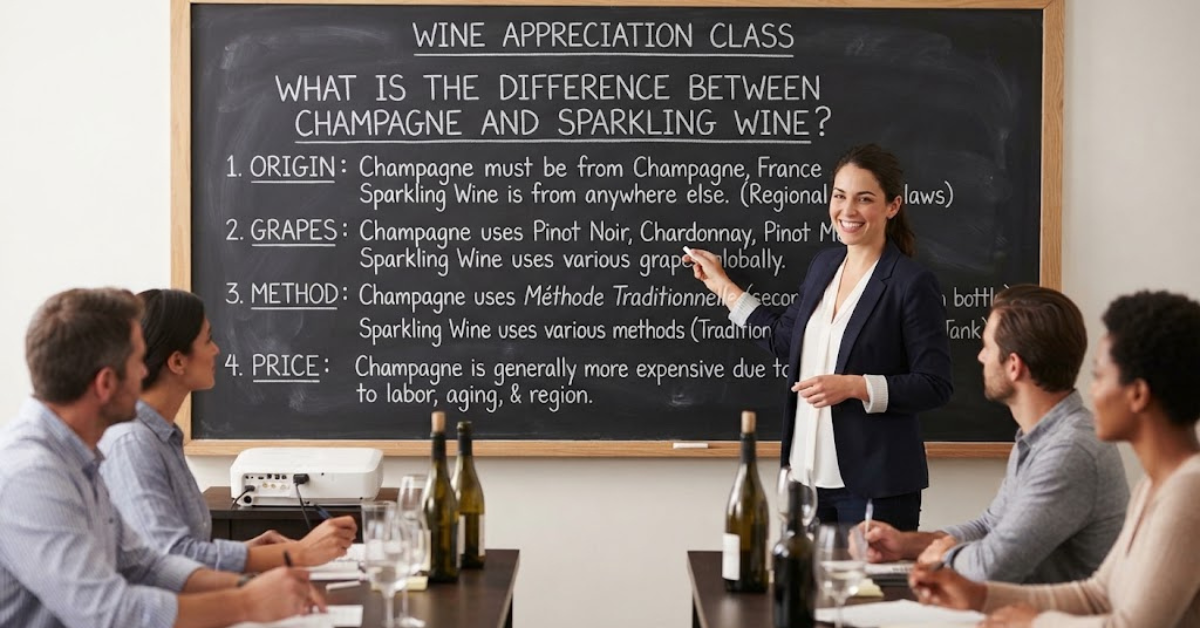
A bottle of bubbly can look festive, elegant, and almost identical whether it says Champagne or sparkling wine. But there is an important distinction between the two—and it has much more to do with where the wine comes from and how it is made than simply how many bubbles are in the glass.
So, what is the difference between champagne and sparkling wine? The simplest answer is that Champagne is a specific type of sparkling wine produced in the Champagne region of France under strict rules. Sparkling wine is the much broader category, covering bubbly wines made in many regions around the world.
Once you understand that difference, choosing between Champagne and other sparkling wines becomes much easier.
What Is the Difference Between Champagne and Sparkling Wine?
The biggest difference is geography and designation.
Champagne is made in the Champagne region of northeastern France and is protected by an official designation of origin. Its production is governed by detailed rules covering factors such as vineyard location, grape varieties, winemaking methods, and maturation.
Sparkling wine, on the other hand, is a general category. It includes wines made in numerous countries and regions using different grape varieties and production techniques.
In simple terms:
| Feature | Champagne | Sparkling Wine |
| Definition | A specific protected wine | A broad category of bubbly wines |
| Origin | Champagne, France | Made around the world |
| Production rules | Highly regulated | Varies by region and style |
| Common grapes | Chardonnay, Pinot Noir, Meunier | Varies widely |
| Production methods | Bottle fermentation is central to Champagne | Several methods are possible |
| Taste | Often fresh, complex and structured | Can range from crisp and dry to fruity and sweet |
The important point is that all Champagne is sparkling wine, but not all sparkling wine is Champagne. The Champagne authority itself describes Champagne as a type of sparkling wine.
Why Is Champagne Called Champagne?
The name comes directly from the Champagne region of France, where the wine is produced.
The designation is legally protected because producers have spent generations establishing the identity and reputation of wines made in this particular region. Champagne’s protected status means wines made elsewhere cannot simply use the name as a generic label for sparkling wine in markets that recognize the designation.
This is similar to other geographically protected foods and drinks. The name tells you something about the product’s origin, production standards, and traditional identity.
So when you see Champagne on a bottle, you’re not simply being told that the wine has bubbles. You’re being given information about where and under what rules it was produced.
How Is Champagne Made?
One reason Champagne has its distinctive character is its traditional production process.
Champagne undergoes a second fermentation in the bottle, a process that creates the carbon dioxide responsible for its bubbles. The official Champagne organization refers to this as the prise de mousse, or second fermentation.
The general process involves several stages:
- Grapes are harvested in the Champagne region.
- The grapes are pressed and the initial wine is produced.
- Different wines may be blended to create the desired house style.
- A second fermentation takes place inside the bottle.
- The wine spends time aging on its lees, or yeast sediment.
- The sediment is gradually moved toward the neck of the bottle.
- The bottle is disgorged to remove the sediment.
- A final dosage may be added before the bottle is sealed.
The production regulations also require minimum aging periods. Non-vintage Champagne must spend at least 15 months in the cellar, while vintage Champagne must be aged for at least three years from bottling under the applicable rules.
These requirements help explain why Champagne production can be more labor-intensive and time-consuming than some other sparkling-wine methods.
What Grapes Are Used in Champagne?
When people think about Champagne grapes, three names come up again and again:
- Chardonnay
- Pinot Noir
- Meunier
These are the three principal grape varieties used in the appellation. Each contributes something different to the finished wine.
Chardonnay
Chardonnay tends to contribute freshness, elegance, floral aromas, citrus character, and aging potential.
Pinot Noir
Pinot Noir provides body, structure, and power. It can also contribute red-fruit and floral characteristics.
Meunier
Meunier generally adds roundness and fruitiness, helping create a softer and more approachable character.
Champagne can also be made from several other authorized varieties, although they represent only a very small portion of the region’s plantings.
How Is Sparkling Wine Made?
Here’s where the comparison gets interesting.
Unlike Champagne, sparkling wine doesn’t have one universal production method. Different producers use different techniques depending on the wine’s style, region, grapes, and price point.
Some sparkling wines are made using a traditional bottle-fermentation method similar to Champagne. Others use fermentation in large tanks, while some styles use other approaches to create or preserve carbonation.
That means two sparkling wines can taste dramatically different even if they look almost identical in the glass.
The production method can influence:
- Bubble size and texture
- Aromas
- Creaminess
- Freshness
- Complexity
- Aging potential
- Production cost
So, if you see a sparkling wine that isn’t Champagne, don’t automatically assume it is inferior. It may simply be made according to a different tradition.
Champagne vs. Sparkling Wine: What About Prosecco and Cava?
Two of the most familiar alternatives to Champagne are Prosecco and Cava.
Both are sparkling wines, but they have different regional identities and production traditions.
Prosecco
Prosecco comes primarily from northeastern Italy and is generally associated with the Glera grape. Many Proseccos are produced using tank fermentation, which can help preserve fresh, fruity aromas.
The result is often a lighter, fruit-forward style that works particularly well as an aperitif.
Cava
Cava is a Spanish sparkling wine made under a protected designation. Traditional Cava production involves secondary fermentation in the bottle, making its production method more closely related to Champagne than many other sparkling wines.
Its character can vary considerably depending on the grapes and region.
Champagne
Champagne has its own protected geographical identity and tightly controlled production rules. Its principal grapes are Chardonnay, Pinot Noir, and Meunier, and bottle fermentation is a defining part of its production.
The key takeaway is that Prosecco, Cava, and Champagne are all sparkling wines, but they are not interchangeable names.
Does Champagne Taste Different From Sparkling Wine?
It can, although there is no single flavor profile for either category.
Champagne often has a combination of bright acidity, citrus or orchard-fruit notes, floral aromas, mineral character, and—especially with extended aging—more developed bread, pastry, or nutty characteristics.
Other sparkling wines can be:
- Very crisp and citrusy
- Fresh and apple-like
- Fruity and floral
- Creamy and rich
- Sweet or off-dry
- Light and easy-drinking
The grape varieties, climate, production method, aging period, and dosage all influence the final taste.
This is why saying “Champagne tastes better” is ultimately a matter of personal preference rather than a simple fact.
Is Champagne More Expensive Than Sparkling Wine?
Champagne is often more expensive, but the price difference isn’t simply because it contains better bubbles.
Several factors can affect the cost, including:
- Limited geographic production
- Strict production requirements
- Vineyard costs
- Labor-intensive harvesting and winemaking
- Extended aging
- Brand reputation
- Vintage and rarity
- Demand
Sparkling wine is produced in many parts of the world at a wide range of price points. You can find inexpensive everyday bottles as well as highly collectible and expensive examples.
In other words, sparkling wine doesn’t automatically mean cheap, and Champagne doesn’t automatically mean the best bottle for every occasion.
Is Champagne Stronger Than Sparkling Wine?
Not necessarily.
Both Champagne and other sparkling wines can have similar alcohol levels, but the exact percentage depends on the specific bottle.
Alcohol content is determined by factors such as:
- Grape ripeness
- Fermentation
- Winemaking decisions
- Residual sugar
- Regional regulations
If alcohol content matters to you, check the percentage printed on the bottle rather than assuming Champagne is stronger.
Is Champagne Always Dry?
No.
Champagne comes in different sweetness levels. Terms such as Brut Nature, Extra Brut, Brut, Extra Dry, Sec, Demi-Sec, and Doux indicate different levels of sweetness.
For example, the Champagne authority defines Brut as containing less than 12 grams of sugar per liter, while Brut Nature contains less than 3 grams per liter.
This can be useful when choosing a bottle.
If you prefer a crisp, relatively dry wine, look for Brut or drier styles. If you enjoy noticeably sweeter sparkling wines, explore the sweeter categories.
Does Sparkling Wine Always Have Bubbles?
A sparkling wine, by definition, is a wine whose characteristic effervescence comes from carbon dioxide produced through fermentation or, depending on legal definitions and markets, through other permitted processes.
The bubbles can vary significantly from one style to another.
Some wines have very energetic carbonation, while others are much softer and more delicate. Serving temperature and glass shape can also affect how the bubbles behave once the bottle is opened.
Champagne vs. Sparkling Wine: Which Should You Buy?
The best choice depends on what you want from the bottle.
Choose Champagne if:
- You want the traditional French style.
- You’re celebrating a major occasion.
- You enjoy complex, structured sparkling wines.
- You want a bottle with a protected regional identity.
- You’re interested in traditional bottle fermentation.
Choose another sparkling wine if:
- You want more variety.
- You’re looking for a particular grape profile.
- You want to explore different wine regions.
- You’re working with a smaller budget.
- You prefer a fruity, lighter, or sweeter style.
There’s no rule saying a special occasion requires Champagne. A well-made sparkling wine can be every bit as enjoyable when it matches your taste and the occasion.
Common Misconceptions About Champagne and Sparkling Wine
“Champagne is just expensive sparkling wine.”
Not quite. Champagne is a specific geographically protected wine with defined production rules. Price is only one consequence of that system, not the definition itself.
“All sparkling wine is made like Champagne.”
No. Sparkling wines can be made using different production methods.
“Only white grapes make Champagne.”
Not necessarily. Pinot Noir and Meunier are dark-skinned grapes, but their juice is naturally light, allowing them to be used in white Champagne when handled appropriately.
“Champagne and sparkling wine taste basically the same.”
They can overlap, but differences in grapes, climate, production method, aging, and blending can create very different wines.
FAQs: Champagne vs. Sparkling Wine
What is the difference between Champagne and sparkling wine?
Champagne is a specific type of sparkling wine produced in the Champagne region of France under strict geographical and production rules. Sparkling wine is the broader category and includes bubbly wines made in many regions around the world.
Is Champagne a sparkling wine?
Yes. Champagne is a type of sparkling wine. The Champagne organization itself describes Champagne as a sparkling wine produced under its protected designation.
Can sparkling wine be called Champagne?
Generally, no. The name Champagne is protected and refers to wine meeting the requirements of the Champagne designation. A sparkling wine produced elsewhere should use its appropriate regional or generic designation.
Is Prosecco Champagne?
No. Prosecco is a different type of sparkling wine associated with Italy. Champagne comes from the Champagne region of France.
Is Cava Champagne?
No. Cava is a Spanish sparkling wine with its own identity and production regulations.
Is Champagne always more expensive than sparkling wine?
No. Champagne is often more expensive, but prices vary widely across both categories. A premium sparkling wine can cost more than some Champagnes.
Which is better, Champagne or sparkling wine?
There is no universal winner. Champagne offers a distinctive regional style and traditional production, while sparkling wines from other regions can offer different flavors, methods, and price points.
Can I use sparkling wine instead of Champagne?
For many recipes and cocktails, yes, although the flavor and sweetness may differ. For a dish or drink that specifically relies on Champagne’s characteristics, the substitution may produce a noticeably different result.
Conclusion: What Is the Difference Between Champagne and Sparkling Wine?
So, what is the difference between Champagne and sparkling wine? It comes down primarily to identity, origin, and production rules.
Champagne is sparkling wine, but sparkling wine is not necessarily Champagne. Champagne must come from the protected Champagne region of France and follow its established production requirements. Its principal grapes include Chardonnay, Pinot Noir, and Meunier, and traditional bottle fermentation is central to its production.
Sparkling wine is the much bigger world outside that designation. From Prosecco and Cava to sparkling wines produced in California, Australia, England, and many other regions, there are countless styles worth exploring.
The next time you reach for a bottle of bubbly, don’t just look at the bubbles. Check the region, grapes, production method, sweetness level, and producer. Those details will tell you far more about what’s actually in your glass than the word “sparkling” alone.