
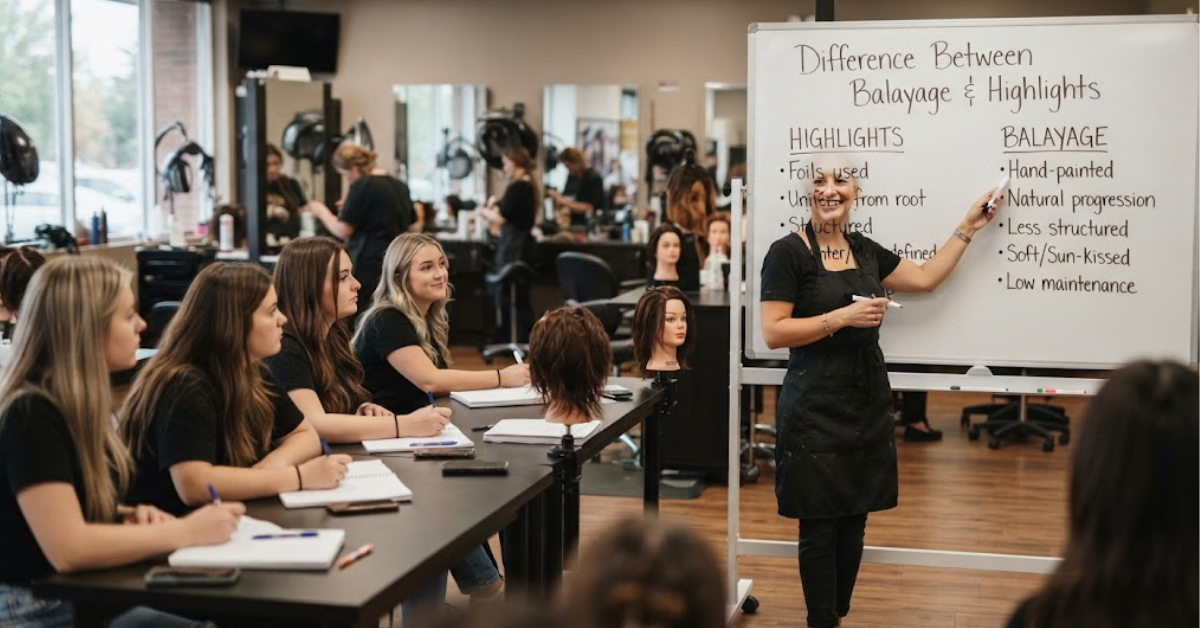
If you’re sitting in a salon chair wondering whether to ask for balayage or highlights, you’re not alone. Both techniques can brighten your hair, add dimension, and create a noticeable change without completely changing your natural color.
But the difference between balayage and highlights comes down to how the color is applied and, more importantly, how the finished hair looks. Traditional highlights usually create more defined, evenly distributed lighter sections, while balayage is designed to create a softer, more naturally blended effect.
Neither technique is automatically better. The right choice depends on the look you want, your natural hair color, how much maintenance you’re comfortable with, and how dramatic you want the result to be.
What Is the Difference Between Balayage and Highlights?
The simplest way to understand the difference is to look at the application technique.
Highlights traditionally involve selecting sections of hair and applying lightener to create deliberate lighter strands. Foils are commonly used to separate the colored sections from the rest of the hair and help the lightener process effectively.
Balayage, on the other hand, comes from a French word meaning “to sweep.” The color is typically painted onto selected sections of the hair by hand, creating a softer transition between the natural base and lighter pieces.
Here’s a quick comparison:
| Feature | Balayage | Traditional Highlights |
| Application | Often hand-painted | Often applied in foils |
| Overall effect | Soft and blended | More defined and uniform |
| Placement | Strategically placed | Often more evenly distributed |
| Root appearance | Usually softer | Can be more noticeable |
| Maintenance | Often lower | Usually requires more regular touch-ups |
| Grow-out | Generally subtle | Can show a stronger line |
| Customization | Highly customizable | Also customizable, but typically more structured |
These are general distinctions. Modern colorists frequently combine techniques, so not every salon’s version of balayage or highlights will look exactly the same.
What Is Balayage Hair?
Balayage is a hair-coloring technique in which a colorist paints lightener or color onto selected sections of the hair.
Rather than creating identical strands from the roots to the ends, the colorist can vary the placement and intensity. This allows the lighter pieces to blend gradually into the natural hair.
The result is usually a dimensional look rather than a solid block of color.
What Does Balayage Look Like?
A well-executed balayage often has:
- Softer color transitions
- Brighter ends
- Natural-looking dimension
- Less obvious regrowth
- Carefully placed lighter pieces
- A blended appearance around the face
Because the color can be customized, balayage can range from extremely subtle to quite bright.
Someone with dark brown hair might choose caramel-toned balayage, while someone with naturally blonde hair might opt for lighter beige or golden tones.
What Are Traditional Highlights?
Highlights are created by lightening selected strands or sections of hair.
The traditional foil method allows a colorist to isolate individual sections and control how much hair is lightened. Depending on the desired result, highlights can be fine and delicate or bold and noticeable.
Highlights can also be placed throughout the entire head or concentrated in specific areas.
What Do Highlights Look Like?
Traditional highlights often create:
- More noticeable lighter strands
- Consistent brightness
- Greater contrast with the base color
- Brightness closer to the roots
- A structured overall pattern
A full head of highlights can create a significantly lighter appearance, particularly when the natural hair is much darker than the desired highlight shade.
Balayage vs Highlights: The Biggest Differences
When comparing balayage vs highlights, several differences stand out.
1. Application Technique
The biggest distinction is how the color is placed.
Traditional highlights are commonly created using foils. The colorist sections the hair and applies lightener before enclosing each section in foil.
Balayage is generally hand-painted onto selected areas. The colorist has more freedom to create a gradual, customized pattern.
However, techniques can overlap. Some stylists use foils as part of a balayage service, so the word “balayage” doesn’t necessarily tell you exactly which tools will be used.
2. Overall Appearance
Balayage usually produces a softer, more blended appearance.
The lighter pieces can transition gradually from the natural base, making the color look as though it has naturally become lighter toward the ends.
Highlights typically produce more defined lighter sections. They can still look natural, especially when fine sections and carefully chosen tones are used, but the result is often more structured.
3. Root Coverage
Traditional highlights can begin closer to the roots, depending on the technique and desired result.
This can create a brighter appearance near the scalp but may also make regrowth more noticeable.
Balayage generally leaves more of the natural root area untouched. As the hair grows, the transition can therefore remain relatively subtle.
4. Maintenance
One of the biggest reasons people choose balayage is its relatively forgiving grow-out.
Because the color is usually blended rather than forming a strong line at the roots, you may be able to go longer between salon appointments.
Traditional highlights can require more frequent maintenance when you want to keep the roots consistently bright.
How often you need appointments depends on your hair growth, the placement of the color, the contrast between your natural hair and the highlights, and the look you’re trying to maintain.
Difference Between Highlights and Balayage for Maintenance
If low maintenance is important to you, balayage hair vs highlights is worth considering carefully.
Balayage tends to have a softer grow-out because the color isn’t necessarily concentrated in a straight line at the roots.
Highlights can also be low maintenance when they’re intentionally placed away from the scalp or blended with techniques such as a root shadow or gloss.
So the maintenance difference isn’t absolute.
A skilled colorist can design either service to require more or less upkeep depending on your preferences.
Balayage vs Highlights for Different Hair Colors
Your starting hair color can make a major difference in the final result.
Balayage on Dark Hair
Balayage can work particularly well on brown or dark hair when the goal is to introduce warmth and dimension.
Popular tones include:
- Caramel
- Honey
- Toffee
- Chestnut
- Warm beige
Going significantly lighter may require multiple sessions, particularly if the hair has previous artificial color.
Highlights on Dark Hair
Highlights can also brighten dark hair dramatically.
Fine caramel or chocolate-toned highlights can create subtle dimension, while lighter blonde highlights produce more contrast.
The desired level of brightness should be discussed with a professional, especially if the hair has been previously colored.
Balayage on Blonde Hair
Blonde balayage can create additional dimension by combining several shades of blonde.
For example, a colorist might incorporate beige, golden, or cooler blonde tones depending on the client’s natural color and desired finish.
Highlights on Blonde Hair
Highlights can make naturally blonde hair appear brighter and lighter.
Fine highlights are often used when someone wants an overall brighter blonde appearance without applying one solid color throughout the hair.
Which Is Better: Balayage or Highlights?
There isn’t one universal winner.
The better choice depends on your desired result.
Choose balayage if you want:
- A soft, blended appearance
- Natural-looking dimension
- A more gradual grow-out
- Strategically placed brightness
- Less obvious root regrowth
- A customized, lived-in color
Choose highlights if you want:
- More uniform brightness
- Noticeable lighter strands
- A brighter appearance closer to the roots
- Greater overall lightening
- A classic highlighted look
- More structured color placement
And there’s another option: combine the two.
Many modern salon services use multiple coloring techniques to achieve a specific result. Your stylist may recommend balayage, foiled highlights, a combination of both, or additional techniques such as a gloss or root shadow.
Balayage vs Highlights: Which Lasts Longer?
Neither technique has one fixed lifespan because hair color gradually changes as your hair grows, is washed, exposed to heat, and interacts with the environment.
However, balayage often looks acceptable for longer between appointments because the grow-out tends to be softer.
Traditional highlights can remain beautiful for months too, but visible regrowth may become more noticeable when the lighter sections begin close to the scalp.
Your natural color also matters. A person with dark brown roots and very light blonde highlights may notice regrowth sooner than someone whose highlights are only a few shades lighter than their natural hair.
Does Balayage Damage Hair Less Than Highlights?
It’s tempting to assume that one technique is automatically gentler, but that’s not necessarily the case.
Both balayage and highlights can involve lightener, and lightening hair can affect the hair’s structure.
The potential for damage depends on factors such as:
- Starting hair condition
- Previous chemical treatments
- Strength of the lightener
- Processing time
- How light you want to go
- Frequency of chemical services
- At-home heat styling and hair care
Balayage isn’t automatically damage-free simply because the color is painted onto the hair.
If your hair is already fragile, heavily bleached, or chemically treated, tell your stylist before beginning any lightening service.
Can You Get Balayage and Highlights Together?
Yes.
In fact, combining techniques can produce a highly customized result.
For example, a stylist might use foiled highlights for extra brightness around the face while using balayage throughout the lengths for a softer transition.
This approach can provide both brightness and dimension without making the entire color look uniform.
If you have a specific photo of the look you want, bring it to your appointment. Photos often communicate the desired brightness and placement more effectively than simply saying “I want balayage.”
How to Choose Between Balayage and Highlights
If you’re still unsure, ask yourself these questions:
1. How much maintenance do I want?
If you prefer longer periods between salon appointments, a softer balayage design may be a good option.
2. How bright do I want my hair?
If you want a noticeably lighter overall appearance, traditional highlights may be more suitable.
3. Do I want visible roots?
If you don’t mind regular root maintenance, highlights can provide brightness closer to the scalp.
If you’d rather keep your natural root visible, balayage may be preferable.
4. What does my hair look like now?
Previous color, bleach, texture, and overall hair condition all influence what can realistically be achieved in one appointment.
5. What does your stylist recommend?
A professional colorist can assess your hair in person and determine which technique—or combination of techniques—is most appropriate.
How to Maintain Balayage or Highlights
Regardless of which technique you choose, proper maintenance can help your color stay attractive for longer.
Consider these habits:
- Use products designed for color-treated hair.
- Limit excessive heat styling.
- Use heat protection when using hot tools.
- Avoid washing your hair excessively if it causes your color to fade quickly.
- Follow your stylist’s recommendations for toning or glossing.
- Protect your hair from prolonged sun exposure when appropriate.
- Keep your hair conditioned, especially after lightening.
If your blonde begins looking too warm or brassy, ask your colorist whether a toner or gloss is appropriate rather than attempting aggressive correction at home.
Common Misconceptions About Balayage and Highlights
“Balayage is always more natural.”
Not necessarily. Balayage can be extremely dramatic if the colorist creates strong contrast or very light ends.
“Highlights always look stripey.”
They don’t have to. Modern highlighting techniques can create very fine, blended results.
“Balayage never uses foils.”
Not always. Some stylists incorporate foils into balayage services depending on the hair and desired result.
“Balayage requires no maintenance.”
It generally offers a more forgiving grow-out, but the hair can still require toning, glossing, conditioning, and occasional salon visits.
“Highlights are always more damaging.”
Damage depends largely on how much the hair is lightened and its condition before treatment, not simply on whether the service is called highlights.
Frequently Asked Questions
What is the difference between balayage and highlights?
The main difference is the way the color is applied and the resulting appearance. Balayage is generally hand-painted to create soft, blended transitions, while traditional highlights commonly use foils to create more defined lighter sections.
What is the difference between highlights and balayage?
Highlights usually create more structured and evenly distributed lighter pieces, while balayage tends to create a softer, more customized effect with a gradual transition between shades.
Is balayage better than highlights?
Not necessarily. Balayage may be better if you want a natural-looking, low-maintenance grow-out, while highlights may be better if you want a brighter and more uniform result.
Which lasts longer, balayage or highlights?
Balayage often appears to grow out more gradually because the color is typically blended away from a strong root line. However, both techniques can last for months depending on placement, hair growth, and maintenance.
Which is more damaging, balayage or highlights?
Neither is automatically more damaging. Both can involve lightening, and potential damage depends on the condition of your hair, the amount of lightening required, processing, and how often the service is repeated.
Can balayage look like highlights?
Yes. A skilled stylist can create balayage with enough brightness and strategically placed sections that the finished result resembles traditional highlights.
Can I get balayage and highlights at the same time?
Yes. Colorists can combine techniques to create additional brightness, dimension, and a more customized result.
Is balayage good for dark hair?
Yes. Balayage can add warmth and dimension to dark hair using shades such as caramel, honey, chestnut, or beige. The amount of lightening possible depends on your starting color and hair history.
Do highlights start at the roots?
They can. Traditional highlights are often placed close to the roots, although the exact placement varies according to the desired result and the stylist’s technique.
Which is better for low-maintenance hair color?
Balayage is often chosen for its softer grow-out and less noticeable root line. However, a well-designed highlight service can also be relatively low maintenance.
Conclusion: Balayage vs Highlights
When comparing the difference between balayage and highlights, the biggest distinction is how the lighter color is applied and how it blends with your natural hair.
Balayage generally creates a softer, hand-painted appearance with a gradual grow-out. Highlights typically create more defined lighter sections and can provide stronger, more consistent brightness, especially when applied close to the roots.
Neither option is automatically better. If you want a subtle, dimensional look that can grow out gracefully, balayage may be the better fit. If you want a brighter, more uniform highlighted effect, traditional highlights may make more sense.
And remember, these techniques aren’t mutually exclusive. A professional colorist can combine them to create a result that fits your hair, lifestyle, and personal style.
The best choice isn’t simply about following the latest trend. It’s about choosing a coloring technique that gives you the look you want while keeping your hair healthy and manageable.