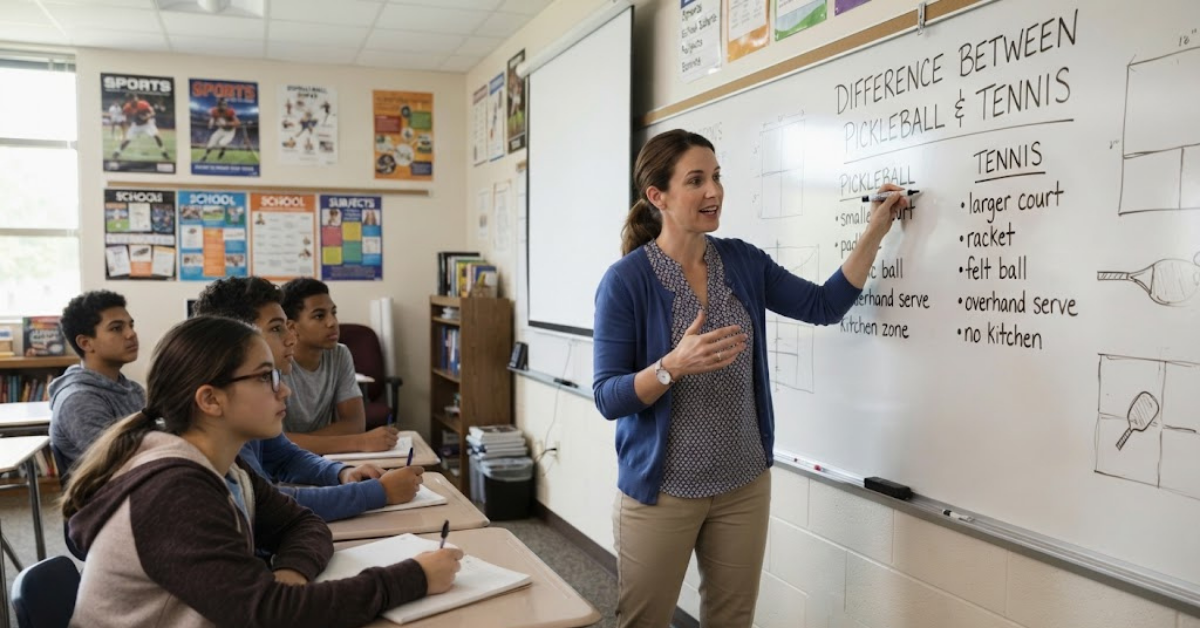
Pickleball and tennis may look similar at first glance. Both involve a net, a ball, racquet or paddle, and players trying to hit shots their opponents can’t return. But once you step onto the court, the differences become much easier to notice.
The difference between pickleball and tennis comes down to much more than equipment. The courts are different sizes, the balls and paddles behave differently, the serving rules aren’t the same, and the style of play can feel completely different.
So, when comparing tennis vs pickleball, which one is easier? Which gives you a better workout? And can a tennis player easily switch to pickleball?
Let’s break it down.
Difference Between Pickleball and Tennis at a Glance
Here’s a quick comparison before we get into the details:
| Feature | Pickleball | Tennis |
| Court size | 20 × 44 feet | 78 × 27 feet singles; 78 × 36 feet doubles |
| Equipment | Solid paddle and perforated plastic ball | Strung racquet and felt-covered tennis ball |
| Net height | 36 inches at sidelines, 34 inches center | 36 inches at posts, 34 inches center |
| Serving | Underhand | Generally overhand |
| Serve bounce | Diagonal into opponent’s service area | Diagonal into service box |
| Non-volley zone | 7-foot “kitchen” on each side | No equivalent zone |
| Scoring | Commonly games to 11, win by 2 | Love, 15, 30, 40; usually sets |
| Singles court | Same 20 × 44-foot court | 27 feet wide |
| Doubles court | Same 20 × 44-foot court | 36 feet wide |
| Ball | Lightweight perforated plastic | Heavier, pressurized or pressureless felt-covered ball |
| Typical movement | Shorter court, quick reactions | More running and covering space |
| Overall feel | Compact, tactical, quick exchanges | More powerful, athletic, court-covering |
USA Pickleball specifies a 20-by-44-foot court for both singles and doubles, while the International Tennis Federation specifies a 78-foot-long tennis court that is 27 feet wide for singles and 36 feet wide for doubles.
What Is the Difference Between Pickleball and Tennis?
The simplest explanation is that pickleball is played on a much smaller court with a solid paddle and perforated plastic ball, while tennis uses a larger court, a strung racquet, and a tennis ball.
That difference in equipment and space changes almost everything else.
Tennis gives players much more ground to cover. Powerful serves, deep groundstrokes, topspin, slices, and aggressive baseline play are major parts of the game.
Pickleball takes place in a tighter space. Players often spend more time thinking about placement, soft shots, reaction speed, and positioning near the non-volley zone, commonly called the kitchen.
USA Pickleball describes the sport as combining elements of tennis, badminton, and table tennis, while emphasizing its smaller court, solid paddle, perforated ball, and unique kitchen area.
Pickleball vs Tennis Court Size
Court size is probably the most obvious physical difference.
A regulation pickleball court measures 20 feet wide by 44 feet long for both singles and doubles.
A tennis court is much larger. The ITF specifies a length of 78 feet, with a width of 27 feet for singles and 36 feet for doubles.
That creates a very different playing experience.
Pickleball court
The smaller court means players don’t have to cover as much distance. However, that doesn’t necessarily make pickleball slow.
Because players are closer together, balls can arrive quickly, particularly during fast exchanges at the net.
Tennis court
The larger tennis court gives players considerably more space to attack.
Players may need to sprint from side to side, move forward and backward, recover toward the center, and chase balls that land deep in the corners.
This is one of the biggest reasons tennis vs pickleball can feel like two very different sports even though their basic concept is similar.
Pickleball vs Tennis Court: Can You Use a Tennis Court?
Yes, and this is one reason pickleball has become relatively easy to introduce in existing facilities.
A standard pickleball court is much smaller than a tennis court, so multiple pickleball courts can potentially be laid out within the footprint of a tennis court, depending on the facility’s design and required surrounding space.
USA Pickleball recommends a minimum playing surface of about 30 by 60 feet for a standard court and notes that a larger area is preferred for certain situations.
This makes tennis facilities useful locations for pickleball, although proper court spacing, fencing, lighting, and line placement still matter.
Pickleball vs Tennis Equipment
The equipment is another major difference.
Pickleball paddle
A pickleball paddle is solid rather than strung like a tennis racquet.
Players use the paddle to control a lightweight plastic ball containing holes. USA Pickleball notes that approved pickleballs have a perforated design with numerous circular holes.
The paddle’s compact shape and solid hitting surface give pickleball its distinctive feel.
Tennis racquet
A tennis racquet has a larger head with strings stretched across it.
The strings allow players to generate different combinations of power, spin, and control. Tennis players can use the racquet face to produce topspin, slice, flat shots, serves, and other variations.
The ball
This is another major distinction.
A pickleball is lightweight and perforated, while a tennis ball is heavier and covered in felt.
Because of those differences, the balls react very differently when struck.
A tennis ball can travel quickly over a large court. A pickleball generally travels more slowly, although its speed can still become surprisingly high during fast exchanges.
Pickleball vs Tennis: The Serve
Serving is one of the clearest rule differences.
In traditional pickleball play, the serve is made underhand and must travel diagonally into the opponent’s service area.
Tennis serves are normally hit overhead, allowing players to generate much greater power and making the serve a major offensive weapon.
This changes the beginning of each point.
A strong tennis server can use speed, spin, placement, and height to put immediate pressure on an opponent.
Pickleball’s serve is generally less dominant. Players often use placement and depth rather than relying on overwhelming speed.
The Pickleball Kitchen vs Tennis
If there’s one pickleball term that tennis players need to learn, it’s the kitchen.
The official name is the non-volley zone, or NVZ.
It extends 7 feet from the net on each side. Players cannot volley the ball while standing inside this zone, subject to the sport’s specific rules.
Tennis doesn’t have an equivalent zone.
This creates one of pickleball’s defining strategic battles.
Players often try to move toward the kitchen line, exchange controlled shots called dinks, and create an opening before attacking.
Why the kitchen matters
The kitchen prevents players from simply standing directly beside the net and smashing every ball out of the air.
Instead, players must think carefully about:
- Shot placement
- Patience
- Footwork
- Positioning
- Ball height
- Timing
- When to attack
This gives pickleball a surprisingly tactical character.
Pickleball vs Tennis Scoring
The scoring systems are also different.
Tennis uses the familiar progression:
Love → 15 → 30 → 40 → game
Players typically need to win games to take sets, with match formats varying by competition.
Pickleball scoring is considerably simpler for beginners.
A common format is playing to 11 points, with a player or team needing to win by two points. Official competition can use different scoring formats depending on the event and rules in effect.
That difference can make pickleball easier to understand when you’re first learning the game.
Is Pickleball Easier Than Tennis?
For many beginners, yes—but that doesn’t mean pickleball is effortless.
The smaller court means you don’t need to cover as much ground. The underhand serve is also easier for many beginners to learn than a technically demanding tennis serve.
The paddle and perforated ball can also make initial rallies feel more approachable.
But once you move beyond the beginner stage, pickleball becomes increasingly strategic.
You still need:
- Quick reactions
- Good hand-eye coordination
- Footwork
- Shot selection
- Positioning
- Timing
- Tactical awareness
So the better description is that pickleball can have a gentler learning curve, while still offering considerable room for advanced skill development.
Is Tennis Harder Than Pickleball?
For many new players, tennis is physically and technically more demanding at the beginning.
A beginner has to learn how to:
- Serve
- Move around a larger court
- Control a strung racquet
- Judge the bounce of a tennis ball
- Hit groundstrokes
- Recover after each shot
- Maintain rallies over greater distances
Tennis also requires players to cover considerably more court.
That doesn’t mean every tennis match is harder than every pickleball match. Advanced pickleball can be extremely fast and demanding, particularly during high-level doubles play.
The sports simply emphasize different skills.
Pickleball vs Tennis: Which Gives a Better Workout?
This depends heavily on how you play.
Tennis generally involves more court coverage and longer movement patterns. Singles tennis can require repeated acceleration, lateral movement, sprinting, and recovery.
Pickleball uses a smaller court, so players usually cover less total distance. But quick reactions, short movements, lunges, and repeated exchanges can still make it physically demanding.
Your fitness level, match length, singles versus doubles, playing style, and intensity all matter.
So it’s better to ask:
Which sport will I actually play consistently?
A sport you enjoy enough to play several times a week can be more valuable to your fitness than a sport that theoretically burns more calories but stays in the closet.
Tennis vs Pickleball: Which Is More Social?
Both sports can be highly social, but pickleball has a particularly strong doubles and recreational culture.
The smaller court makes conversation and interaction easier between points, and games can be organized with rotating groups of players.
Tennis is also highly social, especially in doubles, clubs, leagues, and recreational groups.
If your primary goal is meeting people and having fun, either can work well. The best choice may simply come down to which local community you enjoy more.
Can Tennis Players Play Pickleball?
Absolutely.
In fact, tennis experience can give a player several useful advantages when transitioning to pickleball.
A tennis player already understands:
- Court positioning
- Serving concepts
- Ball tracking
- Racquet or paddle control
- Net play
- Spin
- Rally construction
- Footwork
However, there are habits that need adjustment.
Tennis habits that can hurt in pickleball
A tennis player may initially:
- Swing too hard
- Stand too far behind the baseline
- Expect the ball to bounce like a tennis ball
- Overuse topspin
- Try to win points with power
- Move incorrectly around the kitchen
The smaller court rewards control and patience more than simply hitting harder.
Can Pickleball Players Play Tennis?
Yes, but the transition may require more adjustment in the opposite direction.
A pickleball player moving to tennis needs to become comfortable with:
- A larger court
- A longer racquet
- A heavier, faster ball
- Overhead serving
- More powerful groundstrokes
- Greater court coverage
- Longer movement patterns
The fundamentals of striking and positioning transfer, but tennis generally requires more space and larger swings.
Pickleball vs Tennis: Which Has More Strategy?
This is difficult to answer because the strategy is simply different.
Tennis often revolves around:
- Serve plus one
- Baseline positioning
- Depth
- Topspin
- Angles
- Court coverage
- Attacking weaknesses
Pickleball places greater emphasis on:
- Dinking
- Third-shot drops
- Resets
- Kitchen positioning
- Speed-ups
- Soft hands
- Patience
- Creating openings
Neither sport is inherently more strategic.
They reward different types of strategic thinking.
Pickleball vs Tennis for Older Adults
Pickleball is often attractive to older adults because the smaller court can reduce the amount of running required compared with tennis.
That can make it easier for some people to participate recreationally.
However, pickleball still involves sudden movements, quick reactions, bending, lunging, and changes of direction.
Anyone returning to sport after a long period of inactivity should build intensity gradually and choose equipment and footwear appropriate for the activity.
Tennis can also be perfectly suitable for older players, particularly in doubles or at recreational intensity.
The right choice depends on individual fitness, mobility, preferences, and playing style.
Pickleball vs Tennis for Kids
Both sports can be excellent choices for children.
Pickleball’s smaller court and lighter ball can make the basic game approachable.
Tennis, meanwhile, has extensive junior-development systems and can teach children a broad range of movement, coordination, and racket skills.
For younger players, appropriately sized equipment and modified courts can make either sport more enjoyable and easier to learn.
The best option is usually the one the child actually enjoys playing.
Is Pickleball Faster Than Tennis?
This question can be confusing because “faster” can refer to ball speed or the pace of the rally.
Tennis generally produces much higher ball speeds, particularly on serves and powerful groundstrokes.
But pickleball exchanges can feel extremely fast because players are positioned closer together.
A hard-hit pickleball can reach an opponent quickly even though the ball itself is traveling more slowly than a tennis ball.
So:
Higher ball speeds: Tennis
Shorter reaction distances: Pickleball
More court coverage: Tennis
Quick close-range exchanges: Pickleball
Pickleball vs Tennis: Which Is More Expensive?
The cost depends on how seriously you play.
At a basic level, pickleball equipment can be relatively simple:
- Paddle
- Pickleballs
- Court shoes
- Appropriate clothing
Tennis requires:
- Racquet
- Tennis balls
- Court shoes
- Appropriate clothing
The biggest difference may come from court access and lessons rather than the equipment itself.
If you already have access to a court and own basic equipment, either sport can be relatively inexpensive to play recreationally.
Which Sport Should You Choose?
The answer depends on what you’re looking for.
Pick pickleball if you want:
- A smaller court
- An easier introduction to racket sports
- Less court coverage
- Quick reaction-based exchanges
- Strong doubles and social play
- A tactical game built around positioning
- A lower barrier to getting started
Pick tennis if you want:
- More running and court coverage
- Powerful serves
- Longer rallies across a larger court
- Greater emphasis on traditional racquet technique
- Singles competition with substantial movement
- A long-established competitive pathway
And there’s no rule saying you have to choose only one.
Many players enjoy both.
Frequently Asked Questions
What’s the difference between pickleball and tennis?
The biggest differences are the court size, equipment, ball, serving rules, and style of play. Pickleball uses a 20-by-44-foot court, solid paddles, and perforated plastic balls, while tennis uses a 78-foot court, strung racquets, and tennis balls.
Is pickleball easier than tennis?
For many beginners, pickleball is easier to learn initially because the court is smaller and the serve is underhand. However, advanced pickleball can be highly technical and strategically demanding.
Is pickleball played on a tennis court?
Pickleball can be played on appropriately adapted tennis-court surfaces. Because a pickleball court is much smaller, facilities can sometimes fit multiple pickleball layouts within a tennis-court footprint, provided there is adequate space and proper line placement.
How big is a pickleball court compared with a tennis court?
A pickleball court is 20 by 44 feet. A tennis court is 78 feet long and 27 feet wide for singles or 36 feet wide for doubles.
What is the pickleball kitchen?
The kitchen is the common name for pickleball’s 7-foot non-volley zone on each side of the net. Players cannot volley while standing inside this zone under the game’s rules.
Which is more physically demanding, tennis or pickleball?
Tennis generally requires more running and court coverage, particularly in singles. Pickleball requires less total court coverage but can involve very quick reactions, lunges, and repeated short movements.
Can tennis players switch to pickleball?
Yes. Tennis players often have useful transferable skills, including footwork, ball tracking, positioning, and shot control. They usually need to adjust to pickleball’s smaller court, kitchen, underhand serve, and softer tactical game.
Can pickleball players switch to tennis?
Yes, although the transition can require more adaptation to tennis’s larger court, overhead serve, heavier ball, larger swings, and greater physical coverage.
Which has a bigger court, pickleball or tennis?
Tennis has the much larger court. A standard pickleball court is 20 by 44 feet, while a tennis court is 78 feet long and up to 36 feet wide for doubles.
Is pickleball or tennis better for beginners?
Either can be a good choice. Pickleball often provides a gentler initial learning curve, while tennis can take longer to develop basic consistency. The best choice is the sport that matches your interests, fitness level, access to courts, and willingness to practice.
Conclusion: Pickleball vs Tennis
The difference between pickleball and tennis isn’t simply that one uses a paddle and the other uses a racquet.
Pickleball is played on a much smaller court with a perforated plastic ball, solid paddle, underhand serve, and unique kitchen area. Tennis uses a much larger court, strung racquet, traditional tennis ball, and a more powerful serving and baseline game.
When comparing pickleball vs tennis, neither sport is automatically better.
If you want a more compact, social, reaction-focused game with a relatively approachable learning curve, pickleball may be the better place to start. If you enjoy running, powerful strokes, serving, and covering a large court, tennis may be more appealing.
And if you can’t decide, there’s an even better answer: try both. The fastest way to understand the difference between pickleball and tennis is to pick up a paddle, grab a racquet, and see which one keeps you coming back for another match.