
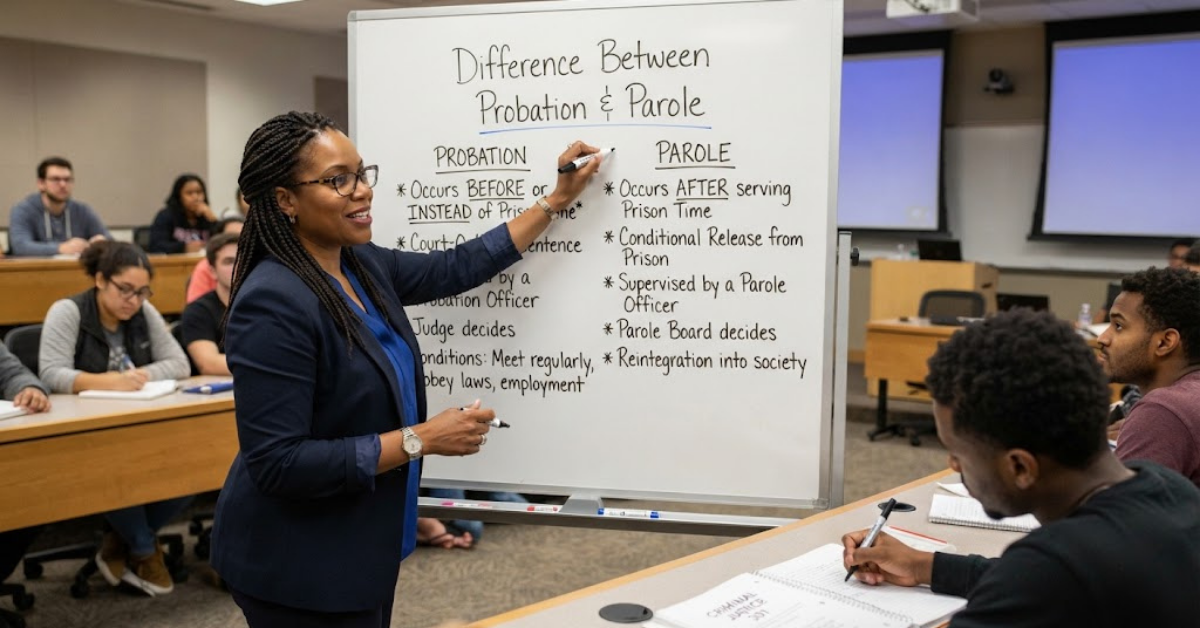
A person can be under court supervision without spending every day in prison—but that does not mean probation and parole are the same thing. Understanding the difference between probation and parole starts with one simple distinction: probation generally serves as an alternative to incarceration or is imposed alongside a sentence, while parole typically allows someone to serve part of a prison sentence in the community under supervision.
The two terms are often used interchangeably in everyday conversation, but they describe different stages of the criminal justice process. Their rules, eligibility requirements, supervision conditions, and consequences can also vary depending on the jurisdiction.
So, what is the difference between probation and parole? The easiest way to understand it is to look at when each begins, who imposes it, and what happens if the person violates its conditions.
Probation vs Parole: The Basic Difference
The simplest way to distinguish probation from parole is to consider where the person is in the sentencing process.
Probation is a period of supervision ordered by a court. In many cases, it allows a person to remain in the community instead of serving a prison sentence, although probation can also be imposed after incarceration as part of a sentence.
Parole, by contrast, generally applies after a person has served some portion of a prison sentence. The individual is released into the community before the sentence has fully expired and must follow conditions while under supervision.
Here is a quick comparison:
| Feature | Probation | Parole |
|---|---|---|
| Usually begins | Instead of or as part of a court sentence | After part of a prison sentence has been served |
| Main purpose | Community supervision and rehabilitation | Supervised transition from incarceration to the community |
| Typically associated with | Court sentencing | Release from prison |
| Conditions | Set by the court and applicable law | Set by the releasing authority and applicable law |
| Violations | Can lead to sanctions or revocation | Can lead to sanctions, revocation, or return to custody |
| Exact rules | Vary by jurisdiction | Vary by jurisdiction |
The important point is that probation and parole are both forms of supervision, but they generally operate at different points in a criminal sentence.
What Is Probation?
Probation is a court-ordered period during which a person must follow specific rules while living in the community.
Instead of sending someone to jail or prison—or sometimes in addition to a period of incarceration—a court may impose probation. The goal can include accountability, rehabilitation, monitoring, and reducing the likelihood of another offense.
A person on probation may be required to:
- Report regularly to a probation officer
- Obey all applicable laws
- Attend counseling or treatment
- Submit to drug or alcohol testing
- Maintain employment or education
- Pay court-ordered fines or restitution
- Avoid certain people or places
- Follow travel restrictions
- Complete community service
- Attend required programs or appointments
Not every person on probation has the same conditions. The requirements depend on the offense, sentence, jurisdiction, and individual circumstances.
How Long Does Probation Last?
There is no universal probation period.
Some probation terms may last months, while others can continue for several years. Certain offenses or jurisdictions may involve particularly long supervision periods.
The sentencing order and applicable law determine the actual requirements.
What Happens When Probation Is Completed?
If a person follows all required conditions and reaches the end of the probation term, supervision may end.
However, completing probation does not necessarily erase the underlying conviction or other legal consequences. Those issues depend on the jurisdiction and the person’s specific case.
What Is Parole?
Parole generally refers to supervised release into the community after a person has served part of a prison sentence.
Instead of remaining incarcerated for the entire sentence, an eligible person may be released under conditions. The individual remains subject to supervision and must comply with the terms of parole.
Parole may involve requirements such as:
- Reporting to a parole officer
- Maintaining approved housing
- Following employment requirements
- Avoiding criminal activity
- Participating in treatment
- Submitting to drug testing
- Following travel restrictions
- Avoiding contact with specified individuals
- Complying with electronic monitoring when ordered
The exact rules vary significantly between jurisdictions.
Why Does Parole Exist?
Parole can provide a structured transition between incarceration and life in the community.
Rather than moving directly from prison to complete independence, a person may receive supervision and support while adjusting to everyday responsibilities.
Depending on the system, parole may also be connected to rehabilitation, public safety, risk management, and reintegration.
Difference Between Probation and Parole in Practice
The biggest practical difference is how the person arrived at community supervision.
Imagine two people convicted of different offenses.
Person A receives a sentence that allows them to remain in the community under court supervision. That person may be placed on probation.
Person B is sentenced to prison, serves part of that sentence, and is later released under supervision. That person may be placed on parole.
Both individuals might have to report to an officer, avoid criminal activity, attend treatment, and comply with other restrictions.
That is why the two terms can sound similar even though they refer to different legal situations.
Probation vs Parole: Who Controls Them?
Another important difference concerns who has authority over the supervision.
Probation is generally connected to the court that imposed the sentence. A probation officer may monitor compliance and report violations to the court.
Parole is generally connected to the authority responsible for supervised release from incarceration. Depending on the jurisdiction, this may involve a parole board, corrections department, or another authorized agency.
The terminology and structure can differ from one state or legal system to another, so it is important not to assume that every jurisdiction uses the same process.
Conditions of Probation and Parole
Both probation and parole can involve strict conditions.
Common requirements may include:
Reporting
The person may need to meet with a probation or parole officer regularly and provide updates about their circumstances.
Employment or Education
Some individuals may be required to maintain employment, participate in education, or demonstrate progress toward a rehabilitation goal.
Treatment
Substance-use treatment, mental-health services, anger-management programs, or other counseling may be required depending on the case.
Travel Restrictions
A person may need permission before leaving a particular geographic area.
Drug Testing
Testing may be required when substance use is relevant to the offense or supervision plan.
No-Contact Rules
The person may be prohibited from contacting victims, witnesses, co-defendants, or other specified individuals.
The exact conditions are case-specific. A condition that applies to one person may not apply to another.
What Happens If You Violate Probation?
A probation violation occurs when someone fails to follow one or more conditions of probation.
Examples might include:
- Missing a required appointment
- Failing a drug test
- Committing another offense
- Leaving the jurisdiction without permission
- Failing to complete a required program
- Violating a no-contact order
A violation does not necessarily mean the person automatically goes to jail or prison.
Depending on the circumstances and local law, possible consequences can include:
- A warning
- Additional supervision
- Modified conditions
- Counseling or treatment
- Community service
- Short-term detention
- Revocation of probation
- Imposition or enforcement of an underlying custodial sentence
The seriousness of the violation and the person’s history can influence the outcome.
What Happens If You Violate Parole?
A parole violation can similarly result in consequences.
For example, a person on parole might violate conditions by committing a new offense, failing to report, possessing prohibited substances, or breaking another specific requirement.
Possible consequences depend on the jurisdiction and circumstances and may include:
- Increased supervision
- Additional conditions
- Treatment requirements
- Administrative sanctions
- A formal revocation process
- Return to custody
A parole violation does not always mean that the person automatically returns to prison. The applicable law and decision-making process determine what happens.
Is Probation Better Than Parole?
There is no universal answer because probation and parole serve different purposes.
For someone who receives probation instead of incarceration, remaining in the community can allow them to continue working, attending school, caring for family, and participating in treatment.
For someone released on parole, supervised release can provide an opportunity to transition back into the community after serving part of a prison sentence.
Neither term automatically means that a person has committed a more or less serious offense. The underlying offense, sentence, criminal history, and applicable law all matter.
Difference Between Parole and Probation for Employment
Both types of supervision can affect employment, but the impact depends on the person’s conditions and circumstances.
Someone on probation may have relatively few restrictions on employment unless the court has imposed specific requirements.
Someone on parole may also work, but release conditions can sometimes affect where they can work, what duties they can perform, or whether they must report employment changes.
In either situation, maintaining stable employment can be an important part of successfully completing community supervision.
Can Probation or Parole Be Ended Early?
In some jurisdictions, early termination or modification of supervision may be possible.
For probation, a person may be able to ask the court to end supervision early if they have complied with conditions and satisfied applicable requirements.
Parole may also have mechanisms for changing or ending supervision, but the rules differ considerably between jurisdictions.
Early release from supervision is not automatic. A person should check the law that applies to their case and, when necessary, obtain advice from a qualified attorney.
Probation vs Parole: A Simple Example
Consider this simplified example.
Example 1: Probation
A court sentences someone to probation instead of incarceration, subject to conditions such as regular reporting, treatment, and compliance with the law.
The person lives in the community while completing the probation term.
This is probation.
Example 2: Parole
A person receives a prison sentence, serves part of it, and is then released into the community under supervision before the sentence has fully expired.
This is parole.
The two situations can look similar from the outside because both involve rules and supervision. The key difference is when the supervision occurs in relation to incarceration.
Common Misconceptions About Probation and Parole
“Probation means you were never sentenced to prison.”
Not necessarily. Some sentences can involve both incarceration and a period of probation or another form of community supervision.
“Parole means the prison sentence is over.”
Generally, no. Parole usually involves supervised release before the sentence has completely expired.
“A violation always means jail or prison.”
Not necessarily. Consequences vary based on the violation, jurisdiction, and individual circumstances.
“Everyone on probation has the same rules.”
No. Conditions are often tailored to the person’s sentence and circumstances.
“Parole and probation officers do exactly the same job.”
They can have similar supervision responsibilities, but their legal authority, agencies, and procedures can differ.
Frequently Asked Questions
What is the difference between probation and parole?
The difference between probation and parole is primarily when and how community supervision occurs. Probation is generally ordered by a court as an alternative to incarceration or as part of a sentence. Parole generally involves supervised release into the community after a person has served part of a prison sentence.
What is the difference between probation and parole in simple terms?
A simple way to remember it is: probation is usually court-ordered community supervision, while parole is usually supervised release from prison.
Is parole before or after probation?
There is no universal sequence because probation and parole are different legal mechanisms. Parole generally follows incarceration, while probation is generally imposed by a court and may occur instead of or in addition to incarceration.
Can you be on probation and parole at the same time?
In some circumstances, overlapping forms of supervision may occur, but this depends on the jurisdiction and the person’s sentences. The terms should not be assumed to be interchangeable.
Which is more serious, probation or parole?
Neither is automatically “more serious.” Parole generally follows incarceration, while probation often allows a person to remain in the community under court supervision. The seriousness of the underlying offense and sentence matters more than the label alone.
What happens if you violate probation?
A probation violation can result in consequences ranging from additional conditions or sanctions to revocation and possible incarceration, depending on the circumstances and applicable law.
What happens if you violate parole?
A parole violation can result in additional supervision, modified conditions, sanctions, a revocation proceeding, or return to custody, depending on the jurisdiction and circumstances.
Do probation and parole require drug testing?
They can. Drug testing may be included as a condition when substance use is relevant to the person’s supervision plan, but it is not automatically required in every case.
Can someone on probation travel?
Travel restrictions vary. A person may need permission before leaving a specified geographic area or jurisdiction, depending on the conditions of probation.
Can someone on parole travel?
Parole can include geographic and travel restrictions. The person may need approval before traveling outside an authorized area.
Does parole mean you are free?
Parole generally allows a person to live in the community, but it is conditional freedom. The person must comply with the conditions of release and remains subject to supervision.
Is probation the same as parole?
No. Although both involve community supervision, they generally apply at different stages of the criminal justice process and are governed by different legal procedures.
Conclusion: Difference Between Probation and Parole
The difference between probation and parole becomes much easier to understand once you focus on timing.
Probation is generally a court-ordered period of community supervision that may be imposed instead of incarceration or as part of a sentence. Parole generally involves supervised release into the community after a person has served part of a prison sentence.
Both can include reporting requirements, treatment, travel restrictions, drug testing, and other conditions. Both can also carry consequences for violations.
The important thing to remember is that probation and parole are not interchangeable terms, and the precise rules can vary significantly by jurisdiction. If you’re dealing with an actual criminal case, read the relevant court or release documents carefully and consider speaking with a qualified legal professional who understands the law in that jurisdiction.
For general understanding, though, the shortcut is simple: probation usually comes from the court as community supervision; parole usually comes after incarceration as supervised release.