
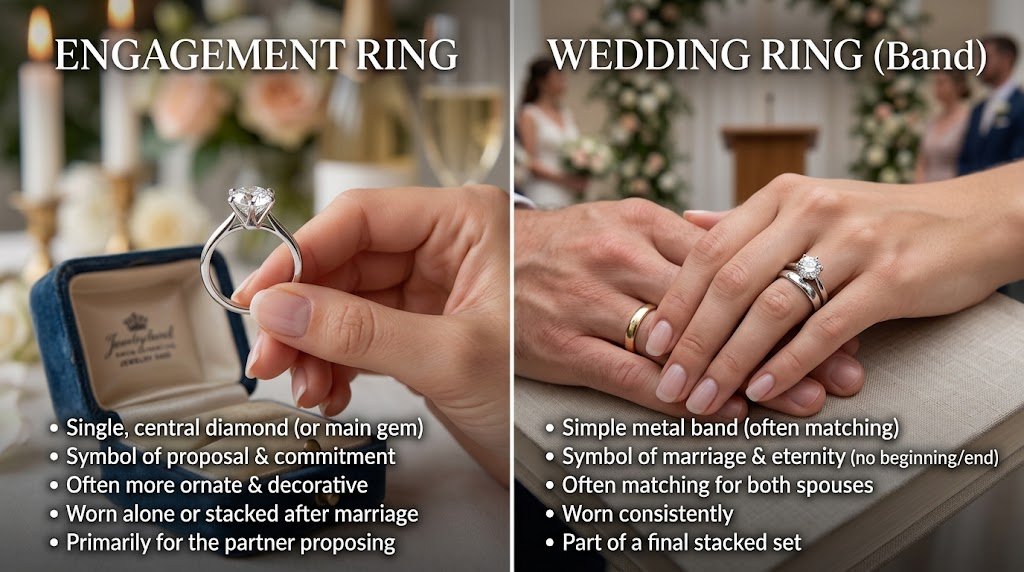
Choosing a ring for one of the biggest moments in your life can feel surprisingly complicated. There are engagement rings, wedding rings, wedding bands, bridal sets, eternity bands, and countless styles in between. So, what exactly is the difference between wedding ring and engagement ring?
The simplest answer is timing and purpose. An engagement ring is traditionally given when a couple gets engaged and represents the promise to marry. A wedding ring, often called a wedding band, is exchanged during the wedding ceremony and represents the marriage itself. While tradition gives each ring a specific role, modern couples have plenty of freedom to choose what works for them.
Engagement Ring vs Wedding Ring: The Main Difference
The easiest way to understand these two rings is to look at when they enter the relationship and what they symbolize.
| Feature | Engagement Ring | Wedding Ring |
|---|---|---|
| When it is given | Usually during the proposal | Usually during the wedding ceremony |
| Main meaning | Promise or intention to marry | Marriage and commitment |
| Typical design | More decorative, often with a center stone | Usually a band, with or without gemstones |
| Who traditionally wears it | Traditionally the person being proposed to | Traditionally both spouses |
| When it is worn | During the engagement and often after marriage | From the wedding onward |
| Typical style | Solitaire, halo, three-stone, cluster and similar designs | Plain, pavé, eternity, curved or matching bands |
These are traditions rather than strict rules. Couples can choose different rings, different fingers, or even a single ring if that better suits their lifestyle.
What Is an Engagement Ring?
An engagement ring is traditionally presented when one partner proposes marriage to the other. It represents the couple’s intention to marry and is often the more eye-catching piece of the two.
Many engagement rings feature a prominent center gemstone. Diamonds are especially common, although sapphires, emeralds, rubies and other gemstones can also be used.
Common engagement ring styles include:
- Solitaire rings
- Halo rings
- Three-stone rings
- Pavé designs
- Oval, round, emerald and pear-shaped stone settings
- Vintage-inspired rings
- Colored gemstone engagement rings
The design is usually chosen around the center stone. That gives an engagement ring a more statement-like appearance compared with a traditional wedding band.
Of course, there is no requirement for an engagement ring to have a diamond. A colored gemstone or even a simple metal design can carry exactly the same personal meaning.
What Is a Wedding Ring?
A wedding ring, also known as a wedding band, is traditionally exchanged during the wedding ceremony. It represents the couple’s marriage and the vows or commitment made during the ceremony.
Wedding bands are often simpler than engagement rings. A classic version may be a plain gold, platinum or other metal band. However, wedding bands can also include diamonds, engraving, textured finishes or other decorative details.
Popular options include:
- Plain metal bands
- Diamond wedding bands
- Eternity bands
- Pavé bands
- Curved or contoured bands
- Matching wedding bands
- Engraved wedding rings
Because wedding bands are often worn every day, comfort and durability can be particularly important when choosing one.
Engagement Ring vs Wedding Band: Design Differences
One of the most noticeable differences is the way each ring is designed.
An engagement ring commonly has a focal point. This could be a large center diamond, a colorful gemstone or a cluster of smaller stones.
A wedding band usually focuses more on the band itself. It may be completely plain or decorated with smaller gemstones.
That said, the distinction is becoming less rigid. Some modern wedding bands are highly detailed, while minimalist engagement rings can look almost identical to traditional wedding bands.
In other words, design alone does not determine whether a ring is an engagement ring or wedding ring. Its purpose and the couple’s choice matter just as much.
When Do You Wear Each Ring?
Traditionally, the engagement ring comes first.
It is given during the proposal and is worn throughout the engagement. After the wedding, many people continue wearing the engagement ring alongside their wedding band. Others wear only one ring on a daily basis.
During the wedding ceremony, the wedding band is exchanged as part of the marriage ceremony.
Afterward, couples often wear both rings on the same finger. However, this isn’t a universal rule. Some people wear their rings on different hands, different fingers or only wear one of them for practical reasons.
For example, someone who works with their hands may prefer a simple wedding band during work and save a larger engagement ring for special occasions.
Which Ring Goes on First?
A common Western tradition is to wear the wedding band closer to the hand and the engagement ring above it.
The idea is sometimes explained through the romantic tradition that the wedding ring should be closer to the heart.
However, this isn’t a requirement.
Ring-wearing customs vary between countries, cultures and religious traditions. GIA notes that while the fourth finger of the left hand is traditional in many places, some countries commonly use the right hand instead.
So if another arrangement feels more comfortable or meaningful, there’s nothing wrong with choosing it.
Do You Need Both an Engagement Ring and a Wedding Ring?
No. You don’t have to own both.
The idea that every couple needs two separate rings is largely based on tradition and personal preference. Some couples love the look of an engagement ring paired with a wedding band. Others prefer a single ring that can serve both purposes.
There are several reasons someone might choose one ring:
- Simplicity: One ring can be easier to wear and maintain.
- Lifestyle: People with hands-on jobs may prefer a low-profile ring.
- Budget: Buying one quality ring may make more sense than purchasing two.
- Personal taste: Some people simply prefer minimalist jewelry.
- Comfort: Fewer rings can mean less weight and fewer edges or stones catching on clothing.
There are no universal rules saying that one option is more meaningful than another. The best choice is the one that fits your relationship and everyday life.
Engagement Ring vs Wedding Ring: Which Costs More?
There is no fixed price difference, but engagement rings are often more expensive than wedding bands.
One reason is that engagement rings frequently contain a larger center gemstone. The cost can therefore depend heavily on the stone’s characteristics, including its size, cut, color and clarity.
Wedding bands can range from relatively simple metal rings to elaborate diamond-encrusted designs, so prices vary widely too.
Rather than relying on a traditional spending rule, set a budget that makes sense for you. The Federal Trade Commission recommends researching sellers, checking return policies and getting important details about jewelry in writing before purchasing.
What Should You Check Before Buying?
Whether you’re shopping for an engagement ring or wedding band, look beyond the appearance.
Consider:
- Metal type and purity
- Gemstone type
- Diamond or gemstone quality
- Ring size
- Setting style
- Durability
- Warranty or repair options
- Return and resizing policies
- Whether the seller provides appropriate documentation
The FTC’s consumer guidance also recommends checking what sellers say about gemstone characteristics, treatments and other important details before completing a purchase.
How to Choose a Wedding Band That Matches an Engagement Ring
If you plan to wear both rings together, think about how they will interact before buying the wedding band.
A few things can make a major difference.
Match the Metal
Matching metals can create a traditional, coordinated appearance. For example, a platinum engagement ring can be paired with a platinum wedding band.
But mixing metals can also look intentional and modern. There is no requirement that both rings use exactly the same metal.
Consider the Ring Shape
Some engagement rings sit high enough to accommodate almost any wedding band. Others have a low setting that leaves little room underneath the center stone.
A curved or contoured wedding band may work better with certain engagement ring shapes.
If possible, try the rings together before making the final decision.
Think About Everyday Comfort
A ring can look beautiful in a display case but feel uncomfortable after eight hours of wearing it.
Think about your daily routine. If you type frequently, work with your hands, exercise regularly or wear gloves at work, a lower-profile combination may be more practical.
Can an Engagement Ring Become a Wedding Ring?
Yes, depending on what you mean.
An engagement ring doesn’t automatically become a wedding ring simply because the wedding takes place. Traditionally, the two are separate pieces with different roles.
However, a couple can decide that one ring will serve both purposes.
For example, someone might receive a simple diamond ring during the proposal and continue wearing that same ring after the wedding. In that situation, the ring can represent both the engagement and the marriage.
There are no official rules requiring couples to maintain a particular distinction.
What Is a Bridal Set?
A bridal set is a coordinated engagement ring and wedding band designed to be worn together.
This can make shopping easier because the two pieces are designed to fit aesthetically and physically.
A bridal set may have:
- A matching metal
- Coordinated gemstone settings
- A shaped wedding band
- Complementary patterns
- A center stone designed to sit neatly with the band
For someone who already knows they want to wear two rings together, a bridal set can be a convenient option.
Common Mistakes to Avoid When Buying Rings
Ring shopping is exciting, but it’s easy to focus entirely on appearance.
Before buying, avoid these common mistakes.
Choosing Style Over Comfort
A beautiful ring that constantly catches on clothes or feels uncomfortable may become frustrating.
Forgetting About Ring Size
Finger size can change slightly with temperature and other everyday factors. Getting a professional measurement is a good starting point.
Assuming Expensive Means Better
Price doesn’t automatically equal quality. Look at the materials, workmanship, gemstone characteristics and seller policies.
Ignoring the Wedding Band Until the Last Minute
If you plan to wear both rings together, consider the wedding band when choosing the engagement ring. Some combinations fit naturally, while others may require a curved or custom-designed band.
Following Outdated Spending Rules
There is no universal amount you have to spend on an engagement ring. Your financial situation should guide your budget.
Engagement Ring and Wedding Ring: Which One Should You Buy?
The answer depends on where you are in the process.
If you’re planning a proposal, an engagement ring is usually the appropriate choice.
Whenyou’re preparing for the wedding ceremony, you’ll want to consider wedding bands for both partners if that fits your tradition and preferences.
If you’re not interested in following traditional customs, you can also choose a single ring or create a completely different combination.
The important thing is to think about how the ring will fit into your actual life, not just how it looks in photographs.
Frequently Asked Questions
What is the difference between wedding ring and engagement ring?
The main difference is their traditional purpose and timing. An engagement ring is usually given during a proposal and represents the promise to marry. A wedding ring is exchanged during the ceremony and represents the marriage.
Is an engagement ring the same as a wedding ring?
No. Traditionally, they are two different pieces of jewelry with different roles. However, couples can choose to use one ring for both purposes if they prefer.
Do you wear an engagement ring and wedding ring together?
Many people do. Traditionally, both are worn on the same ring finger after marriage, but wearing them separately or choosing only one is also perfectly acceptable.
Which ring goes on first?
In the common Western tradition, the wedding band is worn closer to the hand, with the engagement ring placed above it. However, customs vary, and there is no universal requirement.
Do both partners get wedding rings?
Traditionally, wedding bands are exchanged between both partners. Whether both people wear one is ultimately a personal and cultural choice.
Does a wedding ring have to be plain?
Not at all. Wedding rings can be plain metal bands, diamond bands, engraved rings, eternity bands or other designs.
Do you need an engagement ring before getting married?
No. An engagement ring is a tradition, not a requirement for marriage. Some couples skip engagement rings, while others choose one ring that serves both purposes.
Is an engagement ring usually more expensive than a wedding ring?
Often, but not always. Engagement rings frequently have larger center gemstones, which can increase their price. A highly detailed or diamond-heavy wedding band can also be expensive.
Final Thoughts on the Difference Between Wedding Ring and Engagement Ring
Understanding the difference between wedding ring and engagement ring is actually quite simple once you separate tradition from personal choice. An engagement ring traditionally marks the promise to marry, while a wedding ring marks the marriage itself.
Engagement rings often feature a prominent gemstone, while wedding bands tend to have a lower-profile design. Many couples wear both together, but there is no rule saying you have to.
When you’re ready to choose, focus on your budget, lifestyle, comfort and personal taste. A ring should feel right not only on the wedding day but years afterward. And before making a purchase, research the seller, understand the materials and gemstones involved, and review the return and warranty terms carefully.