
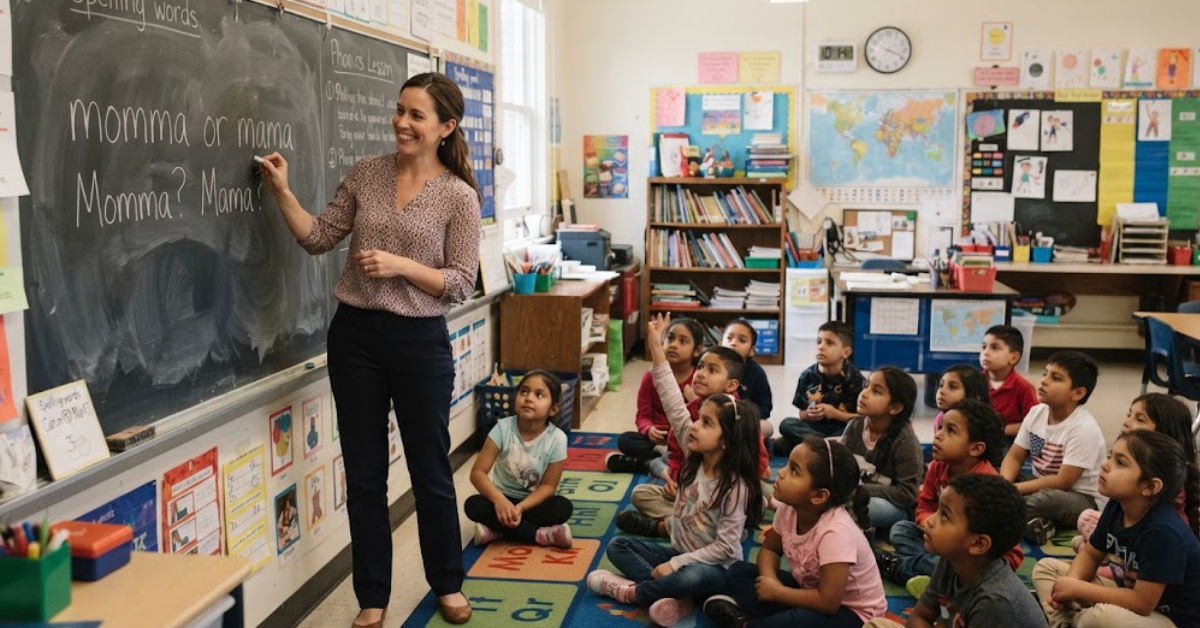
A single word can carry a surprising amount of emotion. Whether someone says “Mama, can you help me?” or writes “Momma” in a heartfelt message, both forms can feel warm, familiar, and deeply personal.
But when you’re unsure about momma or mama, which spelling should you use? The short answer is that both “mama” and “momma” are recognized English words, but they have different usage patterns. Mama is the more widely used and generally more standard form, while momma is an informal variant that is especially associated with American English and can have a more folksy, affectionate, or personal feel.
So, if you’re asking “how do you spell mama?”, the simplest answer is mama. However, momma isn’t automatically wrong. The right choice often depends on dialect, family preference, tone, and context.
Let’s take a closer look at mama vs momma, including pronunciation, examples, regional differences, and when each spelling makes sense.
Momma or Mama: What’s the Difference?
At first glance, mama and momma look almost identical. Both are informal terms used for one’s mother, but their spelling and usage have developed somewhat differently.
| Word | Meaning | Typical Usage | Tone |
| Mama | Mother; mom | Common across many varieties of English | Familiar, affectionate |
| Momma | Mother; mom | Especially associated with American English | Informal, affectionate, folksy |
The important thing is that neither spelling changes the basic meaning. Both can refer to a person’s mother.
For example:
I love you, Mama.
I love you, Momma.
Both sentences can be perfectly natural.
The difference is primarily one of spelling, dialect, style, and personal preference, rather than meaning.
How Do You Spell Mama?
If you’re wondering “how do you spell mama?”, the most straightforward spelling is:
M-A-M-A
Mama is a widely recognized informal word for mother.
It’s also a particularly old and widespread form of address. Similar words occur across many languages and cultures, often using simple syllables such as ma, mama, or related forms.
If you’re writing for a broad English-speaking audience and simply want the familiar word for mother, mama is generally the safest choice.
Is Momma Also Correct?
Yes.
Momma is an established informal spelling, particularly associated with American English. It often appears in personal writing, family speech, song titles, literature, and dialogue.
For example:
Come here, Momma!
Momma always made the best pancakes.
The extra m doesn’t create a new meaning. It simply represents a different conventional spelling.
Mama vs Momma: Which One Should You Use?
There isn’t one universal answer for every situation.
If you’re writing something neutral or intended for a wide audience, mama is usually the simplest option.
If you’re writing in a distinctly American, conversational, regional, or affectionate voice, momma may feel more natural.
Consider the difference in tone:
Thank you, Mama, for everything you’ve done.
This can sound warm and affectionate without being strongly regional.
Compare:
Thanks, Momma, for always being there.
This can feel more personal, informal, or folksy depending on the speaker.
Neither is inherently more loving or more correct. Context matters.
What Does “Mama” Mean?
Mama is an informal term for mother.
It can be used in several ways.
As a Child’s Name for Their Mother
Mama, I’m hungry.
This is a common affectionate form of address.
As an Adult’s Term for Their Mother
Adults may continue using mama throughout their lives.
I’m calling Mama tonight.
The word doesn’t have to be limited to children.
As an Affectionate Name
Sometimes mama is used as an affectionate or familiar form of address within a family or community.
Its exact tone depends heavily on the people using it.
In Family and Cultural Contexts
Mama can also be used in different cultures and communities as a familiar word for mother or an older female family figure. Its pronunciation and spelling may vary depending on the language and dialect involved.
What Does “Momma” Mean?
Momma generally means the same thing as mama: one’s mother.
The spelling with two m’s can create a slightly different impression, however.
It is often associated with:
- American English
- Informal speech
- Family dialogue
- Affectionate writing
- Southern or rural-flavored language
- Personal storytelling
- Songs and literature
That doesn’t mean everyone who writes momma speaks with a particular accent or comes from a particular region. It simply means the spelling can carry a more distinctly informal or American flavor.
Mama vs Momma in American English
In American English, both mama and momma are familiar.
However, momma has a particular spelling pattern that reflects the pronunciation and informal nature of the word for many speakers.
You’ll see it in expressions such as:
Mama’s cooking is the best.
Momma’s cooking is the best.
Both are understandable and grammatical as informal family language.
The choice can come down to how the speaker wants the word to sound on the page.
Mama is simpler and broadly familiar.
Momma can emphasize a particular voice or affectionate style.
Mama vs Momma in British English
British English commonly uses mum or mummy rather than mama or momma in everyday speech.
That doesn’t mean mama is unknown in Britain. It can still appear in particular families, cultural contexts, literature, historical writing, or when referring to speech from another variety of English.
Likewise, momma may be understood but can sound more distinctly American.
So regional vocabulary matters.
| Variety/Context | Common Mother Terms |
| American English | Mom, mama, momma, mother |
| British English | Mum, mummy, mother |
| Informal international usage | Mama and related forms |
| Family-specific speech | Varies considerably |
These are broad tendencies rather than strict rules. Individual families often have their own preferred names.
Mama vs Mommy vs Mom
Another useful distinction is between mama, mommy, and mom.
All three can refer to a mother, but they can carry different tones.
Mama
Mama, can I have some water?
Warm and familiar.
Mommy
Mommy, look at this!
Often associated with younger children’s speech, although adults may also use it in particular contexts.
Mom
Mom, I’ll be home at six.
Very common in American English and generally more neutral or everyday.
The choice depends on age, family habits, regional dialect, and personal preference.
Mama vs Momma Pronunciation
In many varieties of English, mama and momma are pronounced very similarly, and in some contexts they may sound essentially the same.
A common pronunciation of mama is approximately:
MAH-muh
A common pronunciation of momma is approximately:
MAHM-uh
However, pronunciation varies significantly between dialects and speakers.
That’s one reason the words can be confusing when you’re trying to determine their spelling from speech alone.
If you’ve only heard the word spoken, you can’t always tell whether the speaker would write mama or momma.
Is Mama a Formal Word?
Mama is generally an informal word for mother.
It isn’t usually the word you’d choose in formal documents.
For example, in a legal document, academic paper, or formal biography, mother would generally be more appropriate:
Her mother attended the ceremony.
rather than:
Her mama attended the ceremony.
However, mama can be completely appropriate in personal writing, dialogue, storytelling, children’s literature, social media, or an affectionate message.
The important distinction is formality, not correctness.
Is Momma a Formal Word?
Momma is even more clearly informal.
It’s generally used to convey familiar speech, affection, or a particular voice.
For example, it would fit naturally in dialogue:
“Momma, wait for me!”
But in a formal report, you would probably write:
Her mother accompanied her.
Using informal vocabulary in formal writing isn’t necessarily grammatically wrong, but it can be stylistically inappropriate.
How to Choose Between Mama and Momma
If you’re stuck between mama or momma, ask yourself these questions:
- Am I writing formal or informal English?
- Formal → mother is usually better.
- Informal → mama or momma can work.
- What variety of English am I using?
- American English commonly uses both.
- British English more commonly uses mum or mummy.
- Is this a family-specific name?
- If your family spells it Momma, there’s no need to change it simply because another spelling is more common.
- Am I trying to create a particular voice?
- Momma may give dialogue or storytelling a more informal or regional flavor.
- Do I want the most broadly recognizable spelling?
- Mama is a straightforward choice.
Common Examples of Mama
Here are some natural ways to use mama:
I called Mama after work.
Mama, can you help me?
She missed her mama while she was away.
My mama taught me how to cook.
The little boy ran toward his mama.
The capitalization depends on how the word is being used.
When it functions as a name or direct form of address, capitalization is common:
I love you, Mama.
When it’s being used as an ordinary noun, lowercase may be appropriate:
She missed her mama.
Common Examples of Momma
The same general meaning applies to momma:
Momma, look at this!
He called his momma every Sunday.
My momma always told me to be patient.
She wanted to make her momma proud.
The child reached for his momma.
Again, capitalization depends on how the word functions in the sentence.
Mama or Momma in Writing
Both spellings can be useful in creative writing.
Use Mama for a Broad, Familiar Feel
“Mama, are we almost there?”
This is simple and widely recognizable.
Use Momma for a More Distinctive Voice
“Momma said we’d be home before dark.”
The spelling can help convey a particular conversational or regional flavor.
Writers sometimes choose momma intentionally because they want dialogue to feel personal or culturally specific.
However, spelling alone should not be used as a substitute for accurately representing a dialect. If you’re writing a character from a particular region or community, the broader vocabulary, grammar, and context should support the character’s voice.
Mama as a Term of Affection
The word mama isn’t always used strictly as a biological label.
People can use it as an affectionate name within families and communities, and related forms can appear in cultural, religious, literary, or historical contexts.
Its meaning can therefore depend on the relationship between the people involved.
For example:
She always called her grandmother Mama.
In that family, Mama is simply the chosen name for a particular relative.
That’s why there isn’t always one “correct” family term.
Why Do Mama and Momma Both Exist?
English spelling has never been completely uniform, especially for informal family words.
Terms such as mama, momma, mommy, mum, mummy, ma, and mom have developed through different dialects, historical influences, and family speech patterns.
Informal words are particularly likely to develop spelling variations because they are often learned through speech before writing.
A child hears a word, learns its sound, and may later encounter several possible spellings.
That helps explain why forms such as mama and momma can coexist.
Mama vs Momma: Common Mistakes
Mistake 1: Assuming One Is Always Wrong
It’s not accurate to say that momma is simply a spelling mistake.
It is an established informal variant.
Mistake 2: Using the Wrong Tone
While mama and momma are both valid informal forms, neither is necessarily appropriate in every context.
A formal document will usually call for mother.
Mistake 3: Changing a Family’s Preferred Spelling
If someone’s family has always written Momma, correcting it to Mama isn’t necessary.
Personal names and family terms often follow individual preferences.
Mistake 4: Assuming Pronunciation Determines Spelling
Because the words can sound alike or nearly alike, pronunciation alone doesn’t tell you which spelling a particular person prefers.
Mama vs Momma: Quick Comparison
| Feature | Mama | Momma |
| Meaning | Mother | Mother |
| Part of speech | Informal noun/form of address | Informal noun/form of address |
| Standard spelling | Yes | Yes, as an informal variant |
| Common in American English | Yes | Yes |
| Common in British English | Less common | Less common |
| Tone | Warm, familiar | Warm, informal, sometimes folksy |
| Formal writing | Usually avoid | Usually avoid |
| Family-specific use | Common | Common |
Is Mama the Same as Mother?
In many everyday contexts, yes.
Mama is an informal or affectionate term for mother.
The difference is mainly one of register and tone.
Compare:
My mother works at a hospital.
with:
My mama works at a hospital.
The basic relationship is the same, but mama sounds more personal and informal.
Is Momma the Same as Mama?
Generally, yes.
Momma is an informal variant of mama, especially familiar in American English.
The two words generally refer to the same person or relationship.
The choice often depends on:
- Family preference
- Regional usage
- Personal style
- Character voice
- Cultural background
- Desired emotional tone
Frequently Asked Questions About Mama or Momma
How do you spell mama?
The most common spelling is mama: M-A-M-A. Momma is also an established informal variant, particularly in American English.
Is it mama or momma?
Both are valid informal forms, but mama is the simpler and more broadly familiar spelling. Momma is an informal variant often associated with American English and personal or folksy speech.
What is the difference between mama and momma?
The basic meaning is the same: mother. The main difference is spelling and usage. Mama is broadly used, while momma can carry a more distinctly American, informal, affectionate, or folksy tone.
Is “momma” grammatically correct?
Yes. Momma is an established informal word. It isn’t generally considered the standard formal term for mother, but it is perfectly appropriate in informal contexts where that style fits.
Is mama a proper noun?
It depends on how it is used.
When Mama is being used as a name or direct form of address, it is commonly capitalized:
I love you, Mama.
When it is used as a general noun, lowercase is often appropriate:
She missed her mama.
Is “Mama” capitalized?
Usually, Mama is capitalized when it functions like a name or is used directly to address someone.
Mama, can you help me?
But it may be lowercase when preceded by a possessive or used as a common noun:
My mama lives nearby.
Style conventions can vary depending on the publication or writing system.
Is momma an American word?
Momma is especially associated with American English, although it can be understood elsewhere. It is an informal variant of mama and may appear in American family speech, literature, music, and dialogue.
Which is more common, mama or momma?
Mama is generally the more broadly established spelling across English varieties. Momma is also familiar, particularly in American English, but its use is more strongly associated with informal speech and particular personal or regional styles.
Can adults say mama?
Absolutely. Adults can use mama to refer to or address their mother. The word isn’t restricted to children.
Is mama a childish word?
Not necessarily. Mama can be used by children, but adults use it too. Whether it sounds childish, affectionate, traditional, or simply familiar depends on the speaker and the surrounding context.
Is “momma” more affectionate than “mama”?
Not inherently. Both can express affection. Momma may feel more personal or folksy to some speakers, but emotional meaning largely comes from the relationship and context rather than the extra m.
Should I use mama or momma in a formal essay?
If you’re simply referring to someone’s mother, mother is usually the better choice in formal academic writing. Mama or momma would generally be appropriate only when you’re discussing the term itself, quoting someone, or intentionally preserving informal language.
Conclusion: Mama or Momma?
When deciding between momma or mama, remember that both are established informal terms for mother. The main difference isn’t meaning but spelling, dialect, tone, and personal preference.
Mama is the straightforward, widely recognized choice and is usually the best answer if you’re simply asking “how do you spell mama?” The spelling is M-A-M-A.
Momma is also a legitimate informal variant, particularly associated with American English. It can give writing a more personal, conversational, or folksy feel.
The easiest way to remember the distinction is:
- Mama = common informal word for mother
- Momma = informal variant, especially familiar in American English
- Mother = more formal term
- Mom = very common everyday American English term
- Mum = common everyday British English term
So, if you’re choosing between mama vs momma, neither needs to be treated as universally “wrong.” Think about your audience, your tone, and the spelling the person or family actually prefers. For general modern English, mama is the simplest choice; for personal or distinctly American informal writing, momma can work just as naturally.