
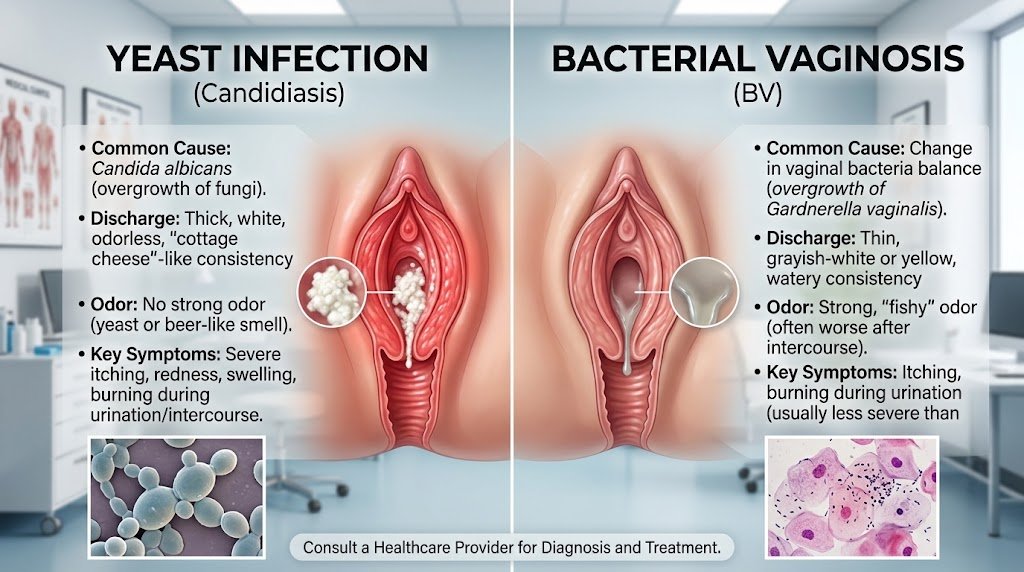
Vaginal itching, unusual discharge, or a change in odor can be uncomfortable and confusing. Two common causes are a yeast infection and bacterial vaginosis (BV). Because their symptoms can overlap, it is easy to assume they are the same thing.
Understanding the difference between yeast infection and BV starts with knowing what causes each condition. A yeast infection involves an overgrowth of Candida, a type of fungus. BV happens when the normal balance of bacteria in the vagina changes. The treatments are different, so identifying the likely cause matters.
Difference Between Yeast Infection and BV at a Glance
Although both conditions can cause vaginal discharge and irritation, there are some useful clues that can help tell them apart.
| Symptom | Yeast Infection | Bacterial Vaginosis (BV) |
|---|---|---|
| Main cause | Overgrowth of Candida yeast | Imbalance of vaginal bacteria |
| Discharge | Usually thick, white and clumpy | Usually thin and white, gray or sometimes greenish |
| Odor | Usually little or no odor | Often strong and fishy |
| Itching | Very common | Less common |
| Redness/swelling | Common | Less typical |
| Burning | May occur, especially when urinating or during sex | May occur |
| Vaginal pH | Usually below 4.5 | Typically higher than normal |
| Treatment | Antifungal medicine | Antibiotics |
These are general patterns rather than a way to diagnose yourself. Several vaginal conditions can produce similar symptoms, and testing may be needed to determine the actual cause.
What Is a Yeast Infection?
A vaginal yeast infection, also called vaginal candidiasis, occurs when Candida yeast grows excessively. Small amounts of Candida can normally be present in the vagina without causing problems. When the vaginal environment changes, however, the yeast can multiply and lead to symptoms.
Common symptoms include:
- Intense vaginal or vulvar itching
- Burning or soreness
- Redness and swelling
- Pain during sex
- Burning or discomfort when urinating
- Thick, white discharge that may resemble cottage cheese
- Little or no vaginal odor
Not everyone experiences every symptom. Some people may have irritation without a major change in discharge.
What Can Cause a Yeast Infection?
Several factors can make a yeast infection more likely. Antibiotic use is one common example because antibiotics can reduce some of the bacteria that normally help keep yeast growth under control.
Other possible risk factors include:
- Pregnancy
- Changes in hormone levels
- Diabetes, particularly when it is not well controlled
- A weakened immune system
- Certain medications or hormonal treatments
Importantly, having a yeast infection does not mean someone has poor hygiene. It is a common medical condition and can happen even when a person takes excellent care of their body.
What Is Bacterial Vaginosis?
Bacterial vaginosis occurs when the normal bacterial balance in the vagina changes. It is different from a yeast infection because BV involves bacteria rather than an overgrowth of Candida yeast.
BV is also not considered a traditional sexually transmitted infection. However, sexual activity can be associated with BV, and sexual partners may influence the vaginal bacterial environment.
Some people with BV have no symptoms. When symptoms do occur, the most noticeable sign is often a change in vaginal discharge accompanied by a strong odor.
Typical symptoms may include:
- Thin white or gray discharge
- Increased vaginal discharge
- A strong fish-like odor
- Odor that becomes more noticeable after sex
- Mild itching or irritation
- Burning when urinating in some cases
The CDC notes that many people with BV do not have symptoms, which is one reason it can sometimes go unnoticed.
Yeast Infection vs. BV: How Does the Discharge Differ?
Discharge is one of the clues people often notice first.
With a yeast infection, discharge is commonly thick, white and clumpy. It may have a cottage-cheese-like appearance and generally has little or no strong smell.
With BV, discharge tends to be thinner. It may appear white, gray or sometimes greenish, and a noticeable fishy odor is a common feature.
However, discharge alone cannot reliably confirm the cause. Other conditions, including sexually transmitted infections, can also change vaginal discharge.
Is It BV or a Yeast Infection if You Have Itching?
Itching is more strongly associated with yeast infections.
A yeast infection commonly causes significant itching around the vagina and vulva. Redness, swelling and burning may occur at the same time.
BV can cause irritation or itching, but itching is not usually its main symptom. A strong odor and thin discharge are more characteristic clues.
That said, symptoms can overlap. The CDC specifically notes that individual symptoms are not enough to definitively diagnose vaginal candidiasis.
How Are Yeast Infections and BV Diagnosed?
It can be tempting to diagnose the problem based only on discharge or itching. Unfortunately, that approach can sometimes lead to the wrong treatment.
A healthcare professional may consider:
- Your symptoms and medical history
- The appearance and characteristics of vaginal discharge
- A physical or pelvic examination
- The vaginal pH
- A sample of vaginal fluid
- Laboratory testing when necessary
For suspected yeast infections, testing can identify Candida. BV can also be evaluated through examination and testing of vaginal fluid.
This is particularly important if symptoms are new, severe, recurring, or different from what you have experienced before.
How Are Yeast Infections Treated?
Yeast infections are treated with antifungal medicines. Depending on the situation, treatment may involve medication applied inside or around the vagina or an oral antifungal medicine.
For uncomplicated vaginal candidiasis, CDC guidance states that short-course topical antifungal treatments can be effective. The appropriate medication depends on the individual situation.
Over-the-counter products can be useful for people who have previously been diagnosed with a yeast infection and recognize the same symptoms. However, self-treatment can be a problem when the underlying condition is actually BV or another vaginal disorder. ACOG recommends medical evaluation when symptoms are new or do not resolve with treatment.
How Is BV Treated?
BV is generally treated with antibiotics, not antifungal medication.
Common prescription options include medicines such as metronidazole or clindamycin. Treatment may be given orally or as a vaginal medication, depending on the prescribed regimen.
This difference is important. Using a yeast infection treatment when you actually have BV will not treat the bacterial imbalance.
Can You Have BV and a Yeast Infection at the Same Time?
Yes. It is possible for someone to have more than one vaginal condition at the same time.
This can make symptoms particularly confusing. For example, someone could experience irritation associated with a yeast infection while also having discharge or odor associated with BV.
If symptoms do not improve after treatment, or if they keep returning, it is worth getting evaluated rather than repeatedly trying different over-the-counter products.
Are Yeast Infections and BV STIs?
Neither a typical vaginal yeast infection nor BV is classified as a traditional sexually transmitted infection.
However, sexual activity can be associated with both conditions. BV, in particular, is associated with changes in the vaginal bacterial environment and may be linked to sexual activity and new or multiple partners.
Other conditions can cause similar symptoms and are sexually transmitted. Trichomoniasis, chlamydia and gonorrhea are examples. If there is a possibility of an STI, testing is important rather than assuming the symptoms are BV or a yeast infection.
How Can You Reduce the Risk of Vaginal Infections?
There is no guaranteed way to prevent every yeast infection or case of BV. Still, some habits can support normal vaginal health.
Helpful steps include:
- Avoid vaginal douching.
- Avoid scented vaginal sprays and deodorants.
- Use condoms correctly when having sex.
- Follow prescribed treatments as directed.
- Avoid repeatedly treating yourself without knowing the cause.
- Seek medical advice when symptoms are unusual or persistent.
Douching can interfere with the natural vaginal environment and is not recommended for maintaining vaginal health.
When Should You See a Doctor?
Consider speaking with a healthcare professional if you have vaginal symptoms for the first time or if you are unsure what is causing them.
You should also seek medical care if:
- Symptoms are severe.
- You have pelvic pain or fever.
- You have a new or unusual vaginal odor.
- Your discharge has changed significantly.
- Symptoms continue after treatment.
- Symptoms repeatedly come back.
- You have a new sexual partner and are concerned about an STI.
- You are pregnant and have symptoms.
Fever, chills or pelvic pain can point to conditions that need prompt medical assessment rather than simple self-treatment.
FAQs About the Difference Between Yeast Infection and BV
Is BV or a yeast infection more likely to cause itching?
A yeast infection is generally more likely to cause noticeable itching, particularly around the vulva. BV can cause irritation or itching, but its more characteristic symptom is thin discharge with a strong fishy odor.
Does BV smell like a yeast infection?
Usually, no. BV commonly causes a strong fish-like odor, particularly after sex. Yeast infections generally produce little or no strong odor.
Can a yeast infection cause a fishy smell?
A strong fishy odor is more commonly associated with BV than a yeast infection. If you have a noticeable unusual odor, it is better to get evaluated rather than assuming it is Candida.
Can BV go away on its own?
BV symptoms can sometimes change or disappear, but symptomatic BV should be evaluated and treated by a healthcare professional. Antibiotics are the standard treatment for symptomatic BV.
Can I treat BV with yeast infection medicine?
No. Yeast infection medicines are antifungal treatments, while BV is treated with antibiotics. If you have BV, an antifungal medicine will not address the bacterial imbalance.
Can I have a yeast infection without discharge?
Yes. A yeast infection does not always cause a major change in discharge. Itching, soreness, redness, swelling or burning can occur without the classic thick white discharge.
How can I tell whether I have BV or a yeast infection?
Symptoms can provide clues, but they cannot always provide a definite answer. Thick white discharge and intense itching are more typical of a yeast infection, while thin discharge and a fishy odor are more typical of BV. Testing may be needed for an accurate diagnosis.
Final Thoughts
Knowing the difference between yeast infection and BV can make confusing vaginal symptoms easier to understand. A yeast infection is caused by an overgrowth of Candida and commonly produces itching, burning and thick white discharge. BV results from an imbalance of vaginal bacteria and is more often associated with thin discharge and a fishy odor.
The important thing is not to rely on symptoms alone when the diagnosis is uncertain. BV, yeast infections and some STIs can look similar, but they require different treatments. If symptoms are new, persistent, severe or recurring, getting the right diagnosis is the safest next step.