
A criminal charge can have consequences that last far beyond a court date. But not every offense is treated the same way. One of the first things people often want to understand is what is the difference between a felony and a misdemeanor.
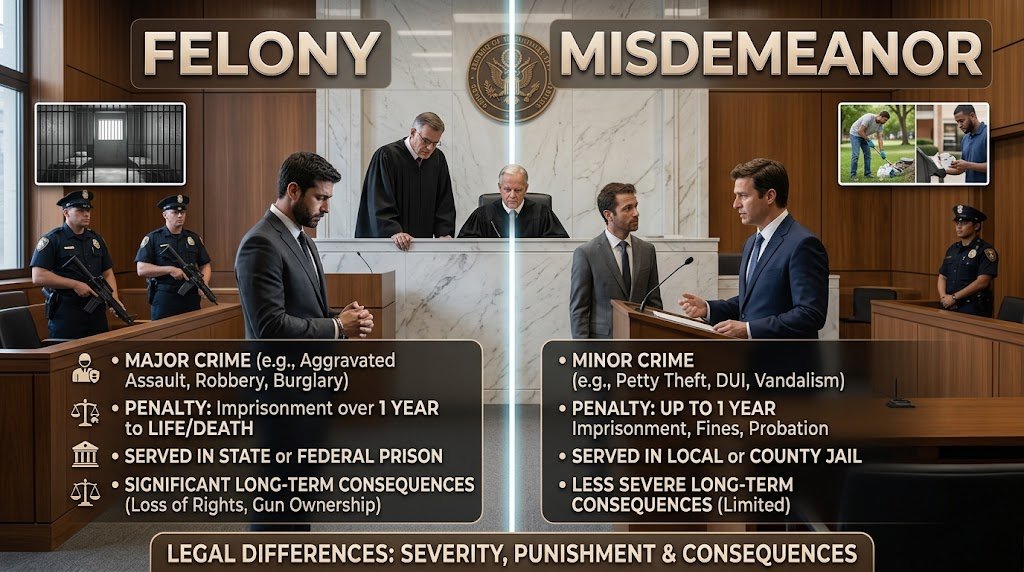
In simple terms, a felony is generally a more serious criminal offense, while a misdemeanor is usually considered less serious. The classification can affect possible jail time, fines, probation, employment opportunities, voting rights, firearm rights, immigration status, and other areas of life.
The exact rules, however, depend on the jurisdiction and the specific offense. Here’s a closer look at how the two categories differ.
What Is a Felony?
A felony is generally a serious criminal offense that can carry a substantial prison sentence. In the United States, felony offenses are typically punishable by more than one year of imprisonment, although the precise definition and classification rules vary between states and under federal law.
Examples can include:
- Murder
- Rape and certain other serious sexual offenses
- Kidnapping
- Robbery
- Serious drug trafficking offenses
- Certain types of aggravated assault
- Some large-scale theft or fraud offenses
Not every felony results in a prison sentence. Courts consider factors such as the circumstances of the offense, the defendant’s criminal history, sentencing laws, and whether there are aggravating or mitigating factors.
What Is a Misdemeanor?
A misdemeanor is generally a less serious criminal offense than a felony. Depending on the jurisdiction, a misdemeanor may be punishable by up to one year in a local or county jail, along with fines, probation, community service, or other penalties.
Common examples may include:
- Simple assault
- Disorderly conduct
- Certain types of theft
- Trespassing
- Some forms of vandalism
- Certain driving offenses
Again, classification varies. An offense that is a misdemeanor in one state could be a felony in another, depending on the law and circumstances.
Felony vs. Misdemeanor: The Main Differences
The easiest way to understand the distinction is to compare the seriousness of the offense and the potential consequences.
| Factor | Felony | Misdemeanor |
| General seriousness | More serious | Less serious |
| Potential incarceration | Often more than one year | Generally up to one year |
| Typical facility | State or federal prison may apply | Usually local or county jail |
| Fines | Can be substantial | Generally lower, depending on the offense |
| Long-term consequences | Often significant | Can still be serious |
| Criminal record | Can create major barriers | Can also affect employment and housing |
| Classification | Depends on applicable law | Depends on applicable law |
These are broad distinctions rather than universal rules. Criminal law differs considerably among jurisdictions.
How Sentencing Can Differ
One of the biggest differences between felony and misdemeanor offenses is the potential sentence.
A felony conviction can result in a lengthy prison sentence, particularly for violent or repeat offenses. Some felony convictions can also carry probation, fines, restitution, or other court-ordered requirements.
Misdemeanor penalties are usually lighter, but that does not mean they are harmless. A person convicted of a misdemeanor could still face jail, fines, probation, community service, restitution, or restrictions imposed by the court.
The actual sentence depends on the offense and the law where the case is prosecuted.
Can a Misdemeanor Become a Felony?
Yes, in some circumstances.
Certain offenses can be charged differently depending on factors such as:
- The amount of property involved.
- Whether a weapon was used.
- Whether someone was injured.
- The defendant’s previous convictions.
- The victim’s age or status.
- Whether the offense occurred under specific aggravating circumstances.
For example, theft may be treated as a misdemeanor when the property value is relatively low but become a felony when the value exceeds a statutory threshold.
Similarly, an offense that is normally a misdemeanor can sometimes carry felony-level consequences when a person has qualifying prior convictions.
Does a Felony or Misdemeanor Stay on Your Record?
A conviction can become part of a person’s criminal record, but the rules governing criminal records vary by jurisdiction.
A criminal record can potentially affect:
- Employment applications
- Professional licensing
- Housing applications
- Educational opportunities
- Immigration matters
- Certain civil rights
- Background checks
The consequences aren’t necessarily identical for every person. Some records may qualify for expungement, sealing, set-aside procedures, pardons, or other forms of relief, depending on local law.
It’s important not to assume that a misdemeanor automatically disappears after a certain period or that every felony can never be removed.
Do Felonies Have More Serious Long-Term Consequences?
Generally, yes.
A felony conviction can create significant legal and practical consequences. Certain rights and opportunities may be affected under federal or state law.
For example, some felony convictions can affect firearm possession, professional licensing, immigration proceedings, and eligibility for certain jobs or government programs.
Misdemeanor convictions can also create problems. Employers, landlords, licensing authorities, and other organizations may consider criminal history when making decisions, subject to applicable laws.
The impact therefore depends not only on whether an offense is a felony or misdemeanor but also on the specific conviction and the laws that apply.
What About Juvenile Offenses?
Juvenile cases are often handled differently from adult criminal cases.
A young person’s case may be processed through a juvenile court system rather than an adult criminal court. The terminology, sentencing options, record rules, and procedures can differ significantly.
In some serious cases, however, a juvenile may potentially be transferred or prosecuted in adult court. The rules depend heavily on the jurisdiction, the person’s age, and the nature of the alleged offense.
Why the Classification Matters
Understanding the classification of an offense is important because it can give you a general idea of the potential legal consequences.
However, the label alone does not tell the whole story. Two misdemeanor offenses can have very different penalties, just as two felonies can have very different sentencing ranges.
Other factors may include:
- Whether there was a conviction or only an arrest
- The exact statute involved
- Previous criminal history
- The circumstances surrounding the offense
- Plea agreements
- Sentencing guidelines
- Whether aggravating or mitigating factors exist
That’s why someone facing criminal charges should look at the specific law involved rather than relying solely on the felony or misdemeanor label.
Frequently Asked Questions
Is a felony worse than a misdemeanor?
Generally, yes. A felony is considered more serious and usually carries more severe potential penalties than a misdemeanor. However, the exact consequences depend on the offense and jurisdiction.
Can you go to jail for a misdemeanor?
Yes. Misdemeanors can result in jail time, depending on the offense and applicable law. Other possible penalties include fines, probation, community service, and restitution.
Can you go to prison for a felony?
Yes. Felony offenses can carry prison sentences, often exceeding one year. The actual sentence depends on the applicable sentencing law and the circumstances of the case.
Does a misdemeanor affect your background check?
It can. A misdemeanor conviction may appear on certain criminal background checks. Whether it appears and how long it remains accessible depends on the jurisdiction, type of record, and applicable reporting laws.
Can a felony be reduced to a misdemeanor?
Sometimes. Certain charges or convictions may be eligible for reduction or reclassification under specific state laws or through a plea agreement. Eligibility depends on the offense and jurisdiction.
Is every serious crime a felony?
Not necessarily. Criminal classifications are determined by law. An offense that seems serious may be classified as a misdemeanor in one jurisdiction and a felony in another.
Final Thoughts
So, what is the difference between a felony and a misdemeanor? The basic distinction is that felonies are generally more serious offenses with potentially harsher penalties, while misdemeanors are generally less serious and carry lighter maximum penalties.
Still, the classification can have consequences that extend well beyond the sentence imposed by a court. Criminal records can affect employment, housing, licensing, and other parts of everyday life.
If you’re dealing with an actual criminal charge, don’t rely on general definitions alone. Check the specific law in the relevant jurisdiction and consider speaking with a qualified criminal defense attorney who can explain how the rules apply to your situation.