
A person’s identity can include many layers—where their family comes from, the culture they grew up in, the language they speak, and how they identify themselves. That’s why questions about what is the difference between race and ethnicity can be surprisingly difficult to answer.
The two terms are often used together, and sometimes people even use them interchangeably. But they don’t mean exactly the same thing.
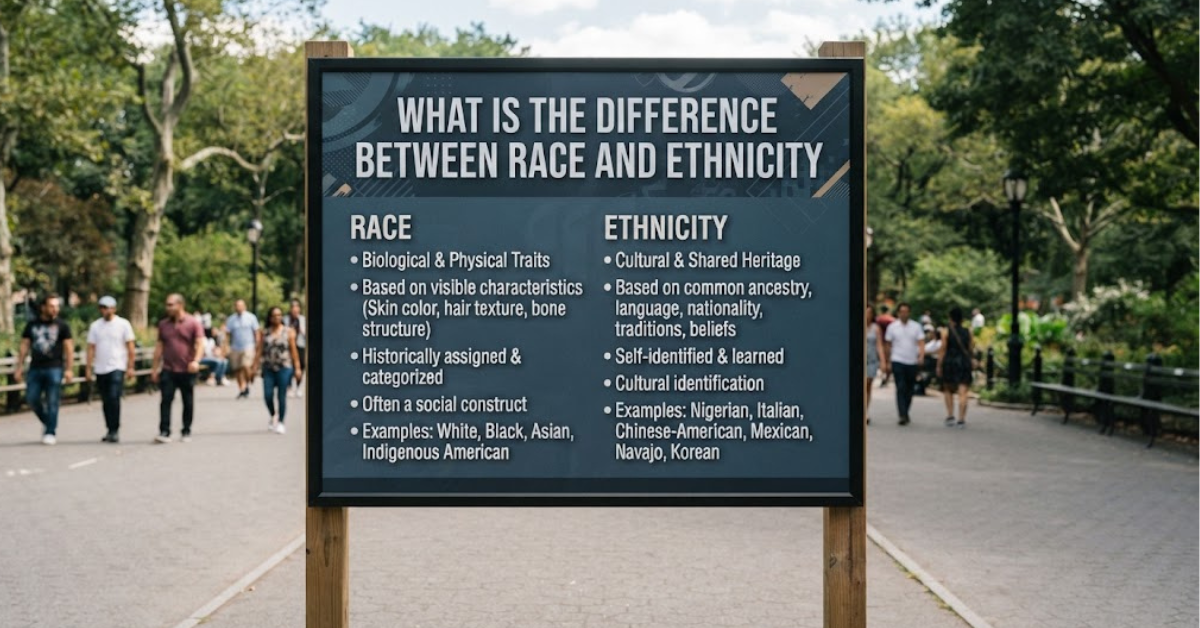
In simple terms, race generally refers to socially created categories associated historically with perceived physical or ancestral characteristics, while ethnicity is more closely connected to shared culture, heritage, history, language, or national or regional background. Both concepts are shaped by society and can vary depending on time and place.
Let’s break down the difference, look at real-world examples of ethnicity, and explain how race, ethnicity, ancestry, nationality, and culture fit together.
What Is Race?
Race is a way societies have historically categorized people based on perceived characteristics such as skin color, physical features, and ideas about ancestry.
Modern researchers generally do not treat race as a set of biologically distinct human groups. The National Academies describes race as a sociopolitical construct—a classification system created and shaped by societies and institutions rather than a precise biological division of humanity.
That doesn’t mean race is unimportant.
Quite the opposite. Racial categories have had—and continue to have—real social consequences. They have been used historically to determine who received certain rights, opportunities, privileges, or disadvantages. Race is therefore socially constructed, but the effects of racism and racial classification can be very real.
Examples of Race
The exact racial categories used depend on the country and the purpose of the classification.
For example, U.S. federal data collection has historically included categories such as:
- Asian
- Black or African American
- White
- American Indian or Alaska Native
- Native Hawaiian or Other Pacific Islander
People can also identify with more than one racial category. The U.S. Census emphasizes that these categories are based on social definitions and self-identification rather than an attempt to classify people according to biological or genetic races.
This is an important distinction because racial categories aren’t universal. A category used in one country may not have exactly the same meaning somewhere else.
What Is Ethnicity?
Ethnicity generally has more to do with shared culture, heritage, history, language, traditions, or national and regional background.
The National Academies defines ethnicity as a socially and politically constructed concept describing people who share national or regional backgrounds and common cultural, historical, and social experiences.
Think of ethnicity as the part of identity that often answers questions such as:
- What cultural traditions does your family share?
- What language or languages are associated with your heritage?
- What historical community do you identify with?
- What region or country does your family’s cultural background come from?
- Which traditions, customs, or beliefs are important to your community?
Ethnicity can therefore be closely connected to culture and heritage.
And unlike a person’s nationality, ethnicity doesn’t necessarily tell you what passport they hold or where they currently live.
What Is the Difference Between Race and Ethnicity?
The easiest way to remember the distinction is to think about social classification versus shared cultural heritage.
| Race | Ethnicity |
|---|---|
| Generally refers to socially created racial categories | Generally refers to shared cultural or historical identity |
| Has historically been associated with perceived physical characteristics and ancestry | Often involves language, traditions, heritage, history, or regional background |
| Categories vary between societies | Categories and identities also vary between societies |
| Can include multiple racial identities | A person may identify with multiple ethnic backgrounds |
| Is not a precise biological classification | Is not simply a biological classification either |
But this table should not be interpreted as an absolute rule.
Race and ethnicity overlap. A person’s racial identity may be connected to their ancestry and cultural experiences, while an ethnic identity may also involve geographic or ancestral origins.
The National Academies specifically notes that race, ethnicity, and ancestry are closely intertwined but represent different concepts.
Race and Ethnicity Examples
Let’s make the distinction more practical.
Imagine someone identifies as Black and Nigerian American.
“Black” may describe their racial identity in a particular social context.
“Nigerian” can describe their national or ethnic background, depending on how the individual uses the term.
“Nigerian American” can describe an identity that combines Nigerian heritage with an American national or cultural identity.
Now imagine someone identifies as Asian and Pakistani.
“Asian” is a broad racial category used in U.S. demographic systems.
“Pakistani” describes a specific national origin and can also be part of a person’s ethnic or cultural identity.
The important point is that these labels answer different questions.
A broad racial category doesn’t necessarily tell you someone’s specific culture, language, or family history.
Likewise, knowing someone’s ethnicity doesn’t automatically tell you which racial category they use to describe themselves.
Examples of Ethnicity
There are countless ethnic identities around the world, and the meaning of an ethnic label can depend on context.
Some examples include:
- Punjabi
- Pashtun
- Bengali
- Kurdish
- Tamil
- Han Chinese
- Japanese
- Yoruba
- Igbo
- Somali
- Armenian
- Basque
- Māori
- Navajo
- Irish
- Scottish
These examples aren’t all equivalent. Some refer primarily to cultural or linguistic communities, while others can overlap with national, Indigenous, regional, or historical identities.
That’s actually part of the point: ethnicity isn’t a single standardized global checklist.
An ethnic identity can involve several elements at once, including language, traditions, shared history, religion, geographic origin, community ties, and ancestry.
Race vs Ethnicity vs Ancestry
One of the biggest sources of confusion is the word ancestry.
Ancestry refers to a person’s family origins, descent, lineage, or “roots.” Genetic ancestry can also refer specifically to the geographic and familial origins reflected in a person’s DNA.
These concepts are related, but they aren’t interchangeable.
For example, a person might have:
- Race: A racial identity they use in their society
- Ethnicity: A cultural identity connected to their heritage
- Ancestry: Family origins from several different regions
- Nationality: Citizenship or national identity
- Culture: The traditions, practices, values, language, and social experiences they participate in
A person’s identity can contain all of these layers simultaneously.
Why Ancestry Is Different
Suppose someone’s DNA test suggests that they have ancestry connected to several parts of the world.
That information doesn’t automatically tell them what their race or ethnicity “is.”
Genetic ancestry is about inherited biological lineage. Ethnicity can involve culture, community, history, language, and identity. Race is a social classification that changes across societies and historical periods.
In other words, DNA can provide information about ancestry, but it cannot simply assign someone a universal racial or ethnic identity.
Race and Ethnicity vs Nationality
Nationality is another term that frequently gets mixed into the conversation.
Nationality generally refers to a person’s legal or national affiliation with a country.
Ethnicity is different.
For example, someone can be an American citizen while identifying with an Irish, Mexican, Nigerian, Korean, or Pakistani ethnic heritage.
Likewise, two people can have the same nationality while having completely different ethnic backgrounds.
That’s why asking, “What is your nationality?” isn’t necessarily the same as asking, “What is your ethnicity?”
A Simple Example
Consider someone who was born in Canada to parents whose families came from India.
They could potentially have:
- Canadian nationality
- Indian ancestry
- An Indian ethnic or cultural identity
- A particular regional identity such as Punjabi, Tamil, Bengali, or another community
- A racial identity that depends on the classification system and their own identification
None of these descriptions automatically cancels out the others.
Is Race Biological?
This is one of the most important questions when discussing race.
Modern scientific understanding does not support the idea that humans can be divided into a small number of biologically distinct races with clear genetic boundaries.
Human genetic variation is continuous and overlapping. The National Academies notes that racial and ethnic categories are social categories and that genetic variation does not divide neatly according to commonly used racial classifications.
That doesn’t mean humans have no genetic differences.
People and populations can have genetic variations associated with geographic ancestry. Certain genetic variants may also be more common in particular populations because of historical migration, isolation, natural selection, or other factors.
But those genetic patterns don’t create the rigid racial boundaries people have historically imagined.
This is one reason scientists distinguish genetic ancestry from race.
Why Do Race and Ethnicity Matter?
If race and ethnicity are social constructs, you might wonder why researchers, governments, schools, and healthcare organizations collect information about them.
The answer is that social categories can have measurable consequences.
For example, race and ethnicity data can help researchers examine disparities in:
- Healthcare access
- Employment
- Education
- Housing
- Environmental exposure
- Income
- Public health
- Experiences of discrimination
The U.S. Census explains that race data can be important for civil rights, policy decisions, and assessing disparities.
The key is understanding what the data actually represent.
Race should not automatically be treated as a biological explanation for a difference between populations. Social conditions, environmental exposure, access to healthcare, discrimination, socioeconomic circumstances, and specific genetic variants can all contribute to observed differences.
Why Race and Ethnicity Can Be Confusing on Forms
You’ve probably encountered forms asking something like:
“Are you Hispanic or Latino?”
followed by:
“What is your race?”
This can seem strange if you think race and ethnicity mean the same thing.
In U.S. federal data collection, Hispanic or Latino has historically been treated as an ethnicity, while categories such as Asian, Black or African American, White, American Indian or Alaska Native, and Native Hawaiian or Other Pacific Islander have been used as racial categories. People identifying as Hispanic, Latino, or Spanish may be of any race.
The categories themselves are administrative and statistical tools. They aren’t intended to provide a universal scientific definition of human identity.
It’s also worth remembering that official categories change. The Office of Management and Budget updated federal race and ethnicity standards in 2024, illustrating how these classification systems evolve over time.
Can Someone Have More Than One Race or Ethnicity?
Yes.
People can have multiple racial identities, multiple ethnic backgrounds, or a combination of cultural identities.
Someone might identify with:
- More than one race
- Multiple ethnic communities
- A national identity and an ethnic identity
- A regional culture within a larger ethnic group
- Different identities depending on context
The U.S. Census, for example, allows people to select more than one racial category.
Mixed heritage is another reason simplistic definitions can fall short. A person may have parents or grandparents from several different cultural and ancestral backgrounds.
There isn’t necessarily one label that captures their entire identity.
Does Ethnicity Mean Culture?
Culture is an important part of ethnicity, but the two words aren’t identical.
Culture is the broader collection of learned behaviors, traditions, values, practices, language, customs, beliefs, arts, food, and social norms shared by a community.
Ethnicity can describe someone’s connection to a group that shares some of those cultural, historical, national, or regional characteristics.
A person can also participate in a culture without necessarily identifying ethnically with the group associated with it.
That’s why identity is often more complicated than checking a single box on a form.
How Race and Ethnicity Change Over Time
Another important point is that racial and ethnic categories aren’t frozen forever.
The way societies classify people can change because of:
- Immigration
- Political changes
- Migration
- Intermarriage
- Changing social attitudes
- Government policies
- New understandings of identity
- Changes in how demographic data are collected
Historical examples show that groups once considered separate racial categories in the United States have sometimes been classified differently over time. The National Academies has documented how racial classifications have changed in response to social and political circumstances.
Ethnic identities can change as well.
People may adopt new identities, reconnect with ancestral cultures, combine traditions, or identify differently from their parents and grandparents.
Common Mistakes About Race and Ethnicity
A few misconceptions come up again and again.
Mistake 1: Race and ethnicity mean exactly the same thing
They overlap, but they are not interchangeable.
Race is generally a social classification associated historically with perceived physical characteristics and ancestry, while ethnicity more often emphasizes shared cultural, historical, national, or regional experiences.
Mistake 2: Ethnicity is the same as nationality
Not necessarily.
Nationality is generally connected to a country or citizenship. Ethnicity can describe cultural or ancestral community.
Mistake 3: Race tells you someone’s DNA
It doesn’t.
A racial category is not a precise genetic profile. Genetic ancestry is a different concept.
Mistake 4: Everyone in one racial group has the same culture
Definitely not.
A broad racial category can include people from many countries, languages, religions, and cultural traditions.
Mistake 5: One person can have only one identity
People can have multiple racial, ethnic, cultural, national, and ancestral identities.
Frequently Asked Questions
What is the difference between race and ethnicity?
Race generally refers to socially created categories historically associated with perceived physical characteristics and ancestry. Ethnicity generally describes shared cultural, historical, national, regional, or heritage-based identity.
What is race and ethnicity in simple terms?
A simple way to think about it is that race is a broader social classification, while ethnicity often describes cultural or heritage-based identity. Neither term is a perfect description of biology or genetics.
What are some examples of ethnicity?
Examples can include Punjabi, Pashtun, Bengali, Kurdish, Yoruba, Igbo, Armenian, Basque, Japanese, and Māori, among many others. The meaning and boundaries of ethnic identities vary by culture and context.
Is ethnicity based on where you were born?
Not necessarily.
Where you were born can influence nationality and cultural experiences, but ethnicity can involve family heritage, language, traditions, community, and historical background.
Is race the same as ancestry?
No.
Ancestry refers to family descent or origins. Race is a social classification that has historically been associated with perceived physical characteristics and ancestry. Genetic ancestry is specifically concerned with inherited biological lineage.
Can you be two ethnicities?
Yes.
Someone can identify with multiple ethnic communities or have a mixed ethnic background. How a person describes that identity is often influenced by family, culture, community, and personal experience.
Can you be two races?
Yes.
People can identify with more than one race. For example, the U.S. Census permits respondents to select multiple racial categories.
Is Hispanic a race or an ethnicity?
In U.S. federal data collection, Hispanic or Latino has historically been treated as an ethnicity rather than a racial category. People who identify as Hispanic, Latino, or Spanish may be of any race.
Is nationality the same as ethnicity?
No.
Nationality generally refers to a person’s national or citizenship affiliation, while ethnicity usually relates more closely to shared cultural, historical, regional, or heritage-based identity.
Does race determine genetics?
No.
Race does not provide a precise genetic description of an individual. Genetic ancestry can reveal information about inherited lineage, but human genetic variation does not divide neatly into conventional racial categories.
Final Takeaway: Race and Ethnicity Are Related but Different
So, what is the difference between race and ethnicity?
The simplest answer is that race generally describes socially constructed racial categories, while ethnicity more often describes shared cultural, historical, national, regional, or heritage-based identity.
But real people’s identities are rarely that simple.
A person can have multiple racial identities, several ethnic backgrounds, a particular nationality, and ancestry from different parts of the world—all at the same time. Race, ethnicity, ancestry, nationality, and culture describe different aspects of identity, and none of them tells the whole story by itself.
Most importantly, race and ethnicity shouldn’t be treated as precise biological categories. They are shaped by history, society, politics, culture, and personal identification, and their meanings can change across countries and over time.
If you’re researching identity, demographics, genealogy, or cultural heritage, the best next step is to look at race, ethnicity, ancestry, and nationality separately rather than assuming they’re interchangeable.