If you hear someone say they have diabetes, it is easy to assume that all diabetes is basically the same. It isn’t. What is the difference between type 1 and type 2 diabetes? The answer comes down to how the body makes and uses insulin, why blood sugar rises, how the condition develops, and how it is treated.
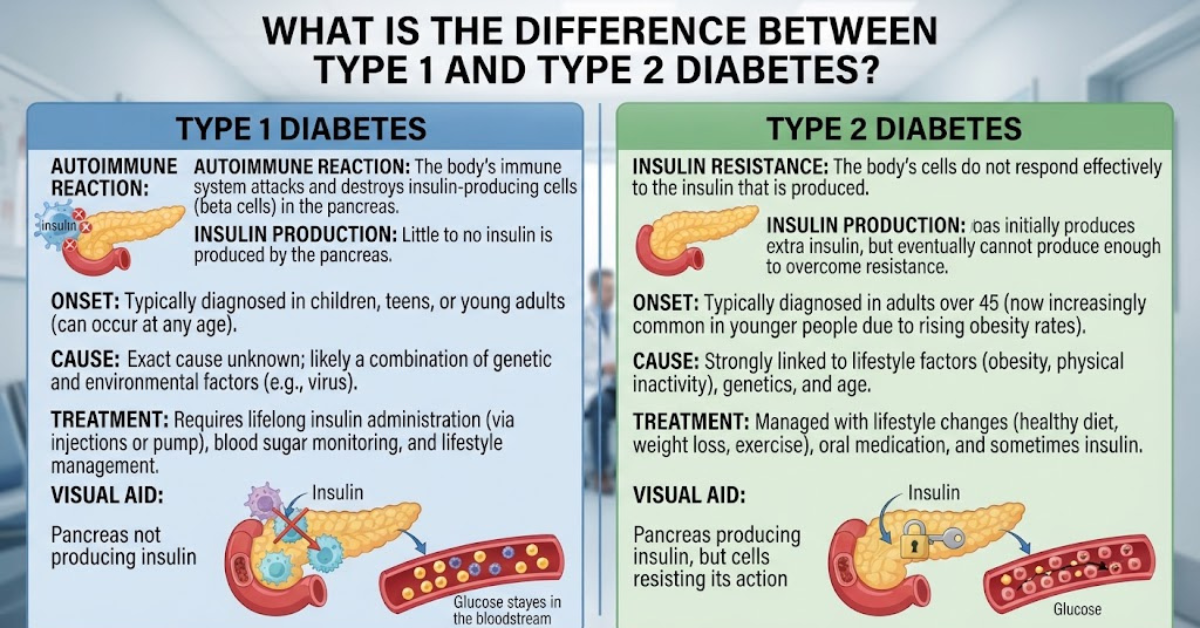
Both type 1 and type 2 diabetes cause high blood glucose, but they are different diseases. Type 1 is an autoimmune condition in which the immune system destroys the pancreatic cells that produce insulin. Type 2 usually develops when the body becomes resistant to insulin and, over time, the pancreas cannot make enough insulin to keep blood glucose in a healthy range.
Understanding that distinction matters because the right treatment depends on the type of diabetes a person has.
What Is Diabetes?
Before comparing type 1 and type 2 diabetes, it helps to understand what they have in common.
Your body normally breaks down much of the food you eat into glucose, which enters the bloodstream. Insulin, a hormone produced by the pancreas, helps glucose move from the blood into cells, where it can be used for energy.
Diabetes develops when this system does not work properly and blood glucose becomes too high. Persistently high blood sugar can damage blood vessels, nerves, kidneys, eyes, and other parts of the body over time.
The two most common forms are type 1 and type 2 diabetes. Gestational diabetes is another major category that develops during pregnancy.
What Is the Difference Between Type 1 and Type 2 Diabetes?
The simplest way to understand the difference is this:
- Type 1 diabetes: The immune system mistakenly attacks insulin-producing beta cells in the pancreas. The body eventually makes little or no insulin.
- Type 2 diabetes: The body becomes resistant to insulin and does not use it effectively. Eventually, the pancreas may also fail to produce enough insulin.
- Insulin treatment: People with type 1 diabetes need insulin every day to survive. People with type 2 diabetes may or may not eventually need insulin.
- Cause: Type 1 is primarily autoimmune, while type 2 results from a combination of genetics, insulin resistance, and other risk factors.
- Age: Type 1 often appears in children and young adults but can occur at any age. Type 2 is more common in adults but can also affect children and teenagers.
- Prevention: Type 1 diabetes currently cannot generally be prevented. Some cases of type 2 diabetes can be delayed or prevented through changes in lifestyle and other risk-factor management.
That last point is important: type 2 diabetes is not simply the result of eating too much sugar, and type 1 diabetes is not caused by eating an unhealthy diet.
Type 1 Diabetes Explained
Type 1 diabetes is an autoimmune disease.
In people with type 1 diabetes, the immune system mistakenly attacks and destroys beta cells in the pancreas. These cells are responsible for producing insulin. As the number of functioning beta cells falls, the body loses its ability to produce enough insulin.
Without enough insulin, glucose cannot move effectively from the bloodstream into cells. Blood sugar rises while the body’s cells are unable to use glucose normally for energy.
Most people with type 1 diabetes therefore need insulin every day. Insulin can be delivered through injections, insulin pens, or an insulin pump, and some people use automated insulin-delivery systems.
What Causes Type 1 Diabetes?
Scientists do not have one simple explanation for why someone develops type 1 diabetes.
Genetic factors can increase the risk, and environmental factors may also play a role. However, having a genetic risk does not mean someone will definitely develop the disease.
One important point is that diet and lifestyle habits do not cause type 1 diabetes.
When Does Type 1 Diabetes Develop?
Type 1 diabetes is often diagnosed in children, teenagers, and young adults, but it can develop at any age.
Symptoms can sometimes appear surprisingly quickly, developing over days or weeks. This is one reason type 1 diabetes may be diagnosed only after noticeable symptoms appear.
Type 2 Diabetes Explained
Type 2 diabetes works differently.
Instead of the immune system destroying insulin-producing cells, the body’s cells become less responsive to insulin. This is called insulin resistance.
The pancreas initially tries to compensate by producing more insulin. Eventually, however, it may not be able to produce enough insulin to overcome the body’s resistance. Blood glucose then rises.
Type 2 diabetes is the most common form of diabetes.
Although it is more common in middle-aged and older adults, it can occur at any age, including during childhood and adolescence.
What Causes Type 2 Diabetes?
Type 2 diabetes usually results from several factors rather than one single cause.
Risk factors can include:
- Family history of type 2 diabetes
- Overweight or obesity
- Physical inactivity
- Increasing age
- A larger waist size
- Previous gestational diabetes
- Certain genetic and health factors
Not everyone with type 2 diabetes has the same risk factors. Genetics can play a major role, which is why it is misleading to describe type 2 diabetes simply as a “lifestyle disease.”
Type 1 Diabetes vs Type 2: A Side-by-Side Comparison
Here’s a quick way to compare the two.
| Feature | Type 1 Diabetes | Type 2 Diabetes |
|---|---|---|
| Main problem | Little or no insulin production | Insulin resistance plus declining insulin production |
| Immune system involved? | Yes | Not the primary cause |
| Insulin needed? | Yes, every day | Sometimes |
| Typical onset | Often childhood or young adulthood, but any age | Usually adulthood, but any age |
| Can lifestyle cause it? | No | Lifestyle can influence risk, along with genetics and other factors |
| Can it be prevented? | Currently no established general prevention | Can often be delayed or prevented in high-risk people |
| Symptoms | Can develop quickly | Often develop gradually |
| DKA risk | Higher | Possible, but less common |
| Most common type | No | Yes |
The table shows why treating the two conditions as interchangeable can create confusion.
What Are the Symptoms of Type 1 and Type 2 Diabetes?
There is considerable overlap between the symptoms of type 1 and type 2 diabetes.
Common symptoms can include:
- Frequent urination
- Increased thirst
- Increased hunger
- Fatigue
- Blurred vision
- Unexplained weight loss
- Frequent infections
- Slow-healing wounds
However, how quickly symptoms appear can be different. Type 1 diabetes may produce noticeable symptoms over a relatively short period, while type 2 diabetes can develop gradually and may cause few or no obvious symptoms for years.
Type 1 Diabetes Symptoms
People developing type 1 diabetes may experience:
- Extreme thirst
- Frequent urination
- Increased hunger
- Unexplained weight loss
- Fatigue
- Blurred vision
- Nausea or vomiting in severe cases
A serious complication called diabetic ketoacidosis (DKA) can occur when there is not enough insulin. DKA can cause symptoms such as vomiting, abdominal pain, dehydration, unusual breathing, and fruity-smelling breath. It requires immediate medical treatment.
Type 2 Diabetes Symptoms
Type 2 diabetes may cause many of the same symptoms, but they can be much less obvious.
Some people discover they have type 2 diabetes during a routine blood test rather than because they noticed symptoms.
Other signs can include slow-healing cuts, recurrent infections, and numbness or tingling in the hands or feet.
What Type of Diabetes Are You Born With?
This is a surprisingly common question: what type of diabetes are you born with?
The answer is usually neither type 1 nor type 2.
Type 1 and type 2 diabetes generally develop rather than being present at birth. Type 1 can develop during childhood, but being born with a genetic susceptibility is not the same as being born with type 1 diabetes.
The Type 2 can also develop at a young age, including in children, but it is not normally something a person is simply born with.
There are rarer forms of diabetes, including certain types of monogenic diabetes, that are caused by changes in a single gene and can appear much earlier in life.
So if someone asks, “Which type of diabetes are you born with?” the safest answer is: neither type 1 nor type 2 is normally present at birth.
How Are Type 1 and Type 2 Diabetes Diagnosed?
Doctors use blood tests to determine whether a person has diabetes.
Depending on the situation, testing may include measurements of blood glucose and A1C, along with other tests when needed.
The diagnosis of diabetes itself does not always immediately tell doctors whether someone has type 1 or type 2. In some cases, particularly when the presentation is unusual, additional testing may help determine the type.
Doctors may consider factors such as:
- Age when symptoms started
- How quickly symptoms developed
- Body weight and other risk factors
- Family history
- Whether insulin production appears limited
- Whether autoimmune markers are present
This distinction matters because treatment can be very different.
How Are Type 1 and Type 2 Diabetes Treated?
Type 1 Diabetes Treatment
For people with type 1 diabetes, insulin is essential.
Treatment generally involves matching insulin doses with food, physical activity, and other factors while regularly monitoring blood glucose.
People may use:
- Insulin injections
- Insulin pens
- Insulin pumps
- Continuous glucose monitors
- Automated insulin-delivery systems
The specific approach varies from person to person and should be developed with a healthcare team.
Type 2 Diabetes Treatment
Type 2 diabetes has a wider range of treatment options.
Depending on the individual, treatment may include:
- Healthier eating patterns
- Regular physical activity
- Weight management when appropriate
- Oral diabetes medications
- Injectable medications
- Insulin when necessary
- Management of blood pressure and cholesterol
Some people can improve their blood glucose significantly through lifestyle changes, while others need medication from the beginning or as the condition progresses.
Importantly, needing insulin does not automatically mean someone has type 1 diabetes. Some people with type 2 diabetes eventually require insulin as their insulin production decreases or during particular situations such as hospitalization or pregnancy.
Which Type of Diabetes Is Worse?
This is where the question “which type of diabetes is worse?” becomes misleading.
There isn’t a simple answer that applies to everyone.
Type 1 diabetes is immediately dependent on insulin. Without sufficient insulin, a person with type 1 diabetes can develop dangerous complications such as DKA.
Type 2 diabetes, meanwhile, can progress quietly for years. If blood glucose remains poorly controlled, it can contribute to serious complications involving the heart, blood vessels, kidneys, nerves, eyes, and feet.
So rather than asking which type is “worse,” it is more useful to ask:
How well is the person’s diabetes being managed, and what complications or risk factors are present?
Both forms deserve serious medical attention.
What Type of Diabetes Is the Worst?
If you’re searching “what type of diabetes is the worst,” there is no medically useful ranking that says one type is always worse.
Type 1 has a critical dependence on insulin and can become dangerous quickly if insulin is absent.
Type 2 can remain unnoticed for a long time and may cause significant complications when high blood glucose continues over many years.
The severity of diabetes depends on much more than the label. Blood glucose control, blood pressure, cholesterol, kidney health, cardiovascular risk, complications, access to treatment, and many individual factors all matter.
The good news is that diabetes can be managed. Modern medications, glucose-monitoring technology, insulin-delivery systems, and structured diabetes care have made it possible for many people to manage the condition effectively.
Can Someone Have Both Type 1 and Type 2 Diabetes?
A person is generally classified as having one primary type of diabetes, but the biology is not always perfectly straightforward.
For example, someone with type 1 diabetes can also develop insulin resistance. Likewise, an adult initially thought to have type 2 diabetes may later be found to have an autoimmune form of diabetes.
That is one reason doctors sometimes need additional testing when the clinical picture does not fit neatly into one category.
If a person’s diagnosis or treatment does not seem to make sense, it is worth discussing the possibility of a different diabetes type with their healthcare professional.
Can Type 1 or Type 2 Diabetes Be Prevented?
At present, there is no established general lifestyle method for preventing type 1 diabetes. Researchers continue to investigate why autoimmune destruction of pancreatic beta cells occurs and whether the disease can be delayed or prevented in people at high risk.
Type 2 diabetes is different.
For people at increased risk, healthy eating, physical activity, and maintaining a healthy weight can help delay or prevent type 2 diabetes. However, genetics and other factors also matter, so developing type 2 diabetes is not simply a personal failure or a matter of willpower.
The Biggest Misconceptions About Type 1 and Type 2 Diabetes
A few common myths are worth clearing up.
Myth 1: Type 1 diabetes is caused by eating too much sugar
It isn’t. Type 1 diabetes is an autoimmune condition in which the immune system attacks insulin-producing beta cells.
Myth 2: Everyone with type 2 diabetes caused it through poor lifestyle choices
Not true. Type 2 diabetes involves genetics, insulin resistance, age, body composition, physical activity, family history, and other factors.
Myth 3: If you take insulin, you must have type 1 diabetes
No. Some people with type 2 diabetes also need insulin.
Myth 4: Children only get type 1 diabetes
No. Children and teenagers can develop type 2 diabetes as well.
Myth 5: Diabetes always has obvious symptoms
Not necessarily. Some people, particularly those with type 2 diabetes, may have few or no noticeable symptoms for a long time.
Frequently Asked Questions
Is type 1 or type 2 diabetes more common?
Type 2 diabetes is much more common. Type 1 accounts for roughly 5% to 10% of diabetes cases, according to the CDC and NIDDK.
Which type of diabetes requires insulin?
People with type 1 diabetes need insulin every day because their bodies make little or no insulin. Some people with type 2 diabetes also need insulin, either temporarily or long term.
What type of diabetes are you born with?
Usually neither. Type 1 and type 2 diabetes generally develop after birth. Certain rare genetic forms of diabetes can appear very early in life.
Which type of diabetes is worse?
Neither type can universally be called the “worse” form. Type 1 can become dangerous quickly without insulin, while poorly controlled type 2 diabetes can cause serious long-term complications.
Can type 2 diabetes turn into type 1?
No. Type 1 and type 2 diabetes have different underlying mechanisms. However, diabetes can sometimes be difficult to classify, and a person initially diagnosed with type 2 may later be found to have another form of diabetes.
Can type 1 diabetes be cured?
There is currently no routine cure for type 1 diabetes. People with established type 1 diabetes generally require insulin to stay alive. Research continues into approaches that could preserve or replace insulin-producing cells.
Can type 2 diabetes go away?
Some people with type 2 diabetes can achieve normal blood glucose levels without diabetes medication, particularly after substantial weight loss or other effective interventions. However, this is generally described as remission rather than a permanent cure, and ongoing monitoring remains important.
Can thin people get type 2 diabetes?
Yes. Although overweight and obesity are important risk factors, body weight is only one part of the picture. Genetics, age, family history, physical activity, and other factors can influence risk.
Final Takeaway: Type 1 vs Type 2 Diabetes
So, what is the difference between type 1 and type 2 diabetes?
The biggest difference is how insulin is involved. The Type 1 diabetes is an autoimmune disease that destroys insulin-producing cells, leaving the body with little or no insulin. Type 2 diabetes usually involves insulin resistance combined with an eventual decline in insulin production.
Type 1 usually requires insulin every day. The Type 2 can often be managed with a combination of lifestyle changes, medications, and sometimes insulin.
And when it comes to which type of diabetes is the worst, there is no one-size-fits-all answer. Both can cause serious complications when poorly controlled, but both can also be managed with appropriate medical care.
If you are concerned about symptoms, risk factors, or a possible diabetes diagnosis, the most useful next step is not trying to determine your type from symptoms alone. Talk with a healthcare professional and ask about appropriate blood-glucose testing and, when necessary, additional tests to identify the type of diabetes.