
A single word can make genetics sound much more complicated than it really is: allele. You probably already know that genes influence traits, but then you encounter terms like alleles, chromosomes, DNA, and genetic variants—and suddenly the explanation gets confusing.
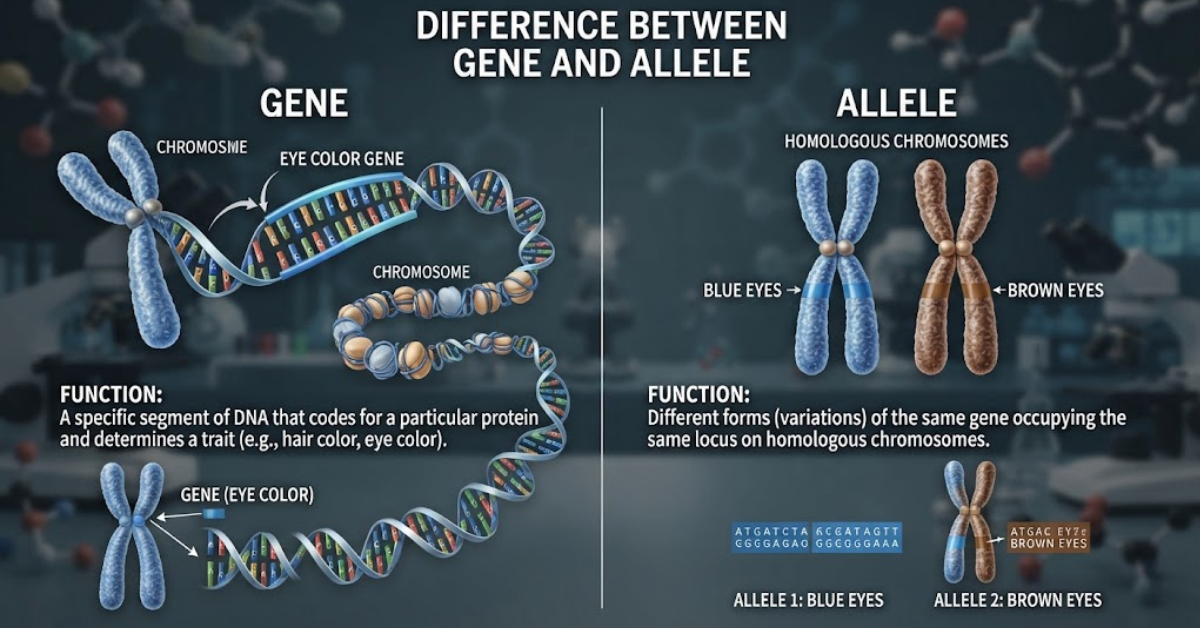
The difference between gene and allele becomes much easier to understand once you separate two ideas: a gene is a stretch of DNA associated with a biological function or trait, while an allele is a particular version of that gene.
Think of a gene as a general instruction and an allele as one possible version of that instruction. For example, a gene involved in a particular biological characteristic can exist in different forms because DNA sequences vary between individuals.
But there’s more to the story. Let’s look at what is the difference between gene and allele, how they relate to DNA and chromosomes, and why the distinction matters when studying heredity.
What Is a Gene?
A gene is a region of DNA that contains information used to produce a functional product, usually a protein or a functional RNA molecule.
Genes are part of our chromosomes, and they play important roles in virtually every biological process.
They can influence characteristics such as:
- Blood-related traits
- Eye pigmentation
- Metabolism
- Immune responses
- Development
- Cell growth
- Physical characteristics
It’s important to be precise here: genes don’t always determine a visible trait by themselves. Many characteristics are influenced by multiple genes as well as environmental factors.
A Gene Is More Than a “Trait Code”
You may have heard that a gene is simply “the code for a trait.” That’s a useful beginner’s shortcut, but it’s not completely accurate.
A gene produces a functional biological product or contributes to a biological process. A visible characteristic may result from the interaction of several genes, regulatory regions, cellular processes, and environmental influences.
So instead of thinking:
One gene = one trait
it’s often more accurate to think:
Genes provide biological instructions that contribute to traits and cellular functions.
What Is an Allele?
An allele is one of two or more alternative versions of a genetic sequence at a particular location, or locus, in the genome.
Different alleles arise because DNA sequences can differ.
For example, suppose a particular gene has a DNA sequence that occurs in several versions in a population. Those different versions are alleles of that gene.
Some differences between alleles may have little or no observable effect. Others can alter how much of a protein is produced or change the protein itself, potentially affecting a characteristic or biological function.
A Simple Analogy
Imagine a cookbook.
The gene is like a particular recipe.
An allele is a particular version of that recipe.
The basic recipe may remain recognizable, but one version could call for slightly different ingredients or quantities.
The analogy isn’t perfect, but it helps explain why a gene and an allele aren’t two unrelated things. An allele is a specific version of a gene or genetic sequence.
What Is the Difference Between Gene and Allele?
So, what is the difference between gene and allele?
The simplest explanation is:
A gene is a functional unit or region of DNA, while an allele is a specific version of a genetic sequence at a particular locus.
Here’s a quick comparison:
| Feature | Gene | Allele |
|---|---|---|
| Meaning | A region of DNA with a biological function | A particular version of a genetic sequence |
| Relationship | The broader genetic unit | A variant/version associated with a locus |
| Location | Found at a specific location on a chromosome | Occurs at the corresponding locus |
| Number | The genome contains many genes | A gene can have multiple alleles in a population |
| Role | Contributes to biological functions and traits | Can contribute to differences in those functions or traits |
| Example | Gene involved in a biological pathway | One specific sequence variant of that gene |
The important relationship is this:
Genes can have different alleles.
That’s why genetic variation exists.
Gene vs. Allele: The Key Difference in One Sentence
If you’re studying for an exam and need a quick definition, remember this:
A gene is a DNA region associated with a biological function, while an allele is a particular version of that genetic sequence.
That single sentence captures the central distinction.
How Genes and Alleles Are Related
Genes and alleles aren’t separate systems working independently.
They are closely connected.
A gene occupies a particular position, or locus, on a chromosome. Different versions of the sequence at that locus are alleles.
In a diploid organism such as a human, there are typically two copies of each autosomal gene—one inherited from each biological parent.
Those two copies may contain the same allele or different alleles.
For example:
- One chromosome may carry allele A.
- The homologous chromosome may carry allele A.
The individual is then homozygous at that locus.
Or:
- One chromosome may carry allele A.
- The other may carry allele B.
The individual is then heterozygous at that locus.
What Are Homozygous and Heterozygous?
These terms make much more sense once you understand alleles.
Homozygous
An individual is homozygous at a particular locus when the two homologous chromosomes carry the same allele.
For example:
AA
Both copies contain the same allele.
Heterozygous
An individual is heterozygous when the two homologous chromosomes carry different alleles.
For example:
Aa
The two copies contain different alleles.
These terms are especially important when learning about inheritance patterns.
Dominant and Recessive Alleles
You will often see alleles described as dominant or recessive in introductory genetics.
A dominant allele can influence the phenotype when only one copy is present in a particular genetic context.
A recessive allele generally influences the phenotype under conditions where the relevant dominant allele isn’t producing the dominant phenotype.
For a simple Mendelian trait, you might see:
- AA = dominant phenotype
- Aa = dominant phenotype
- aa = recessive phenotype
However, real human genetics is often more complicated.
Not every trait follows a simple dominant-recessive pattern. Many traits involve multiple genes, incomplete dominance, codominance, gene interactions, and environmental influences.
Gene vs. Allele Examples
Examples make the distinction much easier.
Example 1: Blood group genetics
The ABO gene is involved in determining the ABO blood group system.
Different alleles of this gene contribute to different blood group phenotypes.
The commonly discussed alleles are:
- Iᴬ
- Iᴮ
- i
Here, the gene represents the broader genetic unit, while Iᴬ, Iᴮ, and i are different alleles.
The relationship demonstrates an important concept: a single gene can have multiple alleles in a population.
Example 2: A gene with different variants
Imagine a gene involved in producing a particular protein.
One allele could contain a DNA sequence that results in the usual version of the protein.
Another allele might contain a DNA change that alters the protein’s structure.
Both are versions associated with the same genetic locus, but their sequences differ.
This is the basic concept behind allelic variation.
Genes, Alleles, DNA, and Chromosomes
These four terms are easy to mix up.
Here’s a simple way to organize them.
DNA
DNA is the molecule that stores genetic information.
Gene
A gene is a functional region of DNA.
Allele
An allele is a particular version of a genetic sequence at a locus.
Chromosome
A chromosome is a large DNA-containing structure that packages genetic material along with associated proteins.
Think of the relationship as a hierarchy:
Chromosome → DNA → Gene → Allele
That isn’t a perfect physical hierarchy in every context, but it’s a useful conceptual framework for beginners.
Where Are Genes and Alleles Located?
Genes are located along chromosomes.
For example, humans have 23 pairs of chromosomes in most body cells: 22 pairs of autosomes and one pair of sex chromosomes.
A gene has a particular position on a chromosome called its locus.
Different alleles associated with that gene occur at the corresponding locus on homologous chromosomes.
This is why alleles aren’t usually thought of as floating randomly around the cell. Their location is tied to the chromosome and locus where the genetic sequence occurs.
How Do We Inherit Alleles?
In sexually reproducing organisms, offspring typically inherit genetic material from both biological parents.
For autosomal genes in humans, an individual generally inherits:
- One chromosome copy from the mother
- One chromosome copy from the father
As a result, an individual typically has two alleles at an autosomal locus—although the broader population may contain many different alleles.
This distinction is important.
A population can have many alleles
A particular gene can have multiple alleles across a population.
An individual usually carries only a small number
For a typical autosomal locus in a diploid human, an individual has two copies and therefore generally two alleles at that locus.
Those two alleles can be identical or different.
How Do New Alleles Arise?
New alleles can arise through mutations, meaning changes in DNA sequence.
Mutations can include:
- Single-base substitutions
- Insertions
- Deletions
- Larger structural changes
Not every mutation is harmful.
Some have no noticeable effect, some can influence traits, and some can contribute to disease.
Changes in DNA can also be introduced or reshaped through processes such as recombination.
Over generations, genetic variation can accumulate in populations.
Are Alleles Always Different?
No.
Two copies of a gene can have the same allele.
For example, if both homologous chromosomes carry the same version of a sequence, the individual is homozygous at that locus.
If the two copies differ, the individual is heterozygous.
So having “two alleles” doesn’t necessarily mean having two different versions.
Can a Gene Have More Than Two Alleles?
Yes.
This is another point that frequently causes confusion.
A particular gene can have multiple alleles within a population.
The ABO blood group system is a classic example because the ABO gene has three commonly discussed alleles: Iᴬ, Iᴮ, and i.
However, an individual with two copies of the locus generally carries only two alleles at that autosomal locus.
So:
Population: potentially many alleles.
One diploid individual: typically two alleles at an autosomal locus.
Gene vs. Allele in Mendelian Genetics
Gregor Mendel’s experiments with pea plants laid the foundation for modern genetics.
Mendel didn’t have today’s molecular understanding of DNA or chromosomes, but his work established important principles of inheritance.
Modern genetics uses genes and alleles to explain those patterns at the molecular and chromosomal levels.
For a simple Mendelian trait, you might represent two alleles as:
A and a
An individual could then have:
- AA
- Aa
- aa
The exact phenotype depends on the biological relationship between those alleles and the trait being studied.
This simple notation is useful for learning genetics, but real organisms often have far more complicated inheritance patterns.
Genotype vs. Phenotype
Another pair of terms often appears alongside genes and alleles.
Genotype
A genotype refers to the genetic makeup relevant to a particular locus or trait.
For a simple example, Aa is a genotype.
Phenotype
A phenotype refers to an observable characteristic or measurable biological outcome.
The phenotype can be influenced by genotype, but it may also be affected by environmental factors and interactions among genes.
This is why knowing someone’s genotype doesn’t always let you predict every aspect of their phenotype with certainty.
Why the Difference Matters
At first glance, distinguishing a gene from an allele may seem like a vocabulary exercise.
It isn’t.
The distinction is essential for understanding:
- Heredity
- Genetic variation
- Evolution
- Population genetics
- Genetic testing
- Inherited disorders
- Breeding
- Molecular biology
- Medical genetics
When scientists describe a genetic variant, they’re often discussing a specific DNA sequence difference rather than an entirely different gene.
That distinction becomes especially important when interpreting genetic research.
Common Misconceptions About Genes and Alleles
“A gene and an allele are the same thing.”
Not quite.
An allele is a particular version of a genetic sequence associated with a locus, whereas a gene refers to the broader functional DNA region.
“Every gene has only two alleles.”
No.
A gene can have many alleles in a population.
“Every person has two alleles for every gene.”
This is generally true for many autosomal loci in diploid human cells, but there are important exceptions involving sex chromosomes, copy-number variation, and other genomic features.
“A dominant allele is always better.”
No.
“Dominant” describes an inheritance relationship or phenotype expression pattern. It does not mean stronger, healthier, more common, or superior.
“A mutation always causes disease.”
Definitely not.
Mutations can be harmful, beneficial, neutral, or have effects that depend on biological and environmental context.
A Quick Gene and Allele Comparison
If you need a fast revision guide, remember these points:
Gene
- A region of DNA associated with a biological function
- Located at a specific genomic locus
- Can influence biological traits and processes
- Can have different versions in a population
Allele
- A particular version of a genetic sequence
- Found at a specific locus
- Can differ from another allele by one or many DNA changes
- Contributes to genetic variation
The relationship can be summarized simply:
Gene = the genetic unit or region
Allele = a particular version of that sequence
Frequently Asked Questions
What is the difference between gene and allele?
A gene is a region of DNA associated with a biological function, while an allele is a particular version of a genetic sequence at a specific locus. Different alleles can produce different versions or levels of a gene product.
What’s the difference between gene and allele in simple terms?
Think of a gene as a recipe and an allele as a particular version of that recipe. The gene represents the broader genetic instruction, while the allele represents one specific sequence version.
How many alleles does a gene have?
A gene can have many alleles in a population. However, a typical diploid individual generally has two alleles at an autosomal locus—one inherited from each biological parent.
Can one gene have multiple alleles?
Yes. A gene can have multiple alleles within a population. The ABO blood group gene is a classic example with three commonly discussed alleles.
What is the difference between an allele and a gene mutation?
A mutation is a change in DNA sequence. An allele is a particular version of a sequence at a genetic locus. A mutation can create a new allele if the resulting sequence becomes a distinct version that is inherited or maintained in a population.
Are genes and alleles found on chromosomes?
Yes. Genes are regions of DNA located on chromosomes, and alleles are different sequence versions associated with the corresponding genetic locus.
What are dominant and recessive alleles?
Dominant and recessive describe how different alleles contribute to a phenotype in particular inheritance contexts. They do not mean that one allele is inherently stronger, better, or more common.
What is the difference between genotype and allele?
An allele is a particular version of a genetic sequence. A genotype describes the combination of alleles an individual has at a particular locus or set of loci.
Are alleles DNA?
Yes. Alleles are DNA sequences. They represent different versions of genetic sequences at a particular locus.
Why are alleles important?
Alleles create genetic variation within populations. Differences among alleles can influence biological traits, disease risk, responses to medicines, and many other characteristics.
Final Thoughts on the Difference Between Gene and Allele
Understanding the difference between gene and allele is one of the first steps toward making sense of genetics.
A gene is a region of DNA associated with a biological function, while an allele is a particular version of a genetic sequence at a specific locus. A gene can have many alleles across a population, while a typical diploid individual generally carries two alleles at an autosomal locus.
Once you understand that relationship, terms such as homozygous, heterozygous, genotype, phenotype, dominant, recessive, mutation, and genetic variation become much easier to understand.
So, if you’re studying genetics, don’t try to memorize isolated definitions. Start by connecting the concepts: DNA contains genes, genes occur at loci, and different alleles represent different sequence versions at those loci. That framework will make the rest of genetics much easier to follow.