Walk into a garden and look around. A grass plant, a bean plant, a lily, and a sunflower may look completely different, but there are clues hidden inside their seeds, leaves, roots, and stems that reveal how they’re related.
The difference between dicot and monocot plants is one of the fundamental concepts in plant biology. Traditionally, flowering plants were divided into two major groups based largely on the number of cotyledons—or embryonic seed leaves—found in their seeds.
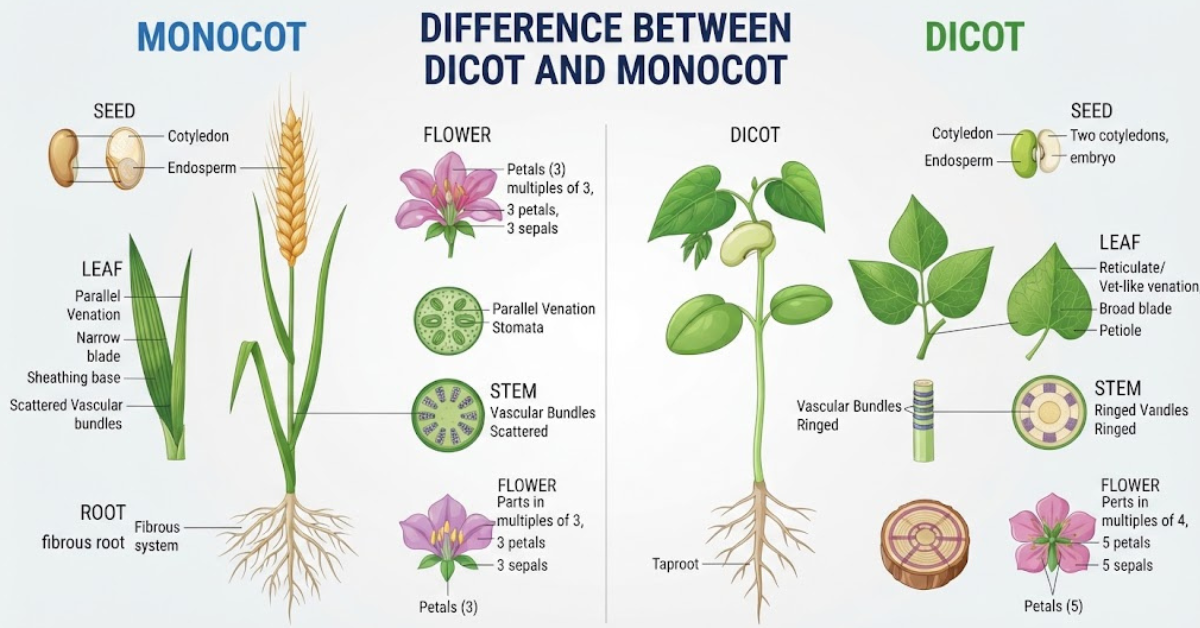
Monocots have one cotyledon, while plants traditionally classified as dicots have two. But that’s only the starting point. Their differences can also be seen in leaf veins, root systems, vascular bundles, flower structures, pollen, and secondary growth.
There’s an important modern classification detail, too: botanists now recognize that the traditional “dicot” group isn’t a single natural evolutionary group. Many plants once called dicots are more accurately described as eudicots, while some flowering plants fall outside both traditional categories.
With that in mind, let’s break down the difference between dicot and monocot plants in a way that’s easy to understand and remember.
What Are Monocot Plants?
Monocots, short for monocotyledons, are flowering plants whose embryos typically have one cotyledon.
A cotyledon is an embryonic leaf found inside a seed. It helps provide or absorb nutrients for the developing seedling during early growth.
Common monocots include:
- Grasses
- Wheat
- Rice
- Corn
- Sugarcane
- Lilies
- Orchids
- Tulips
- Onions
- Palms
Monocots are an incredibly important group of plants. Many major food crops, including rice, wheat, and corn, are monocots.
What Are Dicot Plants?
Dicots, short for dicotyledons, traditionally refer to flowering plants whose embryos have two cotyledons.
Many familiar plants fall into the traditional dicot category, including:
- Beans
- Peas
- Sunflowers
- Roses
- Tomatoes
- Apples
- Oaks
- Maples
- Cotton
- Carrots
The term “dicot” is still widely used in school biology and introductory botany, but modern plant classification is more precise.
Many traditional dicots belong to a major group called eudicots. Eudicots are characterized by several traits, including pollen grains that typically have three apertures or openings.
So while “monocot vs. dicot” remains a useful educational comparison, it shouldn’t be interpreted as a perfect modern evolutionary division of all flowering plants.
Difference Between Dicot and Monocot Plants
The easiest way to understand the distinction is to compare their major structural features.
| Feature | Monocots | Traditional Dicots |
| Cotyledons | One | Usually two |
| Leaf venation | Usually parallel | Usually branching or net-like |
| Root system | Usually fibrous or adventitious | Often a main taproot system |
| Vascular bundles in stem | Usually scattered | Usually arranged in a ring |
| Flower parts | Usually in multiples of three | Often in multiples of four or five |
| Secondary growth | Usually absent or limited | Common in many woody groups |
| Pollen | Often one main aperture | Eudicots typically have three apertures |
| Examples | Corn, wheat, lily, onion | Bean, sunflower, rose, oak |
These are useful general patterns, but biology has exceptions. Plants don’t always follow a simple checklist.
1. Cotyledons: The Biggest Difference
The word itself gives away the most basic distinction.
Monocot = one cotyledon.
Dicot = two cotyledons.
When a seed begins to germinate, cotyledons may provide nutrients to the young plant or help absorb nutrients from stored food.
For example, a bean seed has two prominent cotyledons. When the seed opens, those two fleshy structures are easy to see.
In a typical monocot seed such as corn, there is one cotyledon, called the scutellum.
This is the classic textbook difference between dicots and monocots.
2. Leaf Venation Differences
Look closely at a leaf and you may notice a pattern running through it.
Monocot leaves typically have parallel venation. The veins run roughly alongside one another from the base toward the tip.
Grass is an easy example.
Dicot leaves commonly have reticulate venation, where smaller veins branch from larger veins and form a network.
Think about a typical bean, rose, or maple leaf.
However, this characteristic isn’t absolute. Some monocots can have more complex-looking venation, and some traditional dicots don’t fit the simplest textbook pattern.
That’s why botanists consider multiple characteristics rather than relying on one visible feature.
3. Root System: Fibrous vs. Taproot
Root structure is another commonly taught distinction.
Many monocots develop a fibrous root system. Instead of one dominant primary root, the plant develops numerous roots of similar size, often originating from the stem or its base.
Grass is a familiar example.
Many traditional dicots, on the other hand, develop a taproot system. One main root grows downward, with smaller lateral roots branching from it.
Carrots and many young bean plants illustrate this pattern.
But again, this isn’t universal. Some monocots and dicots have root systems that don’t fit the basic classroom descriptions.
4. Vascular Bundles in the Stem
This difference requires a little more plant anatomy.
Plants contain vascular tissues called xylem and phloem.
- Xylem transports water and minerals.
- Phloem transports sugars and other organic nutrients.
These tissues are grouped into structures called vascular bundles.
In typical monocot stems, vascular bundles are scattered throughout the ground tissue.
In many traditional dicot stems, vascular bundles are arranged in a ring.
This difference can become particularly clear when you examine a cross-section of a stem under a microscope.
Why Does This Matter?
The arrangement is related to how the stem grows and develops.
Many dicot stems contain a vascular cambium that can contribute to secondary growth, allowing stems to increase in thickness.
Most monocots don’t undergo secondary growth in the same typical way.
5. Secondary Growth
Secondary growth refers to an increase in the thickness or diameter of a plant stem or root.
Many woody dicots have vascular cambium that produces additional vascular tissues, allowing the stem to become thicker over time.
Trees such as oaks and maples are familiar examples.
Most monocots don’t produce secondary vascular tissues through the same conventional vascular cambium system.
There are exceptions and specialized forms of thickening in some monocots, particularly certain palms and related plants, so it’s safer to think of this as a general pattern rather than an absolute rule.
6. Flower Structure
Flowers can provide another useful clue.
Monocot flowers commonly have floral parts in multiples of three.
For example, a flower may have:
- 3 petals
- 3 sepals
- 6 stamens
Lilies are a classic example.
Traditional dicots often have floral parts in multiples of four or five.
A flower might have:
- 4 petals
- 5 petals
- 10 stamens
Roses, for example, generally have floral structures based around five-part arrangements.
This is another generalization rather than a rule without exceptions.
7. Pollen Differences
Pollen provides a more technical way to distinguish major flowering plant groups.
Many monocots produce pollen grains with a single aperture or opening.
Eudicots, which make up much of what was traditionally called the dicots, characteristically have pollen with three apertures or derivatives of this basic three-aperture condition.
This feature is particularly important to botanists because it provides evidence about evolutionary relationships.
Unlike simply looking at a leaf or root, pollen structure can help scientists understand how different flowering plants are related.
Monocot vs. Dicot Seed Structure
Seeds are one of the easiest places to introduce the distinction.
Dicot seeds
A typical dicot seed contains two cotyledons.
When you split a bean seed, you can see the two large halves.
The embryo sits between them, along with structures that develop into the young shoot and root.
Monocot seeds
Monocot seeds contain one cotyledon.
Corn is a familiar example, although the structure of a grass seed can be harder to interpret because much of the seed is occupied by the endosperm.
The monocot cotyledon in grasses is called the scutellum.
Monocot and Dicot Germination
Germination can also reveal differences.
In many dicots, the two cotyledons may emerge above the soil during germination. This is called epigeal germination.
In other dicots, the cotyledons remain underground.
Monocots often have a different early growth pattern. In grasses, the emerging shoot is protected by a structure called the coleoptile.
The young root may also be protected by a structure called the coleorhiza.
These adaptations are especially familiar in grasses such as corn and wheat.
Why Are Monocots and Dicots Important?
This isn’t just a classification exercise for biology students.
Monocots and traditional dicots include many of the plants humans depend on every day.
Important monocots include:
- Rice
- Wheat
- Corn
- Barley
- Sugarcane
- Bananas
- Onions
- Garlic
- Palms
Important dicot or eudicot plants include:
- Beans
- Peas
- Soybeans
- Tomatoes
- Potatoes
- Sunflowers
- Cotton
- Apples
- Grapes
These plants provide food, fiber, oils, timber, medicines, ornamental flowers, and many other resources.
Examples of Monocot Plants
If you need to memorize examples, start with familiar plants.
Grasses
Wheat, rice, corn, oats, and barley are all monocots.
Lilies
Many plants in the lily group show classic monocot characteristics, including flower parts commonly arranged in threes.
Orchids
Orchids are monocots and represent one of the largest and most diverse flowering plant families.
Palms
Palms are also monocots, even though their tree-like appearance may seem unlike a typical grass.
Examples of Dicot Plants
Many common garden and crop plants are traditional dicots.
Beans and peas
These are classic examples used to demonstrate two cotyledons.
Sunflowers
Sunflowers have broad leaves with branching veins and flowers with structures typical of many eudicots.
Roses
Roses are another familiar eudicot example.
Oak trees
Oak trees are woody eudicots and demonstrate secondary growth very clearly.
A Simple Way to Remember the Difference
If you’re studying for an exam, don’t try to memorize a huge paragraph.
Remember this basic pattern:
Monocot:
One seed leaf → parallel veins → fibrous roots → scattered vascular bundles → flower parts often in threes.
Traditional dicot:
Two seed leaves → net-like veins → often a taproot → vascular bundles often in a ring → flower parts often in fours or fives.
This isn’t a substitute for understanding the biology, but it makes the major differences much easier to recall.
Are All Dicots Really Dicots?
Here’s where modern botany gets interesting.
The traditional category “dicot” includes flowering plants that aren’t all members of one natural evolutionary group.
Modern classification recognizes several major lineages among flowering plants.
A particularly important group is the eudicots, which includes many familiar plants traditionally called dicots.
So when textbooks say “dicot,” they’re often describing a useful collection of characteristics rather than presenting a perfectly precise evolutionary category.
This distinction matters if you’re taking an advanced botany or plant evolution course.
For introductory biology, however, the monocot-versus-dicot comparison remains a useful way to learn basic plant structure.
Why the Traditional Classification Still Helps
You might wonder why students continue learning about monocots and dicots if modern plant classification is more complicated.
The answer is that these characteristics are still useful for recognizing patterns.
Cotyledon number, vascular arrangement, leaf venation, floral structure, and pollen characteristics help students understand how plant structures differ.
They also introduce an important scientific lesson:
Biological classification evolves as scientists gather more evidence.
Modern molecular studies have helped botanists reconstruct evolutionary relationships with much greater precision than older classification systems could.
Common Misconceptions About Monocots and Dicots
“All monocots have parallel veins.”
Most do, but exceptions exist.
“Every dicot has a taproot.”
No. Root systems can vary significantly.
“Every monocot has flower parts in threes.”
It’s a common characteristic, but plant diversity means there are exceptions and modified structures.
“All dicots are woody.”
Definitely not. Many herbaceous plants, including beans and sunflowers, are traditional dicots or eudicots.
“Dicot and eudicot mean exactly the same thing.”
Not in modern botanical classification. Eudicots represent a major clade within the flowering plants, whereas traditional “dicots” included several lineages outside the eudicots.
Frequently Asked Questions
What is the main difference between dicot and monocot?
The classic difference is the number of cotyledons in the seed embryo. Monocots have one cotyledon, while traditional dicots generally have two. They also differ in typical leaf venation, root systems, vascular bundle arrangement, floral parts, and other characteristics.
What are 5 differences between monocot and dicot?
Five commonly taught differences are cotyledon number, leaf venation, root type, vascular bundle arrangement, and flower-part arrangement. Monocots generally have one cotyledon, parallel veins, fibrous roots, scattered vascular bundles, and floral parts in threes. Traditional dicots generally have two cotyledons, net-like veins, often a taproot, vascular bundles in a ring, and floral parts in fours or fives.
Is rice a monocot or dicot?
Rice is a monocot. Like other grasses, it has one cotyledon and exhibits several characteristic monocot features.
Is wheat a monocot or dicot?
Wheat is a monocot because it belongs to the grass family, Poaceae.
Is corn a monocot or dicot?
Corn, also called maize, is a monocot. It belongs to the grass family and has a single cotyledon.
Is a bean a monocot or dicot?
Beans are traditionally classified as dicots and, more specifically, are eudicots. A bean seed has two cotyledons.
Is a sunflower a monocot or dicot?
Sunflowers are eudicots, which means they belong to the major flowering-plant group traditionally associated with dicots.
Are trees monocots or dicots?
Many familiar trees, including oak and maple, are eudicots. However, some trees are monocots; palms are a well-known example. So being a tree doesn’t automatically determine whether a plant is a monocot or a traditional dicot.
Can monocots have secondary growth?
Most monocots don’t undergo secondary growth through the typical vascular cambium mechanism found in woody eudicots. However, some monocots have specialized forms of secondary thickening.
Why are monocots and dicots important?
They include many economically and ecologically important flowering plants. Major food crops, ornamental plants, timber trees, fibers, and other useful plants occur across these groups.
Final Thoughts on the Difference Between Dicot and Monocot
The difference between dicot and monocot plants starts with one simple feature: the number of cotyledons in the seed embryo. Monocots have one, while traditional dicots generally have two.
From there, the differences extend into leaf venation, root systems, vascular bundles, flower structure, pollen, and patterns of plant growth.
Just remember that these are general characteristics, not absolute rules. Modern botanical classification has moved beyond treating all traditional dicots as one natural evolutionary group, with eudicots representing a major lineage within flowering plants.
If you’re learning the topic for school or simply want to recognize plants more easily, start with the core pattern: one cotyledon for monocots, two for traditional dicots, then use the other characteristics to confirm what you’re seeing.
Once you understand those patterns, identifying and comparing flowering plants becomes much more intuitive.