
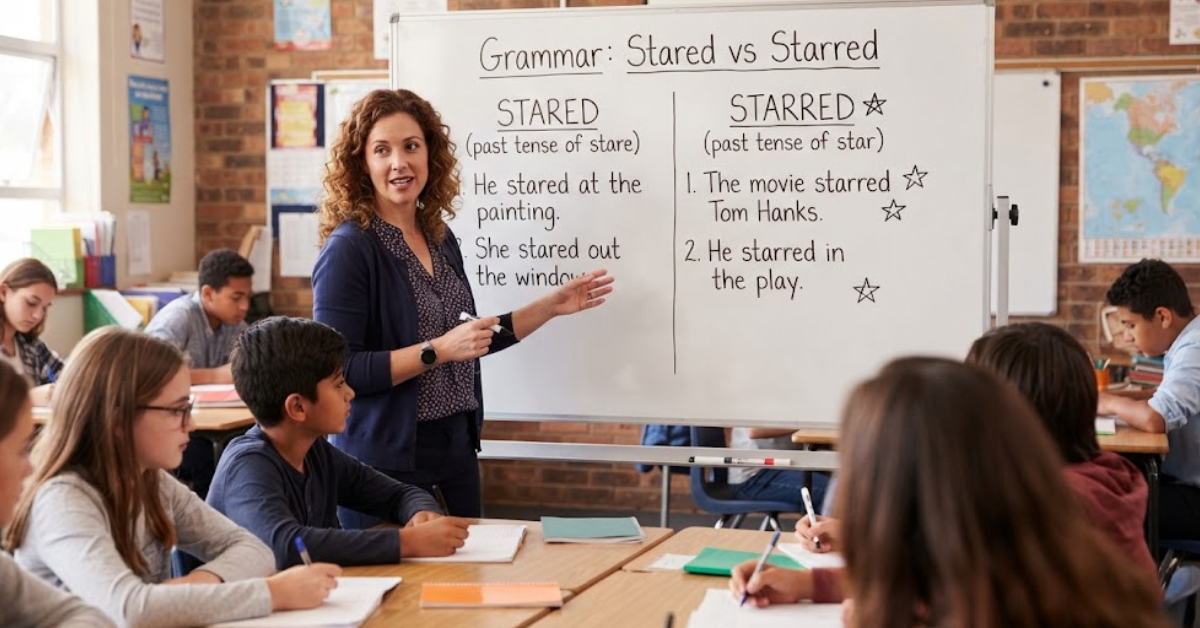
Have you ever written “stared” when you meant something related to a star—or wondered whether “starred” needs two r’s? The difference between stared vs starred is only one letter, but that extra r changes the word’s meaning completely.
Stared and starred are both correct English words. However, they come from different verbs and are used in completely different situations. Stared is the past tense of stare, meaning to look at something fixedly or for a noticeable amount of time. Starred is the past tense of star, which can mean to feature someone in a movie, show, or production, or to mark something with a star.
Once you identify the base verb, the spelling becomes much easier to understand.
Stared vs Starred: What’s the Difference?
The quickest way to tell stared vs starred apart is to look at their base words.
- Stared → comes from stare → means looked fixedly or intently.
- Starred → comes from star → means featured as a main performer or marked with a star.
| Word | Base verb | Main meaning | Example |
| stared | stare | Looked at something fixedly | She stared at the painting. |
| starred | star | Featured as a leading performer | He starred in the movie. |
So, if someone is looking, use stared.
If someone featured in a production or something was marked with a star, use starred.
What Does “Stared” Mean?
Stared is the simple past tense of stare.
To stare means to look at someone or something continuously, directly, or intently. Unlike a quick glance, staring usually involves maintaining your gaze for a noticeable period.
For example:
She stared at the strange object on the table.
This tells us that she looked at the object for some time, probably because it caught her attention or seemed unusual.
Examples of Stared in a Sentence
Here are some natural examples:
- He stared at the clock.
- She stared out the window.
- They stared at each other in silence.
- I stared at the screen, trying to understand the instructions.
- The child stared at the magician.
- She stared into the distance.
In each case, stared describes looking.
What Does “Starred” Mean?
Starred is the simple past tense and past participle of star when star is being used as a verb.
One common meaning is to appear as a leading or featured performer in a movie, television show, play, or other production.
For example:
The actor starred in a popular television series.
This means the actor had a major or leading role in the series.
Examples of Starred in a Sentence
- She starred in a Broadway production.
- The actor starred in three successful films.
- He starred alongside several well-known performers.
- The actress starred in the television drama.
- They starred in a comedy together.
In these examples, starred relates to performing or being a featured person.
Starred Can Also Mean “Marked With a Star”
There is another important meaning of starred.
Something can be starred when it has been marked with a star symbol.
For example:
I starred the most important items on the list.
This means the speaker marked those items with a star.
You might also say:
The questions I needed to answer were starred.
Here, starred means marked with an asterisk or star-like symbol.
This usage is especially common in:
- forms
- documents
- lists
- notes
- instructions
- websites
- applications
- textbooks
So starred doesn’t always have something to do with acting.
Why Is It “Stared” With One R?
The spelling of stared comes from the verb stare.
When forming the simple past tense, the final e is removed before adding -ed:
stare + ed → stared
The result is:
S-T-A-R-E-D
There is only one r.
This is similar to other verbs ending in a silent e:
- care → cared
- share → shared
- hope → hoped
- smile → smiled
- stare → stared
So if you’re talking about looking intently, remember:
stare → stared
Why Is It “Starred” With Two R’s?
Starred comes from the noun star, which can also function as a verb.
When a one-syllable verb ends in a single consonant preceded by a short vowel, that final consonant is often doubled before adding -ed.
For star, the final r is doubled:
star + ed → starred
So the correct spelling is:
S-T-A-R-R-E-D
The same general spelling pattern appears in words such as:
- plan → planned
- stop → stopped
- grab → grabbed
- rub → rubbed
This is why starred has two r’s, while stared has only one.
Stared vs Starred Spelling Rule
The spelling difference becomes much easier if you compare the base forms.
Stare → Stared
The verb stare already ends with a silent e.
Remove the e and add -ed:
stare → stared
Star → Starred
The verb star ends with a consonant, and the final r is doubled when the ending is added:
star → starred
This gives us:
stare → stared
star → starred
The extra r isn’t arbitrary. It reflects the different base words and their spelling patterns.
Stared vs Starred Examples
Let’s put the two words side by side.
Looking at Something
She stared at the painting.
She looked at the painting intently.
Appearing in a Movie
She starred in the movie.
She had a leading or prominent role.
Looking at Someone
He stared at me across the room.
He looked directly at me for a noticeable amount of time.
Appearing in a Television Show
He starred in a television series.
He was one of the featured performers.
Looking at a Screen
I stared at my computer screen.
I looked at the screen for an extended period.
Marking an Item
I starred the most important sentence.
I marked the sentence with a star.
The meanings are completely different even though the words look almost identical.
Stared vs Starred Pronunciation
The pronunciation also differs.
Stared
Stared is generally pronounced like:
STAIRD
It rhymes approximately with words such as:
- cared
- shared
- aired
Starred
Starred is generally pronounced similarly to:
STARRD
In many accents, stared and starred can sound quite similar, and in some varieties of English they may be difficult to distinguish in ordinary speech.
That’s one reason spelling the words correctly can be tricky.
When you’re writing, focus on the meaning and base verb, rather than relying only on pronunciation.
Stare vs Star: The Base Words Matter
The easiest way to understand this pair is to forget the past-tense forms for a moment.
Start with:
stare
and
star
They are entirely different words.
Stare
Stare means to look at someone or something steadily.
Don’t stare at people.
Star
As a verb, star can mean to feature as a leading performer.
She will star in the new film.
When you put both into the past tense, you get:
stare → stared
star → starred
Once you see those two base verbs, the spelling makes much more sense.
Stared in Everyday English
The word stared is common in everyday conversation and writing.
You can stare:
- at someone
- at something
- into space
- out a window
- into the distance
- at a screen
- at a photograph
- at a painting
Examples:
He stared at the floor after hearing the news.
She stared out the window during the long journey.
I stared at the question but couldn’t find the answer.
The word often suggests concentration, surprise, confusion, shock, curiosity, or simply prolonged looking.
Starred in Movies and Television
Starred is particularly common when discussing actors and entertainment.
For example:
Tom Hanks starred in the film.
The actress starred in a popular drama.
The two actors starred together in the movie.
The phrase “starred in” is especially common.
You can say:
- starred in a movie
- starred in a film
- starred in a television series
- starred in a play
- starred in a musical
- starred alongside another actor
For example:
The actor starred alongside his longtime co-star.
“Starred In” vs “Stared At”
These two phrases are particularly useful to remember.
Stared At
Stared at means looked at something or someone intently.
She stared at the photograph.
Starred In
Starred in means appeared as a leading or important performer in a production.
She starred in the movie.
A quick memory trick is:
Stared at → looking
Starred in → performing
That distinction can help you choose the right spelling immediately.
Common Mistakes With Stared and Starred
Because both words are legitimate, grammar and spell-checking software may not catch every mistake.
Mistake 1: “He Starred at Me”
If you mean he looked at you intently:
He starred at me.
He stared at me.
Mistake 2: “She Stared in the Movie”
If you mean she was a leading performer:
She stared in the movie.
She starred in the movie.
Mistake 3: “The Actor Stared in Three Films”
Again, if the actor appeared in those films:
The actor stared in three films.
The actor starred in three films.
Mistake 4: “I Starred at the Screen”
If you mean you looked at the screen:
I starred at the screen.
I stared at the screen.
These errors can be especially confusing because the incorrect word still looks like a real English word.
Stared vs Starred: Quick Memory Trick
Here’s a simple way to remember the difference:
Stared = Eyes
Think:
I stared with my eyes.
If someone is looking at something for a while, use stared.
Starred = Star
Think:
A star starred in a movie.
If someone is performing or something has been marked with a star, use starred.
You can also remember the spelling directly:
STARE → STARED
STAR → STARRED
The extra r belongs to starred because its base word is star.
Related Words and Forms
Understanding the complete word families can make the distinction even clearer.
Word Family for Stare
- stare
- stares
- stared
- staring
- starer
Examples:
She stares at the painting.
She stared at the painting.
She is staring at the painting.
Word Family for Star
- star
- stars
- starred
- starring
Examples:
He will star in the film.
He starred in the film.
He is starring in the film.
Notice another interesting spelling change:
star → starring
The r is doubled here as well.
Stared vs Starred in Passive Sentences
Both words can also appear in passive constructions.
Stared
He was stared at by everyone in the room.
This means people were looking at him.
Starred
The actor was starred in several promotional materials.
However, when discussing a leading role, English more naturally uses the active construction:
The actor starred in several films.
For acting credits, starred in is the much more common expression.
Can “Starred” Be an Adjective?
Yes.
Starred can function as an adjective when something is marked with a star or symbol.
For example:
Please read the starred items carefully.
Here, starred describes the items that have been marked.
You might see similar wording in:
- forms
- instructions
- menus
- schedules
- questionnaires
- product information
For example:
All starred fields are required.
This means the fields marked with an asterisk or star must be completed.
Stared vs Starred: Quick Comparison
| Feature | Stared | Starred |
| Base word | stare | star |
| Main meaning | Looked intently | Featured or marked with a star |
| Spelling | One r | Two r’s |
| Common phrase | stared at | starred in |
| Example | She stared at him. | She starred in the movie. |
| Related noun | stare | star |
How to Choose the Correct Word
If you’re unsure whether to write stared vs starred, use this quick process:
- Identify the meaning.
- Is someone looking?
- Is someone performing?
- Is something marked with a star?
- Find the base verb.
- Looking → stare
- Performing/featuring → star
- Form the past tense.
- stare → stared
- star → starred
- Check the preposition.
- stared at someone/something
- starred in a movie/show
This method is much more reliable than trying to decide based on how the word sounds.
Frequently Asked Questions About Stared vs Starred
Is it “stared” or “starred”?
Both are correct words, but they have different meanings. Stared means looked intently, while starred usually means featured as a performer or marked something with a star.
Is “stared” the past tense of “stare”?
Yes. The past tense of stare is stared.
She stared at the painting.
Is “starred” the past tense of “star”?
Yes. Starred is the past tense and past participle of star when it is used as a verb.
He starred in the film.
Why does starred have two Rs?
The word comes from star. When the -ed ending is added to this one-syllable verb, the final consonant is doubled:
star → starred
Why does stared have only one R?
Stared comes from stare. The final silent e is dropped before -ed is added:
stare → stared
Is “stared in a movie” correct?
No, not if you mean someone appeared as a leading performer. The correct phrase is:
She starred in the movie.
Is “starred at me” correct?
No, not if you mean someone looked at you. The correct expression is:
She stared at me.
What is the difference between “stared at” and “starred in”?
Stared at means looked at something or someone intently.
Starred in means appeared as a leading or featured performer in a production.
Are stared and starred pronounced the same?
They can sound very similar, and in some accents they may be difficult to distinguish. Their spelling and meaning, however, are different.
Can starred mean marked with a star?
Yes. For example:
The starred questions are optional.
Here, starred means marked with a star or asterisk.
Is “starring” related to “starred”?
Yes. Starring is the present participle of star.
She is starring in a new film.
What is the easiest way to remember stared vs starred?
Think about the base words:
stare → stared = looking
star → starred = performing or marking with a star
Conclusion: Stared vs Starred
The difference between stared vs starred is small in spelling but significant in meaning.
Stared comes from stare and means looked at someone or something intently. That’s why you stared at the screen, stared at the painting, or stared at someone across the room.
Starred comes from star and commonly means appeared as a featured performer. That’s why an actor starred in a movie or two performers starred together. It can also mean that something was marked with a star.
The easiest way to remember the difference is:
stare → stared
star → starred
If you’re writing about someone looking, choose stared. If you’re writing about an actor’s role or something marked with a star, choose starred.
Once you connect each word to its base verb, this commonly confused pair becomes much easier to get right.