At first glance, farther and further seem like two versions of the same word. They both relate to distance, and in everyday conversation, people sometimes use them interchangeably. But there is a useful distinction worth knowing, especially in formal or careful writing.
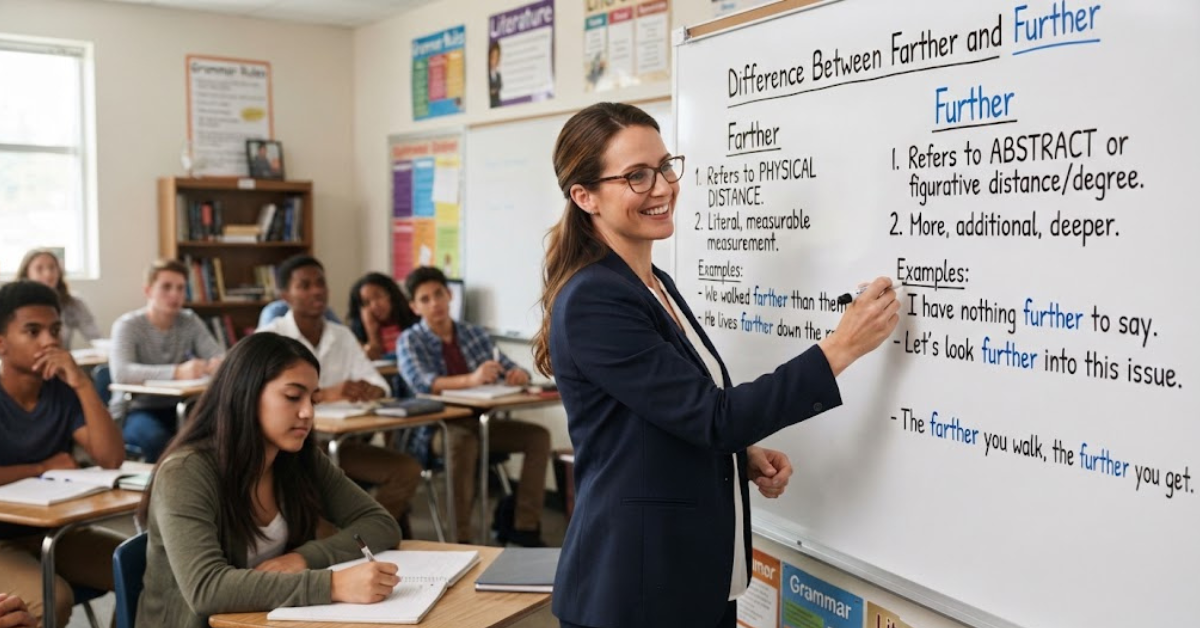
The basic difference between farther and further is that farther is traditionally used for physical distance, while further is commonly used for figurative, additional, or metaphorical distance. However, modern English is flexible, and further can also be used for physical distance.
For example:
The store is farther down the road.
But:
We need to discuss this matter further.
Understanding this distinction will help you choose the word that fits your sentence instead of relying on guesswork.
Difference Between Farther and Further
The easiest way to remember the traditional distinction is:
- Farther → physical distance
- Further → figurative distance, additional extent, or something more
Consider these examples:
| Word | Typical use | Example |
| Farther | Physical distance | The school is farther away. |
| Further | Additional or figurative distance | We need further information. |
So if you can physically measure the distance, farther is often the more precise choice.
If you’re talking about an idea, discussion, progress, information, or degree, further is generally the better option.
What Does “Farther” Mean?
Farther is traditionally used when talking about measurable physical distance.
For example:
The mountain is farther from here than I expected.
The distance between you and the mountain can be physically measured, so farther fits naturally.
Other examples include:
- She walked farther than anyone else.
- How much farther is the station?
- We drove farther than we planned.
- The house is farther down the road.
- He threw the ball farther than his brother.
In all these sentences, the word refers to physical distance.
Farther and Physical Movement
You can also use farther when describing how much someone or something moved.
For example:
The car traveled farther than expected.
The runner went farther than she had ever gone before.
We walked farther into the forest.
These examples involve actual physical movement through space.
What Does “Further” Mean?
Further has several uses, but it is especially common when referring to something additional, greater, or more advanced.
For example:
We need further information before making a decision.
Here, there isn’t a physical distance involved. Further means additional or more information.
Other examples include:
- We need further discussion.
- Please provide further details.
- The investigation requires further review.
- She wants to further her education.
- Nothing could be further from the truth.
These uses involve ideas, degrees, progress, or additional amounts rather than measurable physical distance.
Further Can Also Refer to Physical Distance
This is an important detail.
The simple rule “farther means physical distance and further means figurative distance” is useful, but it isn’t an absolute rule in modern English.
Further can also refer to physical distance.
For example:
We walked further down the road.
This sentence is widely accepted and natural.
You may also hear:
How much further do we have to go?
This is extremely common in everyday English.
So although farther is traditionally associated with physical distance, further has developed a broader range of uses and can refer to both physical and figurative distance.
Farther vs Further: A Simple Rule
If you’re writing and want a quick guideline, use this:
Use “Farther” for Measurable Physical Distance
The airport is farther away than the train station.
We drove farther than expected.
Use “Further” for Abstract or Figurative Ideas
We need to investigate this further.
Let’s discuss the issue further.
Further research is necessary.
Use “Further” for “Additional” or “More”
Please provide further information.
No further action is required.
The company issued a further statement.
This distinction is particularly helpful in formal writing.
Farther and Further as Comparative Words
Both farther and further are comparative forms related to far.
The basic comparison looks like this:
far → farther/further → farthest/furthest
For example:
The park is far away.
The next park is farther away.
The national park is the farthest away.
For figurative meaning:
We need to look further into the issue.
This requires further investigation.
The two forms overlap, but they developed different conventional uses.
Farther vs Further in American English
In American English, the traditional distinction is still taught:
- farther for physical distance
- further for figurative or additional meaning
However, further is also widely used for physical distance.
For example:
We drove further down the highway.
This isn’t generally considered a serious grammatical error.
If you want to make a very clear distinction in formal writing, however, using farther for measurable physical distance and further for abstract or additional meanings is a good strategy.
Farther vs Further in British English
British English also uses both forms, and the distinction is broadly similar.
You may encounter:
The village is farther away.
and:
We need further information.
But British English, like American English, also commonly uses further for physical distance.
This means the distinction is better understood as a traditional usage preference rather than a rigid grammatical law.
Further as an Adjective
Further can function as an adjective meaning additional or more.
Examples include:
We need further evidence.
No further explanation is necessary.
The company released further details.
Here, further doesn’t describe physical distance. It means additional or extra.
This is one of the most common uses of the word.
Further as an Adverb
Further can also function as an adverb.
For example:
Let’s discuss this further.
The research needs to go further.
We should investigate the matter further.
In these sentences, further means to a greater degree, extent, or stage.
It can also describe physical movement:
Walk further down the path.
This is one reason the word has such a broad range of uses.
Further as a Verb
There’s another use that sometimes gets overlooked.
Further can be used as a verb meaning to advance, promote, or help something develop.
For example:
The program aims to further scientific research.
She took additional courses to further her career.
The organization works to further its mission.
Here, further means to help something progress.
It has nothing to do with physical distance.
Farther vs Further in Common Expressions
Certain expressions strongly favor further.
“Further Information”
For further information, contact the office.
Not:
For farther information…
“Further Details”
Please provide further details.
“Further Discussion”
The issue requires further discussion.
“Further Research”
Further research is needed.
“Further Notice”
The service is suspended until further notice.
“Further Action”
No further action is required.
These phrases use further because the meaning is “additional” or “more.”
Common Expressions With “Farther”
Farther tends to appear naturally when actual distance is involved.
For example:
- farther away
- farther down the road
- farther north
- farther south
- farther into the forest
- farther from home
- farther across the field
Examples:
The village is farther north than we expected.
Don’t walk any farther.
The cabin is farther into the woods.
These expressions describe physical location or movement.
Farther vs Further Examples
Let’s compare the words directly.
Physical Distance
The library is farther from my house than the supermarket.
The distance can be physically measured.
Additional Information
I need further information before I decide.
“Further” means additional.
Physical Movement
We walked farther than the other group.
This describes actual distance.
Additional Investigation
The police decided to investigate the matter further.
This describes additional investigation.
Physical Location
The second village is farther down the road.
Figurative Progress
We need to take this discussion further.
The first sentence concerns physical distance; the second concerns the progress of an idea.
“Nothing Could Be Further From the Truth”
One of the most recognizable expressions using further is:
Nothing could be further from the truth.
This means that a statement or belief is completely untrue.
For example:
He claimed that I was angry with him, but nothing could be further from the truth.
Here, further describes figurative distance from the truth.
You aren’t measuring a physical distance. You’re emphasizing how far removed an idea is from reality.
“Further Notice” vs “Farther Notice”
A common phrase is:
Until further notice
This means until additional instructions or information are provided.
The phrase does not use farther.
Until farther notice
Until further notice
It’s worth memorizing this expression because it appears frequently in:
- workplace notices
- official announcements
- school communications
- public transportation
- business correspondence
“Farther Away” vs “Further Away”
Both expressions can be found in English.
For example:
The restaurant is farther away than I thought.
You can also hear:
The restaurant is further away than I thought.
The first follows the traditional distinction more closely because it refers to physical distance.
The second is common in everyday English and is widely accepted.
So if you’re unsure, farther away is a safe choice when you’re specifically emphasizing measurable physical distance.
“Go Farther” vs “Go Further”
Both can be correct, depending on meaning.
Go Farther
Use farther when you’re talking about physical movement.
We need to go farther before we reach the town.
Go Further
Use further when you’re talking about advancing an idea, process, or discussion.
Let’s go further with the proposal.
We need to take the discussion further.
But go further can also refer to physical movement in modern English:
We can’t go any further.
So context is important.
Farthest vs Furthest
The same distinction applies to the superlative forms.
Farthest
Traditionally used for physical distance.
Which runner traveled the farthest?
That is the farthest point we reached.
Furthest
Commonly used for figurative, abstract, or additional meaning.
This is the furthest we’ve gotten with the project.
That idea is the furthest from what we intended.
However, just as with farther and further, modern usage allows some overlap.
Farther vs Further: Quick Comparison Chart
| Situation | Preferred word | Example |
| Measurable physical distance | Farther | The store is farther away. |
| Additional information | Further | We need further information. |
| More discussion | Further | Let’s discuss this further. |
| Additional research | Further | Further research is needed. |
| Advancing a goal | Further | The program furthers its mission. |
| Physical movement | Farther traditionally | We walked farther than expected. |
| Physical movement in everyday English | Further also common | We walked further down the road. |
Common Mistakes With Farther and Further
Because the words overlap, some mistakes are understandable.
Mistake 1: “Farther Information”
We need farther information.
We need further information.
Why? Because you’re asking for additional information, not measuring distance.
Mistake 2: “Farther Discussion”
The issue requires farther discussion.
The issue requires further discussion.
Again, further means additional.
Mistake 3: “Until Farther Notice”
The office is closed until farther notice.
The office is closed until further notice.
This is a fixed expression meaning until additional notice or instructions.
Mistake 4: Assuming “Further” Is Always Wrong for Physical Distance
It’s not.
We walked further down the road.
This is normal modern English.
The traditional distinction is useful, but language usage isn’t always as rigid as a simple rule suggests.
How to Remember the Difference Between Farther and Further
Here’s an easy memory trick:
Farther = Farther Away
Think about actual distance:
The store is farther away.
Both words begin with far, making the connection easy to remember.
Further = Further Information
Think about “more” or “additional”:
I need further information.
If you could replace the word with additional, further is usually the right choice.
For example:
We need further details.
→ We need additional details.
That substitution works.
But:
The mountain is farther away.
You wouldn’t say:
The mountain is additional away.
So farther clearly fits the physical-distance meaning.
A Simple Test for Choosing the Right Word
When you’re stuck between farther and further, try these three questions:
1. Can You Measure the Distance?
If yes, farther is traditionally preferred.
The hotel is farther from the airport.
2. Does It Mean “Additional” or “More”?
If yes, use further.
We need further evidence.
3. Is It an Abstract Idea or Process?
If yes, further is usually appropriate.
Let’s explore the issue further.
This quick test handles most situations you’ll encounter.
Why Do Farther and Further Have Similar Meanings?
Both words developed from forms related to far, which explains why they overlap.
English has gradually allowed further to take on broader meanings, including physical distance. As a result, the old distinction isn’t absolute in modern usage.
That’s why you may see both:
We walked farther than expected.
and:
We walked further than expected.
Neither should automatically be treated as a serious error.
The important distinction is that further has additional meanings that farther generally does not.
Frequently Asked Questions About Farther and Further
What is the difference between farther and further?
Traditionally, farther refers to physical distance, while further refers to figurative distance, additional information, degree, or progress. However, further is also commonly used for physical distance in modern English.
Is farther or further correct for distance?
Both can be correct. Farther is traditionally preferred for measurable physical distance, while further is also widely accepted, especially in everyday English.
Is it “farther away” or “further away”?
Both are used. Farther away follows the traditional physical-distance distinction, while further away is common in modern English.
Is it “further information” or “farther information”?
The correct phrase is further information. Here, further means “additional.”
Is it “until further notice” or “until farther notice”?
The correct expression is until further notice.
Can further mean “more”?
Yes. Further can mean additional, more, or to a greater degree.
For example:
We need further evidence.
Can farther be used for time?
Generally, further is preferred when talking about extending something in time or continuing a process.
For example:
We cannot delay the meeting any further.
Is “further” a verb?
Yes. Further can be a verb meaning to advance, promote, or help something develop.
The program aims to further scientific research.
Is “farther” only used for physical distance?
Traditionally, yes. However, modern English sometimes uses farther and further interchangeably when distance is involved. Further has the broader range of meanings.
Which is more formal: farther or further?
Neither is inherently more formal. The choice depends on meaning. In formal writing, using farther for physical distance and further for abstract or additional meanings is a clear traditional approach.
What is the difference between farthest and furthest?
Farthest is traditionally associated with physical distance, while furthest is often used for figurative distance, degree, or progress. As with farther and further, there is some overlap in modern English.
Is “further” always interchangeable with “farther”?
No. Further has meanings that farther generally doesn’t have, especially “additional,” “more,” or “to advance.”
For example:
Please provide further information.
You cannot naturally replace further with farther here.
Conclusion: The Difference Between Farther and Further
The difference between farther and further is easier to understand when you focus on meaning rather than simply memorizing a rule.
Farther is traditionally used for physical, measurable distance:
We walked farther than expected.
Further is generally used for additional, figurative, or abstract meanings:
We need further information.
Let’s discuss the matter further.
However, modern English frequently uses further for physical distance too, so you may hear phrases such as “walk further” or “further away.” These are widely accepted.
If you want a simple rule for careful writing, remember:
Farther = physical distance.
Further = additional, figurative distance, or progress.
Once you understand that distinction—and recognize that modern usage allows some overlap—you’ll have a much easier time choosing between these two commonly confused words.