Sometimes a tiny punctuation mark can completely change the meaning of a word. That is especially true when you’re looking at boys vs boys and wondering whether you need an apostrophe.
At first glance, boys and boys’ look almost identical. The difference is small, but it matters: boys is the ordinary plural form of boy, while boys’ is the possessive form used when something belongs to, is associated with, or is connected to more than one boy.
There is also boy’s, which is the possessive form of the singular noun boy.
Once you understand that basic pattern, choosing the right form becomes much easier.
Boys vs Boys: What’s the Difference?
Strictly speaking, boys and boys without any punctuation are the same spelling. If you’re comparing boys with boys’, however, the apostrophe changes the grammatical function.
Here’s the simplest breakdown:
- boy = one male child
- boys = more than one boy
- boy’s = something belonging to one boy
- boys’ = something belonging to or associated with multiple boys
Compare these examples:
The boys are playing soccer.
Here, boys is simply a plural noun. It tells us that more than one boy is playing.
Now look at:
The boys’ soccer team won the match.
Here, boys’ is possessive. The team is associated with the boys.
And:
The boy’s backpack is on the chair.
Here, boy’s is singular possessive because the backpack belongs to one boy.
What Does “Boys” Mean?
Boys is the regular plural form of boy.
The noun boy generally refers to a male child or young male person. When you’re talking about more than one, you normally add -s:
boy → boys
For example:
- One boy is waiting outside.
- Two boys are waiting outside.
- The boys are playing basketball.
- Several boys joined the activity.
- Those boys are my classmates.
Notice that none of these examples requires an apostrophe.
The word is simply telling us that there is more than one boy.
What Does “Boys'” Mean?
Boys’ is the plural possessive form of boy.
We use it when something belongs to, is associated with, or relates to more than one boy.
For example:
The boys’ shoes were left by the door.
The shoes belong to multiple boys, so the apostrophe comes after the s.
Another example:
The boys’ classroom was decorated for the event.
The classroom is associated with the boys.
The important rule is:
Plural noun ending in -s + possession = apostrophe after the s.
So:
boys → boys’
This is the same general pattern used with many regular plural nouns.
For example:
- teachers → teachers’
- players → players’
- students → students’
- parents → parents’
- girls → girls’
- boys → boys’
Boys vs. Boy’s vs. Boys’: The Complete Comparison
These three forms cause far more confusion than they need to.
| Form | Meaning | Example |
| boy | One boy | The boy is reading. |
| boys | More than one boy | The boys are reading. |
| boy’s | Belonging to one boy | The boy’s book is new. |
| boys’ | Belonging to multiple boys | The boys’ books are new. |
The easiest question to ask is:
How many boys are involved?
If there is one, use boy or boy’s, depending on whether possession is involved.
If there is more than one, use boys or boys’.
One Boy: “Boy’s”
The boy’s bicycle is blue.
Only one boy is involved, and the bicycle belongs to him.
Multiple Boys: “Boys'”
The boys’ bicycles are outside.
More than one boy is involved, and the bicycles belong to them.
Multiple Boys Without Possession: “Boys”
The boys are riding their bicycles.
There is no apostrophe because boys is simply the plural subject.
When Should You Use “Boys”?
Use boys when you’re simply referring to two or more boys.
There is no need for an apostrophe unless you’re expressing possession or another possessive relationship.
Examples
- The boys went to school.
- Five boys joined the team.
- The boys were laughing.
- Those boys live nearby.
- The boys finished their homework.
- Several boys were waiting outside.
A common mistake is adding an apostrophe just because the noun is plural.
For example:
The boy’s are playing outside.
This is incorrect if you mean multiple boys.
The correct sentence is:
The boys are playing outside.
An apostrophe does not normally make a regular noun plural.
When Should You Use “Boys'”?
Use boys’ when something belongs to or is connected with more than one boy.
For example:
The boys’ uniforms were hanging in the locker room.
The uniforms belong to multiple boys.
More examples:
- The boys’ team practiced after school.
- We visited the boys’ dormitory.
- The boys’ parents attended the meeting.
- The boys’ bicycles were parked outside.
- The boys’ locker room was renovated.
- The teacher collected the boys’ assignments.
In each sentence, the apostrophe comes after the s because boys is already plural.
When Should You Use “Boy’s”?
Use boy’s when something belongs to or is associated with one boy.
For example:
The boy’s jacket is on the sofa.
Only one boy is being discussed.
Other examples include:
- The boy’s name is Daniel.
- I found the boy’s notebook.
- The boy’s bicycle was damaged.
- The boy’s parents arrived early.
- The boy’s room is upstairs.
The pattern is:
one boy → boy’s
multiple boys → boys’
That’s one of the most useful rules to remember.
Boys vs. Boys’ in a Sentence
Let’s compare some sentences side by side.
Example 1
The boys are playing in the park.
Here, boys is simply the plural subject.
Example 2
The boys’ parents are waiting outside.
Here, boys’ shows that the parents are associated with multiple boys.
Example 3
The boy’s parent is waiting outside.
Here, boy’s shows a relationship with one boy.
The punctuation tells you something important about the sentence.
Does an Apostrophe Make “Boys” Plural?
No.
This is one of the most common apostrophe mistakes in English.
The plural of boy is:
boys
Not:
boy’s
The apostrophe in boy’s indicates possession when the noun is singular.
For example:
The boy’s hat.
That means the hat belongs to one boy.
You shouldn’t write:
I saw three boy’s at the park.
The correct sentence is:
I saw three boys at the park.
The same principle applies to many other regular nouns.
For example:
- car → cars
- teacher → teachers
- student → students
- book → books
- boy → boys
Apostrophes are generally not used simply to form regular plurals.
How to Remember Boys vs. Boys’
Here’s an easy memory trick.
“Boys” = More than one
If you’re simply counting:
One boy
Two boys
Three boys
Use boys.
“Boys'” = Belonging to the boys
If you’re asking:
Whose?
and the answer is the boys, use boys’.
For example:
Whose bags are these?
They are the boys’ bags.
That simple “Whose?” test works surprisingly well.
Common Mistakes With Boys and Boys’
Mistake 1: Using “boy’s” for the plural
Incorrect:
There were four boy’s in the room.
Correct:
There were four boys in the room.
Why? Because you’re talking about four people, not possession.
Mistake 2: Forgetting the apostrophe in a possessive
Incorrect:
The boys shoes were dirty.
Correct:
The boys’ shoes were dirty.
Why? The shoes belong to multiple boys.
Mistake 3: Putting the apostrophe before the “s”
Incorrect:
The boy’s shoes were dirty.
This sentence means the shoes belong to one boy.
If the shoes belong to several boys, write:
The boys’ shoes were dirty.
Mistake 4: Adding an apostrophe to every plural
Incorrect:
The boys’ are outside.
Correct:
The boys are outside.
There is no possession here, so no apostrophe is needed.
Boys vs. Boys’ in Questions
Questions can make the distinction easier to see.
Who is outside?
The boys are outside.
Here, boys is the subject.
Whose shoes are these?
They are the boys’ shoes.
Here, boys’ shows possession.
Whose jacket is this?
It is the boy’s jacket.
Here, only one boy owns or is associated with the jacket.
The question “Who?” and the question “Whose?” can help you determine whether you need a possessive form.
Boys’ as a Possessive Modifier
You will often see boys’ before another noun.
For example:
- boys’ clothing
- boys’ shoes
- boys’ school
- boys’ team
- boys’ locker room
- boys’ sports
- boys’ education
- boys’ uniforms
In each case, boys’ identifies a relationship between the boys and the following noun.
For example:
The store sells boys’ clothing.
This means clothing intended for or associated with boys.
The word doesn’t necessarily mean that the clothing literally belongs to particular boys. Possessives in English can express a broader relationship or association.
Boys’ vs. Girls’
The same grammar rule applies to girls.
Compare:
The boys are playing.
and:
The girls are playing.
Neither word needs an apostrophe because both are ordinary plural nouns.
Now compare:
The boys’ uniforms are blue.
and:
The girls’ uniforms are red.
Both boys’ and girls’ are plural possessives.
The rule is exactly the same:
boys → boys’
girls → girls’
Because both plural nouns already end in s, the apostrophe is added after the s.
Boys’ vs. Children’s
There’s an important spelling difference when comparing boys’ with children’s.
Boys is a regular plural:
boy → boys
Therefore, its possessive form is:
boys’
But children is an irregular plural:
child → children
Because children doesn’t end in s, its possessive form is:
children’s
For example:
The boys’ books are on the desk.
but:
The children’s books are on the desk.
This illustrates a broader rule:
- Regular plural ending in s → add apostrophe: boys’
- Irregular plural not ending in s → add ’s: children’s
What About “Boys’ Boys”?
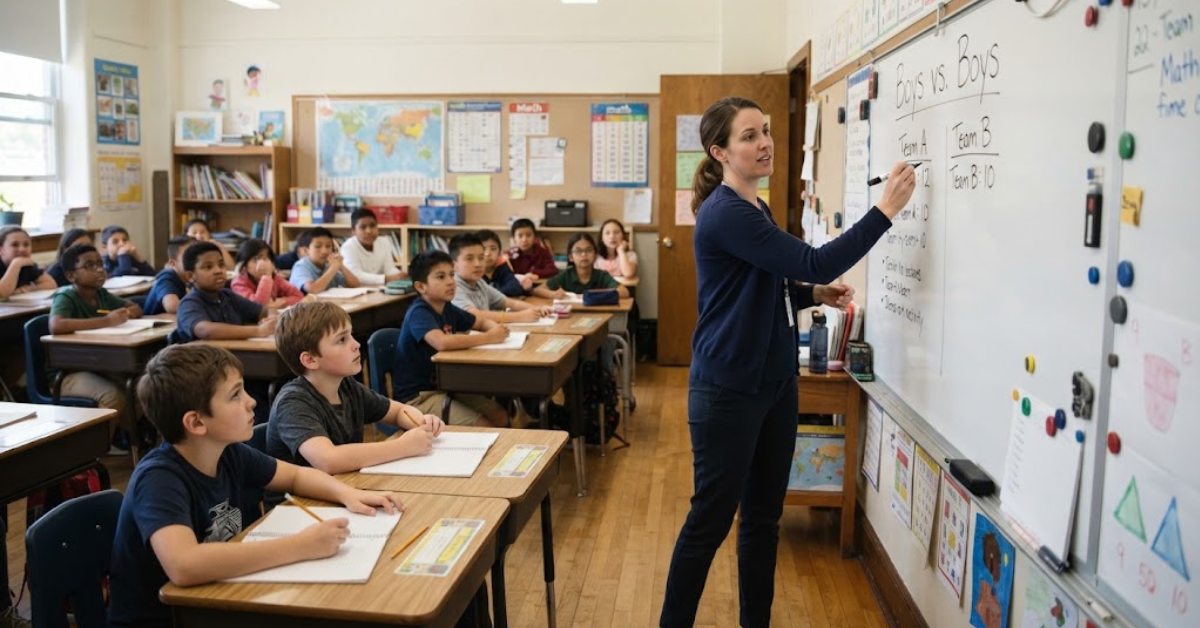
You may occasionally encounter phrases such as “boys vs. boys” in sports, games, competitions, or other situations where two groups of boys are competing against each other.
For example:
The tournament featured boys vs. boys matches.
Here, boys is plural on both sides. Neither word is possessive.
The phrase means one group of boys is competing against another group of boys.
In a sports context, wording such as “boys vs. boys” can therefore be perfectly grammatical when the intended meaning is a competition between two male youth groups. Real-world sports reporting uses the phrase this way when divisions are separated for competition.
The important point is that vs. means versus, or “against,” and does not require an apostrophe.
What Does “Vs.” Mean?
Vs. is an abbreviation of versus, a Latin-derived term commonly used in English to mean against, in opposition to, or compared with.
You’ll often see it in:
- Sports competitions
- Legal case names
- Comparisons
- Debates
- Product comparisons
- Informal headlines
For example:
Team A vs. Team B
or:
Boys vs. boys
When used as a comparison, the words on either side of vs. generally retain their normal grammatical form.
Boys vs Boys: Is the Phrase Correct?
Yes, “boys vs. boys” can be grammatically correct when you’re describing one group of boys competing or being compared with another group.
For example:
Today’s tournament includes boys vs. boys and girls vs. girls matches.
Here, boys is simply the plural noun.
However, if you’re trying to express possession, the grammar changes:
The boys’ competition starts at noon.
Here, boys’ is possessive because the competition is associated with the boys.
So the apostrophe depends on the meaning—not on the word vs.
A Quick Boys vs. Boys Grammar Test
When you’re unsure whether to write boys or boys’, use this three-step test.
Step 1: Are you simply talking about more than one boy?
If yes, use:
boys
Example:
The boys are outside.
Step 2: Does something belong to or relate to multiple boys?
If yes, use:
boys’
Example:
The boys’ bags are outside.
Step 3: Does something belong to one boy?
If yes, use:
boy’s
Example:
The boy’s bag is outside.
This gives you a simple three-way distinction:
boys = plural
boy’s = singular possessive
boys’ = plural possessive
Boys vs. Boys’: A Simple Cheat Sheet
Keep this quick reference handy:
| If you mean… | Use… | Example |
| One male child | boy | The boy smiled. |
| More than one | boys | The boys smiled. |
| Belonging to one boy | boy’s | The boy’s hat fell. |
| Belonging to multiple boys | boys’ | The boys’ hats fell. |
If you remember only one thing, remember this table.
Frequently Asked Questions About Boys vs. Boys
Is “boys” or “boy’s” correct for more than one boy?
Boys is correct. Boy’s is the singular possessive form and normally means something belongs to one boy.
What is the plural of boy?
The plural of boy is boys.
For example:
One boy
Two boys
No apostrophe is needed.
What is the possessive form of boys?
The possessive form of the plural boys is boys’.
For example:
The boys’ classroom is upstairs.
What is the difference between boys and boys’?
Boys is the ordinary plural form. Boys’ is the plural possessive form, used to show a relationship or ownership involving multiple boys.
Is “boys’ ” grammatically correct?
Yes. Boys’ is grammatically correct when it is being used as a plural possessive.
Example:
The boys’ uniforms are ready.
Is “boys’s” correct?
For the ordinary plural noun boys, the standard plural possessive is boys’, not boys’s. The apostrophe comes after the existing s.
Should I write “boys team” or “boys’ team”?
In standard English, boys’ team is generally the appropriate possessive construction when you mean a team associated with boys.
For example:
The boys’ team won the match.
Is “boys vs. boys” correct?
Yes, if you mean one group of boys competing against or being compared with another group of boys. In that construction, boys is plural and does not need an apostrophe.
Is “boys” singular or plural?
Boys is plural. The singular form is boy.
Why doesn’t “boys” have an apostrophe?
Because boys is simply the regular plural form. An apostrophe is generally needed only when you’re expressing possession or using an apostrophe for another specific grammatical purpose.
Final Takeaway: Boys vs Boys
The confusion surrounding boys vs boys usually comes down to one tiny punctuation mark, but the underlying rule is straightforward.
Use boys when you’re talking about more than one boy:
The boys are playing outside.
Use boy’s when something belongs to one boy:
The boy’s backpack is on the chair.
Use boys’ when something belongs to or is associated with multiple boys:
The boys’ backpacks are on the chair.
And when you see boys vs. boys, the phrase can simply describe one group of boys competing against another. The word vs. doesn’t change the plural form.
The best way to avoid mistakes is to stop thinking about the apostrophe as a decoration and ask what job it is doing. If you’re only making boy plural, use boys. If you’re showing possession, decide whether you’re talking about one boy or multiple boys.
Once that distinction becomes familiar, boys vs boys, boy’s, and boys’ are much easier to handle correctly.