Sometimes a word sounds perfectly clear when you say it aloud but becomes surprisingly easy to misspell when you write it down. Compair vs Compare is a good example.
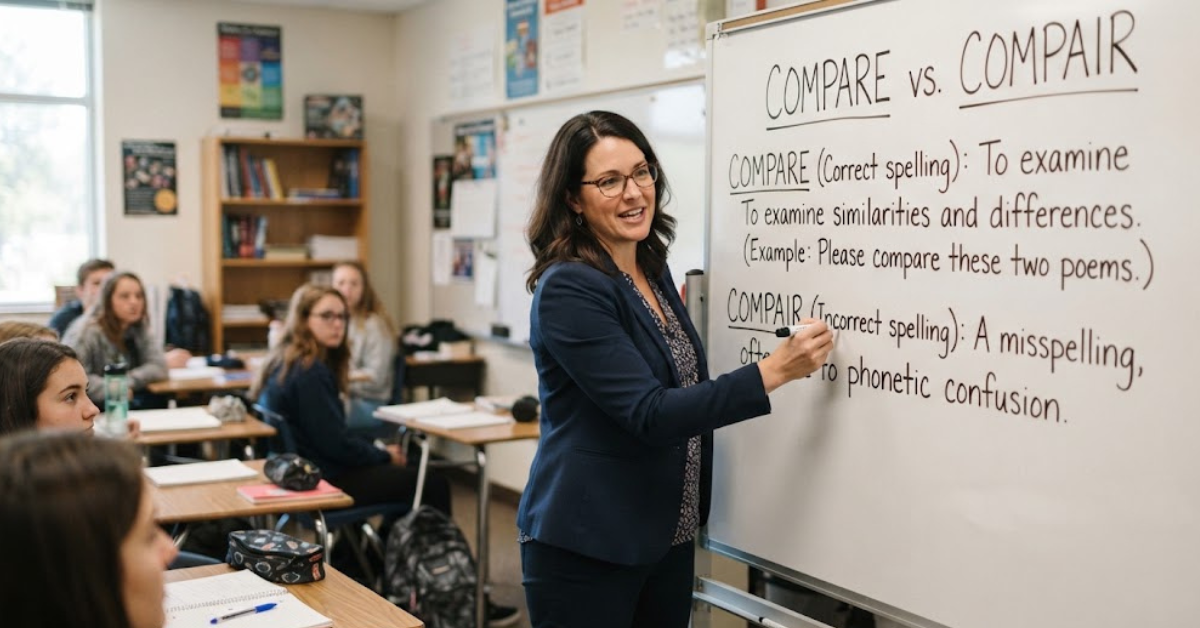
The correct spelling is compare. Compair is a common spelling mistake, not the standard English word. Although the two forms sound similar, only compare is used in standard English when you mean to examine two or more things and identify their similarities and differences.
Let’s look at why compare is correct, what it means, how to use it naturally, and why compair is so easy to write by mistake.
Compair vs Compare: The Quick Answer
The correct spelling is:
Compare
The incorrect spelling is:
Compair
Compare is a verb meaning to examine two or more people, objects, ideas, situations, or things in order to identify similarities, differences, or relative qualities.
Examples
- Let’s compare the two products.
- We need to compare prices before buying anything.
- The study compares two different approaches.
- How does this model compare with the previous one?
The spelling compair does not serve as the standard spelling of this verb.
What Does “Compare” Mean?
Compare means to examine things in relation to one another.
When you compare two things, you’re usually looking at what they have in common, how they differ, or which one performs better according to a particular standard.
For example:
Let’s compare these two phones.
This could mean looking at their:
- Prices
- Features
- Battery life
- Cameras
- Performance
- Storage
- Design
The purpose of the comparison is to understand the similarities and differences between them.
Compare in Simple Terms
You can think of compare as meaning:
Look at two or more things side by side to see how they are alike or different.
For example:
I compared the two job offers before making my decision.
The speaker examined both offers and considered their differences and similarities.
Why Is “Compair” Incorrect?
The spelling compair is most likely caused by pronunciation.
Compare is generally pronounced approximately:
kuhm-PAIR
Because the final part sounds like “pair,” it can be tempting to spell the word as compair.
But English spelling doesn’t always follow pronunciation exactly.
The correct spelling comes from the established word compare, which contains -pare, not -pair.
So remember:
compare = correct
compair = misspelling
The word pair is a completely different word.
Compare vs Compair: Spelling Breakdown
Let’s look at the correct word letter by letter:
C-O-M-P-A-R-E
The final part is:
-pare
Not:
-pair
This gives us:
compare
rather than:
compair
One useful way to remember it is to connect compare with related words such as:
- comparison
- comparable
- comparatively
- comparative
These words all retain the compar- spelling.
What Is the Correct Spelling of Compare?
The correct spelling is:
C-O-M-P-A-R-E
Compare is the standard English spelling in both American and British English.
Unlike some words that change spelling between varieties of English, compare does not normally have a British-versus-American spelling difference.
For example:
We need to compare the results.
is correct in both American and British English.
Compare Meaning and Usage
The verb compare has several related uses.
1. To Examine Similarities and Differences
This is probably the most common meaning.
We compared the two restaurants.
The speakers examined the restaurants to see how they were alike or different.
2. To Evaluate Relative Quality
Compare can also be used when determining how one thing performs relative to another.
How does this laptop compare with more expensive models?
This asks how the laptop measures up against those models.
3. To Say That Two Things Are Similar or Different
Compare can also be used to draw a relationship between two things.
The author compared the city to a living organism.
Here, the writer is drawing a connection between the city and an organism.
Compare vs Comparison
A common source of confusion is the difference between compare and comparison.
Compare is a verb.
We need to compare the options.
Comparison is a noun.
We made a comparison between the options.
Think of it this way:
| Word | Part of speech | Example |
| compare | Verb | Let’s compare the prices. |
| comparison | Noun | The comparison was useful. |
| comparable | Adjective | The two products are comparable. |
| comparative | Adjective/noun | We conducted a comparative analysis. |
| comparatively | Adverb | This model is comparatively inexpensive. |
Understanding this word family can make the spelling of compare much easier to remember.
Compare in a Sentence
Here are some natural examples of compare in everyday English.
Everyday Examples
- Let’s compare our answers.
- I want to compare these two jackets.
- You should compare prices before purchasing.
- It’s difficult to compare the two situations.
- We can compare the results later.
Business Examples
- The manager asked us to compare the quarterly reports.
- Customers often compare prices online.
- The company wants to compare sales figures.
- We need to compare the proposals before choosing one.
Academic Examples
- The essay asks students to compare two historical events.
- Researchers compared the results from both groups.
- The study compares traditional and modern methods.
Compare With or Compare To?
This is another question that often comes up after learning the correct spelling.
Both compare with and compare to are established constructions, but they can carry slightly different emphasis.
Compare With
Compare with is commonly used when examining two things to identify similarities and differences.
Let’s compare this product with the older model.
The focus is on a detailed comparison.
Compare To
Compare to is often used when one thing is likened to another.
The poet compared her voice to a bird’s song.
The comparison presents one thing as resembling another.
In everyday English, however, the distinction is not always rigid, and compare to and compare with can overlap depending on context.
Compare vs Contrast
Compare and contrast are related but not identical.
A Compare generally involves examining similarities and differences.
Contrast focuses especially on differences.
For example:
The essay compares the two novels.
This could involve similarities and differences.
But:
The essay contrasts the two novels.
suggests that the writer is particularly interested in how the novels differ.
A useful shortcut is:
- Compare → similarities and differences
- Contrast → differences
Compare, Compared, Comparing, and Compares
The spelling changes slightly depending on the grammatical form.
Compare
We should compare the options.
Compares
The report compares three different products.
Compared
We compared the results yesterday.
Comparing
She is comparing the two prices.
Notice an important spelling rule:
When adding -ing, the final e is dropped:
compare → comparing
Not:
compareing
Similarly:
compare → compared
The final e remains before -d.
Compare Conjugation and Word Forms
Here’s a quick reference:
| Form | Example |
| compare | We need to compare them. |
| compares | She compares the results. |
| compared | They compared the products. |
| comparing | He is comparing prices. |
| comparison | The comparison was useful. |
| comparable | The results are comparable. |
| comparative | This is a comparative study. |
| comparatively | The product is comparatively affordable. |
The consistent compar- spelling across this word family is a useful memory aid.
Common Mistakes With “Compare”
Mistake 1: Writing “Compair”
Incorrect:
Let’s compair the two options.
Correct:
Let’s compare the two options.
The final syllable may sound similar to pair, but the spelling is -pare.
Mistake 2: Writing “Compareing”
Incorrect:
She is compareing the prices.
Correct:
She is comparing the prices.
When -ing is added, the final silent e is removed.
Mistake 3: Confusing Compare With Comparison
Incorrect:
We made a compare of the two products.
Correct:
We made a comparison of the two products.
Or:
We compared the two products.
The first sentence needs a noun, so comparison is appropriate.
Why “Compare” Is Easy to Misspell
There are several reasons people write compair instead of compare.
Pronunciation
The ending of compare sounds similar to the word pair.
That naturally encourages a spelling such as compair.
English Spelling Isn’t Purely Phonetic
English contains many words whose spelling can’t be predicted perfectly from pronunciation.
For example:
- pair
- pare
- pear
These words have the same pronunciation in many varieties of English but different meanings and spellings.
Compare belongs to the -pare spelling pattern.
Related Words Provide a Clue
Words such as comparison and comparable make the spelling easier to remember:
compare → comparison → comparable
All use the compar- root.
Compare vs Pair
Because compair resembles pair, it’s worth separating the two words.
Pair means two things that belong together or are considered together.
I bought a pair of shoes.
Compare means to examine two or more things in relation to each other.
Let’s compare the two pairs of shoes.
The words sound different in meaning even though part of their pronunciation overlaps.
Also remember pare, which is a separate verb meaning to cut away the outer layer or reduce something.
For example:
She used a knife to pare the apple.
So:
- pair = two things
- pare = trim or remove an outer layer
- compare = examine things in relation to each other
Is “Compair” Ever Correct?
For ordinary English writing, compair is not the standard spelling of the verb meaning “to examine similarities and differences.”
If you intend that meaning, use:
compare
You may occasionally encounter unusual names, specialized terms, or proper nouns that happen to contain Compair, but those are separate cases and don’t make compair a standard spelling of the English verb.
For normal writing, the safe choice is simple:
Compare.
Compare in American and British English
Unlike words such as colour/color or travelling/traveling, the spelling compare remains the same in American and British English.
Examples:
American English:
We need to compare the prices.
British English:
We need to compare the prices.
The pronunciation may vary slightly by accent, but the spelling does not change.
How to Remember the Correct Spelling
If you regularly confuse compair and compare, try one of these memory tricks.
Memory Trick 1: Remember “Pare”
Think:
compare = com + pare
The ending is pare, not pair.
Memory Trick 2: Remember the Word Family
Think of:
compare → comparison → comparable
Seeing the shared compar- spelling reinforces the correct form.
Memory Trick 3: Think “Compare = Comparison”
If you can remember comparison, you can work backward:
comparison → compar- → compare
This is especially useful when writing quickly.
Quick Comparison Table
| Word | Correct? | Meaning |
| compare | ✅ | Examine similarities/differences |
| compair | ❌ | Common misspelling of compare |
| comparison | ✅ | An examination of similarities/differences |
| comparable | ✅ | Able to be compared |
| comparative | ✅ | Involving comparison |
| comparing | ✅ | Examining things in relation to one another |
| compared | ✅ | Past tense/past participle of compare |
Frequently Asked Questions
Is it “compair” or “compare”?
The correct spelling is compare. Compair is a common misspelling.
Why is “compair” wrong?
The word is spelled compare, with -pare at the end. Although compare sounds somewhat like compair, English spelling is not always based directly on pronunciation.
What does “compare” mean?
Compare means to examine two or more things to identify their similarities, differences, or relative qualities.
How do you spell compare?
The correct spelling is:
C-O-M-P-A-R-E
Is “compare” a verb?
Yes. Compare is primarily a verb.
Example:
Let’s compare the two options.
What is the noun form of compare?
The common noun form is comparison.
Example:
We made a comparison between the two products.
What is the adjective form of compare?
Related adjectives include comparable and comparative.
For example:
The two products are comparable.
Is “compare” spelled differently in British English?
No. Compare is spelled the same way in standard American and British English.
What is the difference between compare and contrast?
Compare generally examines similarities and differences, while contrast focuses particularly on differences.
Is “comparing” spelled with an e?
No. The correct spelling is comparing, not compareing.
When -ing is added to compare, the final e is dropped:
compare → comparing
Is “compared” spelled with an e?
Yes.
compare → compared
The final e is retained before -d.
Final Verdict: Compair vs Compare
When it comes to Compair vs Compare, the answer is simple: compare is the correct standard English spelling.
Compair is a common misspelling caused largely by the pronunciation of the word. The correct form uses -pare, just as in the word family comparison, comparable, comparative, and comparatively.
So, whenever you mean to examine two or more things to identify similarities, differences, or relative qualities, write:
Compare
Not:
Compair
Once you connect compare with comparison, the spelling becomes much easier to remember. Keep that word family in mind, and you’ll be far less likely to make this mistake the next time you’re comparing products, ideas, prices, results, or anything else.