
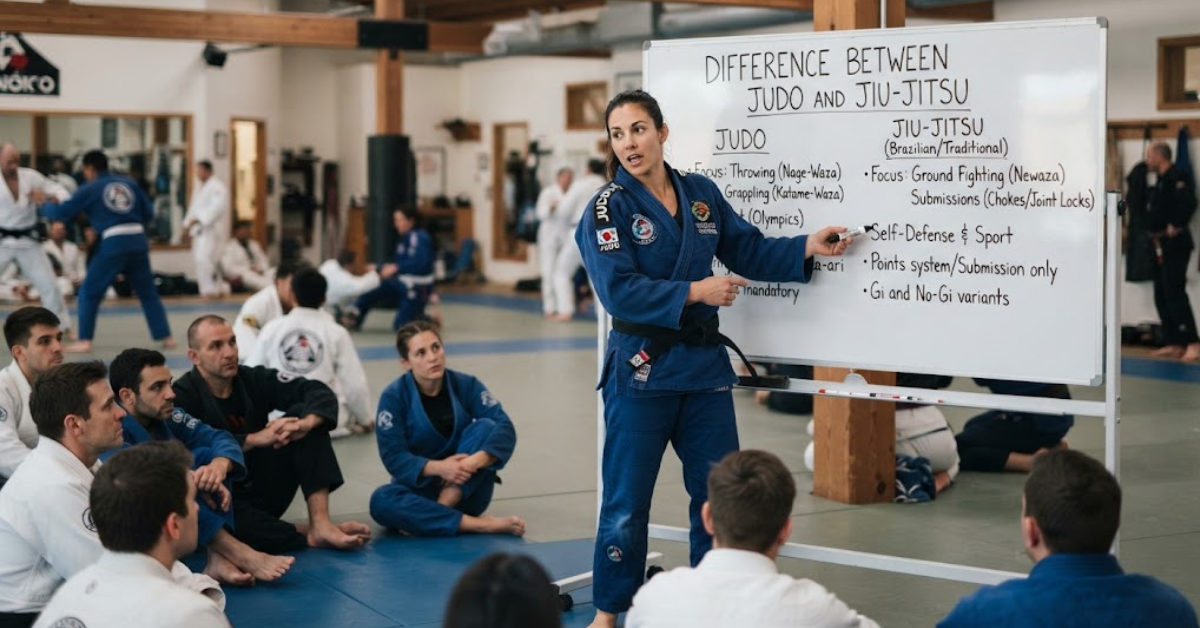
Two people can step onto a mat, grab each other by the jacket, and look like they’re practicing the same martial art. But watch for a few minutes and the differences become obvious. The difference between judo and jiu jitsu goes far beyond the names.
Both martial arts developed from Japanese grappling traditions and share techniques such as throws, pins, joint locks, and chokes. Yet they have different competitive goals, training styles, scoring systems, and areas of emphasis.
If you’re wondering what is the difference between judo and jiu jitsu, the easiest way to put it is this: judo places a strong emphasis on throws and controlling an opponent through takedowns and pins, while Brazilian jiu jitsu (BJJ) places much greater emphasis on ground fighting, positional control, and submissions.
What Is the Difference Between Judo and Jiu Jitsu?
The biggest distinction is where and how the fight is usually developed.
Judo is a Japanese martial art created by Jigoro Kano in 1882. Modern judo competition strongly emphasizes throws, takedowns, pins, and submissions performed within its ruleset.
Brazilian jiu jitsu evolved from Japanese jujutsu and judo influences in Brazil during the early 20th century. BJJ became particularly known for its sophisticated ground-fighting system, using positional control and submission techniques to overcome an opponent.
In simple terms:
| Judo | Brazilian Jiu Jitsu |
| Strong emphasis on throws | Strong emphasis on ground fighting |
| Takedowns are central | Takedowns are important but often lead to groundwork |
| Pins can score heavily | Positions such as mount and back control are central |
| Limited time on the ground in many competitions | Extended ground exchanges are common |
| Standing grip fighting is highly developed | Guard fighting is a major component |
| Throws can end a contest immediately | Submissions are a major path to victory |
There is plenty of overlap, though. Neither art is exclusively standing or exclusively ground-based.
Judo vs Jiu Jitsu: A Look at Their Origins
Understanding their history makes the differences easier to appreciate.
The origins of judo
Jigoro Kano developed Kodokan Judo in Japan during the late 19th century. Kano studied several traditional jujutsu systems and organized techniques into a structured martial art emphasizing physical education, efficient movement, and personal development.
Judo eventually became an Olympic sport, with competition rules that reward effective throws and other forms of control.
The origins of Brazilian jiu jitsu
Brazilian jiu jitsu has roots in Japanese martial arts that reached Brazil in the early 20th century. The Gracie family and other practitioners helped develop and popularize a style that placed particular emphasis on fighting from the ground and finishing opponents with submissions.
Over time, BJJ became a major competitive grappling discipline in its own right.
So while judo and BJJ share historical DNA, they developed in noticeably different directions.
Judo vs Jiu Jitsu Techniques
Both sports contain a surprisingly large technical vocabulary, but their priorities differ.
Common judo techniques
Judo practitioners spend substantial time learning:
- Throws
- Takedowns
- Grip fighting
- Pins
- Chokes
- Arm locks
- Transitions from standing to ground
A successful throw is one of the most recognizable features of judo. Learning how to control an opponent’s balance, movement, and posture is fundamental.
Common jiu jitsu techniques
BJJ training commonly focuses on:
- Guard positions
- Sweeps
- Escapes
- Mount control
- Back control
- Passing the guard
- Joint locks
- Chokes
- Positional transitions
Rather than simply trying to overpower an opponent, BJJ teaches practitioners to create advantageous positions and use leverage to attack or escape.
The Biggest Difference: Standing vs Ground Fighting
This is probably the easiest way to understand the difference between judo and jiu jitsu.
Judo spends much more training time on the standing phase. A judoka learns how to establish grips, break an opponent’s balance, create an opening, and execute a throw.
In BJJ, getting the opponent to the ground is often only the beginning. Once both athletes are on the mat, they can spend considerable time working through guards, pins, escapes, sweeps, and submissions.
That doesn’t mean judo ignores groundwork or BJJ ignores takedowns. It means the two sports allocate different amounts of attention to each phase.
Judo vs Jiu Jitsu Rules and Scoring
Competition rules are another major difference.
How judo is scored
Modern judo competition heavily rewards decisive throws. A clean, powerful throw that meets the required criteria can result in an ippon, which immediately wins the contest.
Judo competitors can also score through techniques such as pins, depending on how long control is maintained and under the applicable competition rules. Certain submissions can also result in victory.
The exact rules can change over time and may vary between competitions, so competitors should always check the current ruleset.
How Brazilian jiu jitsu is scored
BJJ competitions generally award points for achieving advantageous positions.
Depending on the ruleset, competitors may score for actions such as:
- Takedowns
- Sweeps
- Passing the guard
- Knee-on-belly
- Mount
- Back control
A competitor can also win immediately by submitting the opponent.
This creates a different strategic environment. A BJJ match can involve long sequences of positional battles before either competitor attempts a final submission.
Judo vs Jiu Jitsu Gi: Are the Uniforms Different?
Yes. The difference between judo and jiu jitsu gi is noticeable, although the uniforms look similar at first glance.
A judo gi is generally designed to withstand substantial pulling and gripping. Because throws and grip fighting are central to judo, the jacket tends to be robust and reinforced.
A BJJ gi is also designed to withstand gripping, but its cut and construction can differ. BJJ gis commonly come in different fits and may use different fabric weights.
Judo gi vs BJJ gi
| Feature | Judo Gi | BJJ Gi |
| Primary use | Judo training and competition | Brazilian jiu jitsu |
| Jacket | Generally robust for throws and gripping | Designed for prolonged gripping and ground work |
| Fit | Often roomier | Available in varied, sometimes more tailored cuts |
| Reinforcement | Built to handle judo gripping and throwing | Reinforced for grappling |
| Competition requirements | Must meet applicable judo regulations | Must meet the relevant BJJ organization’s rules |
A BJJ gi may not meet the exact requirements for a judo competition, and a judo gi may not comply with every BJJ competition’s uniform rules.
For casual training, however, schools may have their own policies about what students can wear.
Is Judo Harder Than Jiu Jitsu?
There isn’t a universal answer.
Judo can be physically demanding because practitioners repeatedly practice throws, grips, movement, and breakfalls. Learning to safely fall while being thrown is an essential part of training.
BJJ can also be extremely demanding. Long ground exchanges require endurance, strength, flexibility, concentration, and the ability to remain calm while an opponent is applying pressure.
The difficulty often depends on your experience, fitness level, training environment, and personal strengths.
Which Is Better for Self-Defense?
This question comes up frequently, but it doesn’t have a simple winner.
Judo can provide useful skills for:
- Balance disruption
- Takedowns
- Grip fighting
- Controlling an opponent
- Staying upright
- Learning how to fall safely
BJJ can provide useful skills for:
- Escaping unfavorable positions
- Ground control
- Maintaining dominant positions
- Chokes and joint locks
- Fighting from the bottom
- Controlling an opponent without relying entirely on strength
Real-world self-defense is different from a regulated martial-arts competition. There may be multiple attackers, weapons, hard surfaces, or other factors that neither sport is designed to reproduce.
For general self-defense training, the quality of instruction and your ability to apply techniques under pressure matter enormously.
Judo vs Jiu Jitsu for Beginners
If you’re choosing your first grappling martial art, consider what kind of training sounds enjoyable.
Judo may suit you if you enjoy:
- Fast-paced standing exchanges
- Throws and takedowns
- Athletic movement
- Grip fighting
- Short, explosive exchanges
- Learning how to fall safely
Brazilian jiu jitsu may suit you if you enjoy:
- Ground grappling
- Positional strategy
- Submissions
- Escapes and reversals
- Technical problem-solving
- Longer exchanges
There is no requirement to choose one forever. Many experienced grapplers train both because the skills complement each other.
Judo vs Jiu Jitsu: Which Is Better for MMA?
Both can contribute valuable skills to mixed martial arts.
Judo can help develop:
- Clinch control
- Throws
- Trips
- Balance
- Grip fighting
BJJ can contribute:
- Ground control
- Submission attacks
- Submission defense
- Escapes
- Positional awareness
MMA, however, requires much more than either martial art alone. Fighters must also develop striking, wrestling, takedown defense, conditioning, and the ability to combine techniques under MMA rules.
Can a Judoka Do Jiu Jitsu?
Absolutely.
A judoka already has experience with balance, grips, throws, pins, and some submission techniques. That background can make the transition to BJJ easier in certain areas.
The biggest adjustment is usually spending significantly more time on the ground.
A judoka may initially be comfortable getting an opponent down but less familiar with the extensive guard systems, positional exchanges, and submission chains commonly used in BJJ.
Can a Jiu Jitsu Practitioner Do Judo?
Yes, and BJJ practitioners can gain a lot from learning judo.
BJJ athletes often benefit from developing stronger takedowns and becoming more comfortable starting from a standing position.
The adjustment can work both ways. A BJJ practitioner may need to become accustomed to judo’s grip fighting, faster throwing exchanges, and the consequences of being thrown.
Common Misconceptions About Judo and Jiu Jitsu
“Judo has no ground fighting.”
Not true.
Judo includes ne-waza, or ground techniques, including pins, chokes, and arm locks. Competition rules simply limit ground exchanges differently from BJJ.
“Jiu jitsu has no throws.”
Also incorrect.
BJJ practitioners can use takedowns and throws. Many BJJ schools incorporate wrestling and judo techniques into their standing game.
“They are basically the same martial art.”
They share historical roots and techniques, but their modern competitive priorities are quite different.
“One is automatically better.”
Not really.
The better choice depends on what you want from training, the instructor available to you, and the type of grappling you enjoy.
Frequently Asked Questions
What is the difference between judo and jiu jitsu?
The main difference between judo and jiu jitsu is their emphasis. Judo places a strong focus on standing techniques, throws, and pins, while Brazilian jiu jitsu emphasizes ground fighting, positional control, and submissions.
What’s the difference between judo and jiu jitsu?
Judo is generally more throw-oriented, while BJJ is more ground-oriented. Both use grappling, leverage, throws, pins, joint locks, and chokes, but their competition rules and training priorities differ.
Is judo or jiu jitsu better?
Neither is universally better. Judo may be a better fit if you enjoy throws and fast standing exchanges, while BJJ may appeal more if you enjoy ground grappling and submission-based strategy.
Is judo harder than jiu jitsu?
Both can be physically and technically demanding. Judo tends to involve more explosive standing movement and repeated throws, while BJJ often involves prolonged ground exchanges and positional battles.
What is the difference between a judo gi and a jiu jitsu gi?
A judo gi is generally built to handle the strong gripping and pulling associated with throwing. A BJJ gi is designed for grappling and may have different cuts, fabric weights, and competition requirements.
Can you use a BJJ gi for judo?
It depends on the training facility and competition rules. A BJJ gi may not meet the specifications required for a particular judo competition, so competitors should check the applicable regulations.
Can you use a judo gi for BJJ?
Some BJJ gyms may allow it for training, but competition rules can specify particular uniform requirements. Always check with the academy or tournament organizer.
Which is better for self-defense, judo or jiu jitsu?
Both teach useful grappling skills. Judo offers strong training in balance, takedowns, grips, and throws, while BJJ provides extensive practice in ground control, escapes, and submissions.
Can you learn judo and jiu jitsu together?
Yes. The two arts can complement each other particularly well. Judo can strengthen your standing game, while BJJ can expand your ground-fighting skills.
Conclusion: Understanding the Difference Between Judo and Jiu Jitsu
The difference between judo and jiu jitsu becomes much clearer when you look at what each art emphasizes.
Judo is strongly associated with standing grappling, grip fighting, throws, pins, and explosive movement. Brazilian jiu jitsu places much more emphasis on ground fighting, positional control, escapes, and submissions.
Neither approach is inherently superior. If you love the speed and impact of throws, judo may be the better fit. If you enjoy the strategic puzzle of ground grappling and submissions, BJJ may be more appealing.
And if you’re interested in becoming a more complete grappler, learning both can be an excellent option. The important next step is simple: find a reputable academy, take an introductory class, and see which style keeps you wanting to come back to the mat.