
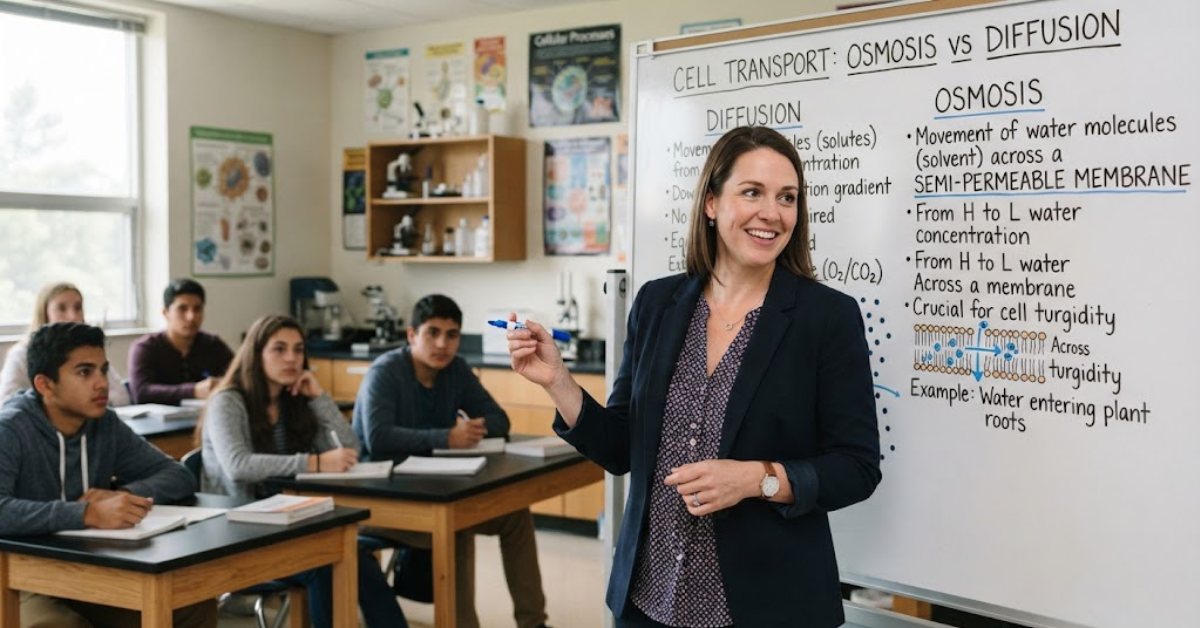
A cell may look tiny, but a surprising amount of traffic is constantly moving in and out of it. Oxygen enters, carbon dioxide leaves, water shifts, and various molecules move across membranes—all without the cell necessarily spending energy to make it happen.
That brings us to the difference between osmosis and diffusion in cells. Both are forms of passive transport, meaning they can occur without the cell using ATP to drive the movement. But they aren’t the same process. Diffusion involves the movement of particles down a concentration gradient, while osmosis specifically refers to the movement of water across a selectively permeable membrane.
Understanding this distinction makes cell biology much easier, especially when you’re trying to figure out what happens to a cell in different solutions.
What Is Diffusion in Cells?
Diffusion is the movement of particles from an area where they are more concentrated to an area where they are less concentrated.
Think about opening a bottle of perfume in one corner of a room. At first, the perfume molecules are highly concentrated near the bottle. Over time, they spread through the room because of their random molecular motion.
Cells experience a similar process.
If a particular substance has a higher concentration on one side of a cell membrane than the other, molecules that can cross the membrane tend to move down their concentration gradient. Diffusion is a passive process, so the cell doesn’t have to directly spend ATP to make it happen.
How Does Diffusion Work?
The basic process looks like this:
- A concentration difference exists.
- Molecules move randomly.
- More molecules move from the higher-concentration region toward the lower-concentration region.
- The concentration difference gradually decreases.
- Movement continues in both directions, but there is no longer a net movement once equilibrium is reached.
An important detail is that molecules don’t simply stop moving at equilibrium. They continue moving randomly. What disappears is the net movement caused by the concentration gradient.
What Is Osmosis in Cells?
Osmosis is a specific type of passive transport involving water.
More precisely, osmosis is the net movement of water across a selectively permeable membrane in response to differences in water concentration and solute concentration. In typical cell-biology examples, water moves toward the side with the higher concentration of solutes that cannot freely cross the membrane.
This is where students often get confused.
If diffusion is the general movement of particles down a concentration gradient, osmosis is essentially the diffusion of water through a membrane.
OpenStax describes osmosis as a special case of diffusion because water itself moves down its concentration gradient.
Why Does Water Move Toward More Solute?
Here’s an easy way to picture it.
Imagine two sides of a container separated by a membrane. One side has relatively little dissolved sugar, while the other has much more sugar. If the membrane allows water to cross but doesn’t allow the sugar to cross, water tends to move toward the side with more solute.
Why?
The side with more dissolved solute has a lower concentration of free water molecules. Water therefore moves across the membrane toward that side.
That’s osmosis.
Osmosis and Diffusion Difference: A Quick Comparison
The easiest way to understand the osmosis and diffusion difference is to look at what is moving.
| Feature | Diffusion | Osmosis |
|---|---|---|
| What moves? | Particles such as gases or solutes | Water |
| Requires a concentration difference? | Yes | Yes |
| Requires a membrane? | Not always | Yes, a selectively permeable membrane is involved |
| Energy required? | No ATP required | No ATP required |
| Direction | Higher concentration to lower concentration | Water moves toward lower water concentration, often corresponding to higher solute concentration |
| Type of transport | Passive transport | Passive transport |
| Example | Oxygen moving into a cell | Water entering or leaving a cell |
The key takeaway is simple:
Diffusion can involve many different particles. Osmosis specifically involves water moving across a selectively permeable membrane.
Diffusion and Osmosis Are Both Passive Transport
One major similarity between diffusion and osmosis is that both are forms of passive transport.
Passive transport means the cell doesn’t have to use ATP directly to drive the movement.
Instead, the movement is powered by existing gradients. A concentration gradient represents a difference in concentration between two areas, and molecules can move down that gradient through random molecular motion.
This is different from active transport, where cells use energy to move substances against a gradient.
Diffusion vs Active Transport
Consider two situations.
With diffusion, molecules naturally move from high concentration toward low concentration.
With active transport, a cell can move substances from low concentration toward high concentration by using energy, typically through membrane proteins.
So don’t confuse passive diffusion with active transport. They can both move substances across a cell membrane, but the energy requirements and mechanisms are different.
Simple Diffusion vs Facilitated Diffusion
Not all diffusion across a cell membrane happens in exactly the same way.
Simple Diffusion
Some small, uncharged or lipid-soluble molecules can pass directly through the phospholipid bilayer.
Examples include:
- Oxygen
- Carbon dioxide
- Certain small molecules
Because these substances can cross the membrane without a transport protein, this is called simple diffusion.
Facilitated Diffusion
Other substances can’t easily pass through the membrane’s hydrophobic interior.
Charged ions and many polar molecules fall into this category.
Instead, they can move down their concentration gradients through membrane proteins such as channels or carrier proteins. This process is called facilitated diffusion, and it still doesn’t require the cell to spend ATP directly.
For example, sodium ions cannot simply slip through the lipid portion of the membrane because they are charged. Specialized membrane proteins can provide a pathway for their passive movement.
How Osmosis Affects Cells
Osmosis becomes especially important when cells are placed in solutions with different solute concentrations.
Three terms are particularly important:
- Hypotonic
- Isotonic
- Hypertonic
These terms describe the relationship between the solute concentration of a solution and the cell.
Hypotonic Solution
A hypotonic solution has a lower solute concentration than the cell’s interior.
Because there is relatively more water outside the cell, water tends to move into the cell through osmosis.
As a result, an animal cell can swell and, under sufficiently extreme conditions, may burst.
Isotonic Solution
An isotonic environment has an approximately equal effective solute concentration on both sides of the membrane.
Water still moves in both directions, but there is no overall net movement of water.
Animal cells generally maintain their normal size and shape under isotonic conditions.
Hypertonic Solution
A hypertonic solution has a higher solute concentration outside the cell.
Water tends to leave the cell through osmosis.
As the cell loses water, it can shrink or shrivel.
What Happens to a Red Blood Cell?
Red blood cells provide one of the clearest examples of osmosis.
Place a red blood cell in a solution that is too dilute compared with the cell’s interior, and water can enter the cell. The cell swells and may eventually rupture.
Place it in a sufficiently concentrated solution, and water leaves the cell. The cell shrinks.
In an isotonic solution, the cell maintains its normal shape because there is no net movement of water.
This simple example shows why controlling water and solute balance is so important for living cells.
What Is the Role of the Cell Membrane?
The cell membrane is central to osmosis.
Cell membranes are selectively permeable, meaning they allow certain substances to cross more easily than others. This selectivity is essential because a cell needs to control its internal environment.
If every molecule could cross the membrane freely, the cell would struggle to maintain the concentration differences necessary for normal function.
The membrane therefore acts somewhat like a controlled border. Some substances pass directly, some require protein channels or carriers, and others are restricted.
Aquaporins and Water Movement
Water can cross cell membranes, and specialized membrane proteins called aquaporins can provide channels that facilitate water movement.
Aquaporins are particularly important in tissues such as the kidneys, where water movement is tightly connected to maintaining the body’s fluid balance.
This doesn’t mean osmosis becomes an active process. Water movement through aquaporins is still passive when it follows its gradient.
What Is the Difference Between Osmosis and Diffusion in Cells?
If you need to differentiate between diffusion and osmosis for a biology class, remember these four points:
1. The substance moving is different
Diffusion can involve many substances.
Osmosis specifically concerns water.
2. A membrane is essential for osmosis
Osmosis involves water crossing a selectively permeable membrane.
Diffusion can happen without a membrane—for example, perfume spreading through air.
3. Both are passive
Neither process requires the cell to directly use ATP to drive the movement.
4. Osmosis is a special type of diffusion
This is perhaps the most useful relationship to remember.
Osmosis can be considered the diffusion of water across a selectively permeable membrane.
What Is Osmosis and Diffusion? An Everyday Example
Let’s say you drop a little food coloring into a glass of water.
Initially, the dye is concentrated in one small area.
Over time, dye molecules spread throughout the water. That’s diffusion.
Now imagine a cell surrounded by a solution where the concentration of substances that cannot cross its membrane differs from the inside of the cell.
Water can move across the membrane in response to that difference. That’s osmosis.
The two processes are related, but the substances involved and the membrane conditions make the distinction important.
Factors That Affect Diffusion
Several factors can influence how quickly diffusion occurs.
Temperature
Higher temperatures generally increase molecular motion, which can increase the rate of diffusion.
Concentration Gradient
A larger concentration difference generally provides a stronger driving force for diffusion.
Distance
Shorter distances allow particles to travel more quickly than longer distances.
Surface Area
A greater available surface area can allow more particles to cross at the same time.
Molecular Size
Smaller molecules generally diffuse more readily than larger molecules, all else being equal.
Membrane Permeability
For diffusion across a cell membrane, the substance must be able to cross the membrane or use an appropriate transport protein.
The membrane’s structure therefore strongly influences which substances can diffuse and how they do so.
Factors That Affect Osmosis
Osmosis is influenced by several related factors:
- Difference in solute concentration
- Water concentration
- Membrane permeability
- Temperature
- Available membrane surface area
- The presence and activity of water channels such as aquaporins
- Hydrostatic pressure
In living cells, the situation can become more complicated because different solutes may or may not be able to cross the membrane. That’s why tonicity is particularly useful when predicting whether a cell will gain or lose water.
Diffusion and Osmosis in Plant Cells
Osmosis isn’t limited to animal cells.
Plant cells also depend heavily on water movement across membranes.
When water enters a plant cell, the cell’s internal pressure can increase. The rigid cell wall helps prevent the cell from simply bursting, allowing plant cells to become firm or turgid.
When plant cells lose substantial amounts of water, the plasma membrane can pull away from the cell wall, a process known as plasmolysis.
This relationship between water movement, membranes, and cell walls is an important reason osmosis appears so frequently in plant biology.
Why Diffusion and Osmosis Matter in the Human Body
These processes aren’t just classroom concepts.
They are essential to everyday physiology.
Oxygen and carbon dioxide move by diffusion in several parts of the body. For example, gases move between the lungs and blood according to their concentration or partial-pressure gradients.
Water movement through cell membranes is also fundamental to maintaining fluid balance.
The kidneys are especially important because they regulate water and electrolyte balance, helping maintain the appropriate conditions for cells and tissues. OpenStax notes that osmoregulation maintains salt and water balance across the body’s fluid compartments.
Common Mistakes About Osmosis and Diffusion
Mistake 1: “Osmosis is the movement of salt.”
Not quite.
Osmosis refers specifically to the movement of water across a selectively permeable membrane.
Mistake 2: “Diffusion always requires a cell membrane.”
No.
Diffusion can happen in gases, liquids, and other environments without a cell membrane.
Mistake 3: “Osmosis requires ATP.”
No.
Osmosis is passive transport. The cell doesn’t directly spend ATP to make water move down its gradient.
Mistake 4: “Water moves toward the area with less solute.”
In a typical osmosis example involving a membrane that allows water through but restricts the solute, water moves toward the side with higher solute concentration, because that side has a lower concentration of free water.
Mistake 5: “Particles stop moving at equilibrium.”
They don’t.
Molecules continue moving randomly. At equilibrium, however, movement occurs in both directions without a net change in concentration.
Frequently Asked Questions
What is the difference between osmosis and diffusion in cells?
The main difference is what moves. Diffusion is the movement of particles from higher concentration toward lower concentration, while osmosis is the passive movement of water across a selectively permeable membrane.
Is osmosis a type of diffusion?
Yes. Osmosis is commonly described as a special type of diffusion involving water moving across a selectively permeable membrane.
What is the difference between diffusion and osmosis in simple words?
Diffusion is the spreading of particles from an area of higher concentration to an area of lower concentration. Osmosis is the movement of water across a membrane toward the side with a higher concentration of solutes that cannot cross the membrane.
Does diffusion require energy?
Simple and facilitated diffusion are passive processes, so the cell does not directly use ATP to drive them. Molecules move down their concentration gradients.
Does osmosis require energy?
No. Osmosis is passive transport and does not require the cell to directly spend ATP to move water across the membrane.
What moves during osmosis?
Water moves during osmosis. The membrane allows water to cross while restricting at least some of the dissolved solutes.
What moves during diffusion?
Many different particles can diffuse, depending on the environment and membrane. Examples include oxygen, carbon dioxide, and certain ions or molecules that can cross through membrane proteins.
What happens to a cell in a hypotonic solution?
Water tends to enter the cell. An animal cell may swell and can potentially rupture if water influx is severe.
What happens to a cell in a hypertonic solution?
Water tends to leave the cell, causing an animal cell to shrink or shrivel.
What happens to a cell in an isotonic solution?
There is no net movement of water into or out of the cell, so an animal cell generally maintains its normal volume and shape. Water molecules still move in both directions.
Why is osmosis important to cells?
Osmosis helps cells regulate their water content. Maintaining appropriate water balance is essential because excessive water gain or loss can disrupt cell structure and function.
Conclusion: Osmosis vs Diffusion Made Simple
The difference between osmosis and diffusion in cells becomes much easier to remember once you focus on what is moving.
Diffusion is the movement of particles down a concentration gradient. Osmosis is the movement of water across a selectively permeable membrane. Both are forms of passive transport and can occur without the cell directly using ATP to drive the movement.
If you need one memory trick, use this:
Diffusion = particles spread.
Osmosis = water moves.
Once you understand that basic distinction, concepts such as concentration gradients, hypotonic and hypertonic solutions, facilitated diffusion, and cell volume become much easier to understand.
If you’re studying cell biology, the next useful topic to explore is active vs passive transport, because it explains what happens when cells ne