Picking a bottle of water seems simple—until you see labels like purified water and spring water staring back at you. Both are intended for drinking, but they describe different things: one primarily refers to how the water is treated, while the other refers to where the water comes from.
Understanding the difference between purified and spring water can make it easier to choose the right bottle for your preferences. The key distinction is straightforward: purified water is processed to remove impurities, while spring water comes from an underground source that naturally flows to the surface.
Purified vs. Spring Water: The Basic Difference
The easiest way to remember the difference is to focus on treatment versus source.
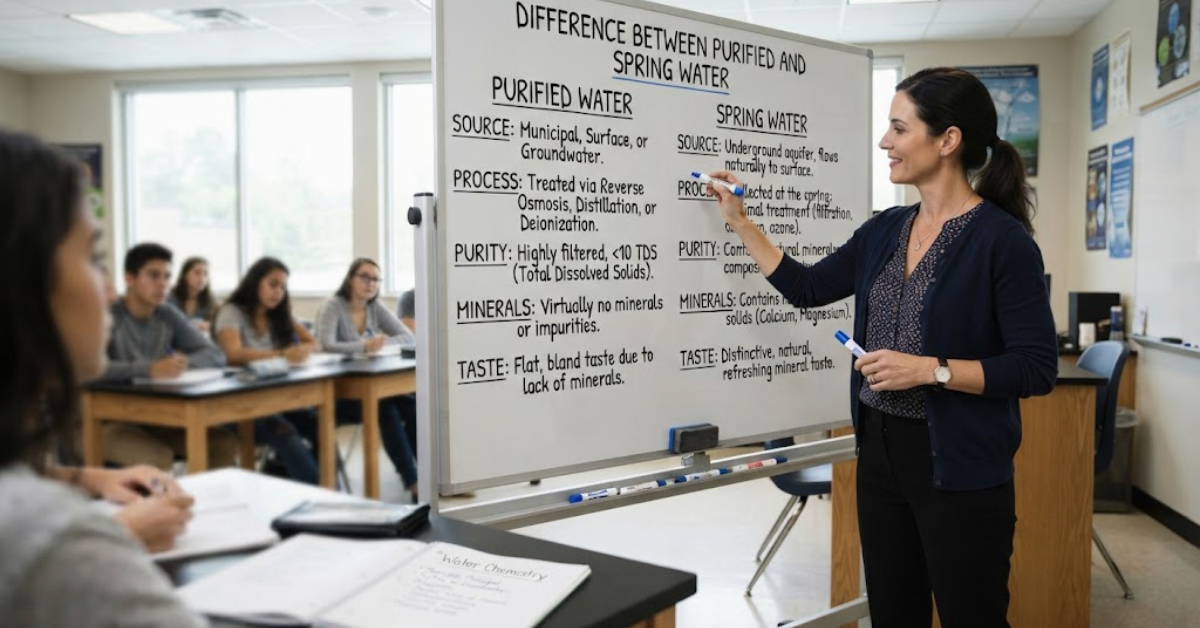
Purified water describes water that has been treated to meet the applicable standard for purified water. It can begin from several different sources, including municipal water, and may be processed using methods such as reverse osmosis or distillation.
Spring water, on the other hand, describes water based on its natural underground source. Under U.S. FDA rules, spring water comes from an underground formation and flows naturally to the surface, or is collected through a borehole that taps the formation feeding the spring.
| Feature | Purified Water | Spring Water |
|---|---|---|
| Main distinction | Treatment | Source |
| Can start from different sources? | Yes | No; must meet spring-source requirements |
| Common processing | Reverse osmosis, distillation, filtration | May be treated, depending on the product |
| Naturally occurring minerals | Often reduced | May remain |
| Taste | Usually clean and neutral | Can vary by source |
| Label tells you | How water was purified | Where the water originated |
What Is Purified Water?
Purified water is water that has undergone treatment to remove impurities and meet the relevant purity standard.
It can originate from a variety of sources. In fact, bottled water that begins as municipal water can be treated through processes such as distillation or reverse osmosis and then labeled as purified water when it meets the applicable requirements.
How Is Purified Water Made?
The exact process depends on the producer, but common treatment methods include:
- Reverse osmosis: Water is pushed through specialized membranes that remove many dissolved substances.
- Distillation: Water is converted to vapor and then condensed, leaving many minerals and other substances behind.
- Filtration: Filters can remove particles and certain contaminants.
- Other treatment methods: Bottlers may use approved processes such as ultraviolet treatment or ozonation as part of their water-treatment system.
The result is water that has been treated rather than water defined primarily by a particular natural source.
What Is Spring Water?
Spring water is defined primarily by its source.
The FDA describes spring water as water derived from an underground formation from which water naturally flows to the Earth’s surface. It can also be collected through a properly connected borehole, provided the water meets the applicable requirements.
That doesn’t mean spring water is necessarily untreated.
A spring-water bottler may use certain treatments to ensure the product is safe and meets regulatory requirements. The important point is that the water must still satisfy the definition of spring water based on its source.
Difference Between Purified and Spring Water in Processing
One of the biggest misconceptions is that spring water automatically means “untreated” water.
That’s not necessarily true.
Bottled water companies may use treatment processes to control microorganisms or other contaminants. FDA regulations cover bottled-water safety, quality standards, and sanitary production practices.
The distinction is therefore:
- Purified water: The treatment is central to the product’s classification.
- Spring water: The qualifying source is central to the product’s classification.
A bottle can tell you something about both its source and its treatment, so reading the entire label is more useful than relying on the front label alone.
Does Spring Water Have More Minerals?
It can, but there is no guarantee that every bottle of spring water will contain a particular amount of minerals.
Water naturally picks up dissolved minerals as it moves through soil and rock. Because spring water comes from an underground source, its mineral profile can vary depending on the geology surrounding that source.
Purification processes such as reverse osmosis and distillation can substantially reduce dissolved minerals. That’s one reason purified water may have a different mineral profile and taste from some spring waters.
If mineral content matters to you, check the product’s label or the bottler’s published water-quality information rather than assuming that “spring” automatically means mineral-rich.
Does Purified Water Taste Different From Spring Water?
Taste is one of the areas where people may notice a difference.
Purified water often has a relatively neutral taste because treatment can remove many dissolved substances. Spring water can have a more distinctive taste depending on the minerals and other characteristics of its source.
Neither taste is automatically better. It largely comes down to personal preference.
If you prefer a clean, neutral profile, purified water may appeal to you. If you enjoy the subtle mineral character associated with some natural waters, you may prefer spring water.
Is Purified Water Safer Than Spring Water?
It is too simplistic to say that one category is always safer.
Commercial bottled waters are subject to applicable safety and quality requirements, and bottled-water producers are responsible for producing safe products. The FDA also conducts inspections and verifies aspects such as source controls, sanitation, bottling operations, and water analysis.
Safety depends on the actual product, source, treatment, handling, and compliance with applicable standards.
For example, FDA testing published in 2025 found detectable PFAS in some bottled-water samples, including both purified and spring waters, although none of the tested samples had PFAS levels that exceeded EPA maximum contaminant levels for public drinking water.
So the label alone shouldn’t be treated as a guarantee of absolute purity.
Which Is Better: Purified or Spring Water?
There isn’t one universal winner.
The better choice depends on what you’re looking for.
Choose purified water if you prefer:
- A neutral taste
- Water that has undergone substantial treatment
- Reduced mineral content
- A product where purification is a key part of the label
- Consistency from bottle to bottle
Choose spring water if you prefer:
- Water associated with a natural underground source
- A potentially more noticeable mineral character
- Source-based labeling
- The taste of a particular spring-water brand
Both can be reasonable choices for everyday hydration when they are produced and handled according to applicable safety requirements.
Purified vs. Spring Water for Everyday Drinking
For most people, the practical question is not “Which one is universally healthiest?” but rather “Which one fits my preferences and circumstances?”
If you are drinking bottled water regularly, consider:
- Read the label. Look at the water type, source information, and any treatment details.
- Check the manufacturer. Reputable bottlers should provide useful product and contact information.
- Consider your local water. In many situations, properly regulated tap water can also be a perfectly reasonable drinking option.
- Think about packaging. If bottled water is a frequent purchase, reusable containers and properly maintained filtration systems may reduce waste and cost.
- Don’t assume marketing language equals a health benefit. Terms describing source or treatment don’t automatically mean one product is healthier for everyone.
The EPA notes that bottled water can come from public water systems or private sources such as springs and wells, which is another reason the source and treatment information on the label matter.
Common Misconceptions About Purified and Spring Water
“Spring water is always untreated.”
Not necessarily. Spring water is defined by its source, and bottlers can use appropriate treatment processes while maintaining the required source characteristics.
“Purified water always comes from a natural spring.”
No. Purified water can originate from different sources, including municipal water, before undergoing treatment.
“Spring water is automatically healthier.”
There isn’t enough basis to make that blanket claim. Safety and quality depend on the actual water source, treatment, production, and regulatory compliance.
“Purified water contains no minerals at all.”
Not necessarily. The amount and composition depend on the purification process and the product. Some purification methods remove substantially more dissolved minerals than others.
How to Choose Between Purified and Spring Water
If you’re standing in a store comparing two bottles, don’t overthink it.
Use this quick checklist:
For purified water:
- Check the purification method if listed.
- Look for the bottler’s quality information.
- Consider whether you prefer a neutral taste.
For spring water:
- Check the source information.
- Look at the mineral or electrolyte information if provided.
- Consider whether you enjoy the taste of that particular brand.
Ultimately, the source, treatment, quality controls, and your personal preference all matter more than the word printed in large letters on the front of the bottle.
FAQs About the Difference Between Purified and Spring Water
What’s the difference between purified and spring water?
The main difference is that purified water is defined by treatment, while spring water is defined by its underground source. Purified water can come from different sources and undergo processes such as reverse osmosis or distillation. Spring water must meet requirements related to its natural underground source.
Is spring water healthier than purified water?
Not necessarily. Neither label by itself proves that one type is healthier for everyone. Both types of bottled water are subject to applicable safety requirements, while individual products can differ in source, treatment, mineral content, and quality.
Is purified water better for drinking every day?
Purified water can be a suitable everyday drinking choice when it is produced and sold in accordance with applicable safety standards. Whether it is “better” depends on factors such as taste, mineral preference, cost, and availability.
Does spring water contain more minerals?
Spring water can contain naturally occurring minerals, but the amount varies according to its source. You should check the label or the bottler’s water-quality information if mineral content is important to you.
Can spring water be purified?
Spring water can undergo certain treatments while still being classified as spring water, provided it continues to meet the applicable requirements for that category. The source requirement remains important.
Does purified water come from tap water?
It can. The FDA notes that bottled water may originate from municipal water supplies, and water treated through processes such as reverse osmosis or distillation may qualify for the purified-water designation.
Which tastes better, purified or spring water?
That’s subjective. Purified water often has a clean, neutral profile, while spring water may have a more noticeable taste influenced by its naturally occurring dissolved minerals.
Which water should I buy?
If you prefer heavily treated water with a neutral taste, purified water may be the better fit. If you prefer water associated with a natural underground source and enjoy its particular taste, spring water may be more appealing.
Conclusion: Purified vs. Spring Water
The difference between purified and spring water becomes much easier to understand once you separate source from treatment.
Purified water is primarily about what happens to the water during processing. Spring water is primarily about where the water comes from. Both can be safe choices when properly produced, and neither label alone should be viewed as a universal guarantee of superior health benefits.
So the next time you’re comparing purified and spring water, check the source, treatment information, quality details, and your own taste preference. A little label-reading can tell you far more than the marketing on the front of the bottle.