Walk into a barn, farm supply store, or rural feed shop and you may see bales that look almost identical. But despite their similar appearance, hay and straw are not the same thing. They come from different parts of plants, are harvested for different reasons, and serve very different purposes.
So, what is the difference between hay and straw?
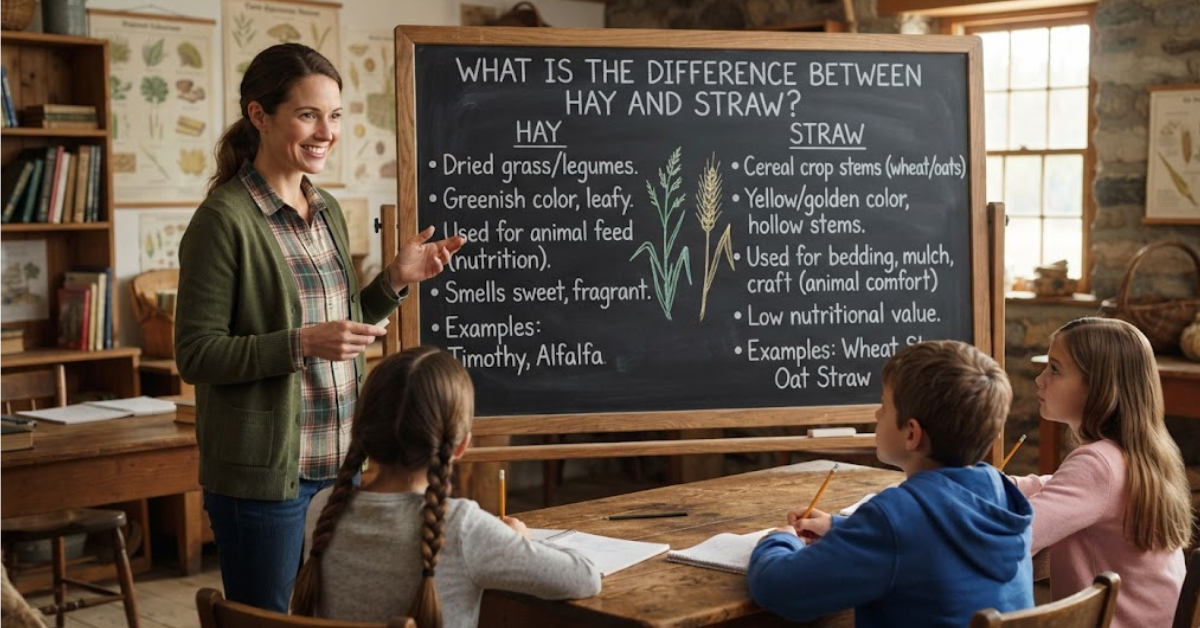
The simplest answer is this: hay is dried plant material—usually grasses or legumes—grown and harvested as animal feed, while straw is the dry stem left behind after cereal grains have been harvested.
That basic distinction explains why hay is generally valuable as food for livestock, while straw is more commonly used for bedding, mulch, construction, and other non-feed purposes.
What Is the Difference Between Hay and Straw?
The main difference comes down to what part of the plant is harvested and why.
Hay is made from forage plants such as grasses, alfalfa, clover, or mixtures of forage species. Farmers cut these plants while they are still nutritionally useful, allow them to dry, and then bale or store them for later feeding.
Straw is primarily the dried stalk or stem that remains after a grain crop has been harvested. Wheat straw is particularly common, but straw can also come from crops such as barley, oats, and rye.
Here’s a quick comparison:
| Feature | Hay | Straw |
| Primary purpose | Animal feed | Bedding, mulch, and other uses |
| Common source | Grasses and legumes | Cereal grain crops |
| Plant part | Leaves and stems of forage plants | Mostly dry stalks after grain harvest |
| Nutritional value | Relatively high | Generally much lower |
| Appearance | Often greenish, depending on crop and storage | Usually yellow, tan, or golden |
| Typical use | Feeding livestock | Bedding and agricultural uses |
| Harvest timing | Before or around forage maturity | After grain is harvested |
Although there can be exceptions, this is the most useful rule to remember.
Hay is primarily food. Straw is primarily a dry agricultural by-product.
What Is Hay?
Hay is forage that has been cut and dried for storage and later use as animal feed.
Instead of allowing livestock to depend entirely on fresh pasture throughout the year, farmers can harvest forage when it is growing well and preserve it as dried hay.
Common plants used for hay include:
- Timothy grass
- Orchard grass
- Bermudagrass
- Alfalfa
- Clover
- Fescue
- Various grass mixtures
The exact nutritional value depends on the plant species, soil conditions, weather, maturity at harvest, and how the hay was handled and stored.
How Is Hay Made?
Making good hay is more than simply cutting grass and leaving it in a field.
A typical process involves:
- Growing forage: Grass, legumes, or another suitable forage crop is grown.
- Cutting: The crop is mowed at an appropriate stage of growth.
- Drying: The cut forage is allowed to lose enough moisture for safe storage.
- Turning or conditioning: Depending on the equipment and weather, the forage may be conditioned or turned to encourage more uniform drying.
- Baling: Once sufficiently dry, the hay is formed into bales.
- Storage: The bales are stored in conditions that minimize moisture exposure and spoilage.
Moisture management is particularly important. Hay that is stored too wet can heat, mold, or deteriorate, and excessively wet hay can even create a fire hazard.
What Is Straw?
Straw is the dry stalk material left after grain crops have been harvested.
Think about a wheat field. The valuable wheat grain is harvested for food, flour, feed, or other products. The remaining dry stems are commonly collected as wheat straw.
Other common types include:
- Wheat straw
- Barley straw
- Oat straw
- Rye straw
Because straw consists largely of structural plant material, it generally contains much less nutritional value than quality forage hay.
That makes straw useful for purposes where absorbency, structure, and low cost matter more than nutrition.
Hay vs Straw: How Are They Made?
The harvesting process helps explain the difference between straw and hay.
Hay is harvested for its nutritional value
Forage crops are cut while they still contain useful nutrients. Farmers want to preserve as much of the plant’s feeding value as possible while reducing moisture enough for storage.
Leaves can be particularly important because they may contain a substantial portion of the plant’s nutrients.
Straw is harvested after grain production
With a cereal crop such as wheat, the farmer’s primary objective is usually the grain.
Once the grain is harvested, the remaining stalks have relatively little nutritional value compared with the grain and are often collected as straw.
This means hay and straw may pass through similar-looking equipment, but they are products of different agricultural goals.
Difference Between Straw and Hay for Animals
This is where confusing the two can become a practical problem.
Hay is intended to provide forage
Many grazing animals depend on forage as an important part of their diet.
Depending on the species and quality, hay can provide:
- Fiber
- Protein
- Energy
- Minerals
- Other nutrients
Good hay can be an important feed source for horses, cattle, sheep, goats, and other herbivorous livestock.
Straw is generally not a substitute for good hay
Straw is much more fibrous and generally less nutritious than quality hay.
Animals may eat some straw, particularly when it is incorporated into a suitable ration, but that doesn’t mean straw should automatically replace forage.
Its suitability depends on the animal, the type of straw, its quality, and the overall diet.
If you’re feeding livestock, nutritional requirements should take priority over simply choosing whichever bale is cheapest.
Can Horses Eat Straw?
This is a common question because straw is frequently used around horses.
Horses primarily need a diet based on forage, and hay is generally much more nutritionally valuable than straw.
Some types of straw can be incorporated into horse diets under appropriate circumstances, but straw should not automatically be treated as equivalent to hay.
The type and quality matter, as do the horse’s age, health, workload, and nutritional requirements.
If you’re considering using straw as part of a horse’s diet, it is sensible to consult a veterinarian or qualified equine nutrition professional rather than making a major dietary change based solely on appearance.
Can Cows Eat Straw?
Cattle can consume straw, but its nutritional value is considerably lower than that of most good-quality hay.
Straw may sometimes be included in cattle rations as a source of fiber, particularly when the ration is carefully balanced with other feeds.
However, straw alone generally does not provide the nutrition required for productive livestock.
For growing animals, pregnant animals, dairy cattle, or other animals with elevated nutritional needs, the complete diet is especially important.
Hay vs Straw for Bedding
Here’s where straw really shines.
Straw is commonly used as animal bedding because it is relatively dry, bulky, absorbent, and widely available in agricultural areas.
It can provide a comfortable layer between an animal and the floor while helping manage moisture and waste.
Common bedding applications include:
- Horse stalls
- Poultry housing
- Cattle barns
- Small-animal housing
- Calf areas
Hay can also be used as bedding in some circumstances, but it is generally a poor economic choice when a less expensive material such as straw is available.
There’s another practical problem: animals may eat hay bedding.
If the goal is to provide a clean sleeping surface rather than additional feed, straw is often more appropriate.
Hay vs Straw for Gardening
Both materials can have agricultural uses outside livestock, but they behave differently in gardens.
Straw as mulch
Straw is commonly used as mulch because it can help:
- Reduce soil evaporation
- Suppress some weeds
- Protect soil from erosion
- Reduce soil splashing
- Provide organic material as it breaks down
Clean straw is generally preferred for gardening because it contains less viable seed than some types of hay.
Why Hay Can Cause Weeds
Hay is made from forage plants, and depending on when it was harvested and how it was produced, it may contain viable seeds.
If you spread hay containing seeds throughout a garden, those seeds can potentially germinate.
That’s one reason gardeners often prefer straw rather than hay for mulch.
However, not all straw is completely seed-free, and the quality and source of the material still matter.
Can You Use Hay as Mulch?
Yes, but there are reasons to be cautious.
Hay can provide organic matter and help cover soil, but it may introduce unwanted seeds.
If you are using hay around vegetables, flowers, or other plants, consider where it came from and whether it contains mature seed heads.
For many garden applications, clean straw is the more predictable choice.
Can You Use Straw as Hay?
This is where the distinction becomes especially important.
Straw generally should not be treated as a direct replacement for hay.
Hay is produced specifically to preserve the feeding value of forage. Straw is primarily the leftover structural material from grain production.
Although some livestock can consume straw as part of a carefully formulated diet, it does not have the same nutritional role as quality hay.
If an animal needs forage, replacing hay with straw without accounting for the nutritional difference can result in an inadequate diet.
Hay vs Straw: Which Is More Nutritious?
In most situations, hay is significantly more nutritious than straw.
The nutritional value of hay depends heavily on:
- Plant species
- Stage of maturity at harvest
- Leaf-to-stem ratio
- Growing conditions
- Weather
- Drying conditions
- Storage
- Mold or spoilage
For example, early-cut forage may have considerably different nutritional characteristics from mature, stemmy forage.
Straw generally contains more structural fiber and less digestible nutritional material.
This doesn’t make straw useless. It simply means its primary value is usually not as a nutrient-dense feed.
How to Tell Hay and Straw Apart
If you have two bales sitting next to each other, there are several clues that can help.
Color
Hay is often green, greenish-brown, or golden depending on its type and how it was cured.
Straw is usually pale yellow, tan, or golden.
Color alone isn’t a reliable identification method, though. Weather exposure and storage can change the appearance of either material.
Texture
Hay often feels softer and leafier, particularly when made from leafy forage.
Straw tends to feel coarser, stiffer, and more stem-like.
Smell
Good-quality hay often has a pleasant, fresh, grassy smell.
Clean straw usually has a dry, earthy smell.
A musty or moldy smell is a warning sign for stored forage or bedding and should not be ignored.
What plant material is visible?
Look closely at the bale.
Hay may contain recognizable leaves, seed heads, and stems from grasses or legumes.
Straw generally consists of long, hollow or relatively stiff cereal stems and may contain remnants of grain heads depending on harvesting and processing.
What Is the Difference Between Hay and Straw in Appearance?
Appearance can be useful, but it shouldn’t be your only test.
| Appearance | Hay | Straw |
| Typical color | Green to golden | Pale yellow to golden |
| Texture | Often leafy and softer | Usually coarse and stiff |
| Main material | Forage stems and leaves | Cereal crop stems |
| Smell | Fresh, grassy when good | Dry, earthy |
| Primary visual clue | Leaves and forage structure | Long dry grain stalks |
Remember that old or weathered hay can become quite pale, while straw can vary in color depending on the crop and storage conditions.
Hay vs Straw for Composting
Both hay and straw can eventually break down and contribute organic matter to compost.
However, their composition and moisture content can differ.
Hay may contain more nitrogen than mature straw, while straw is often more carbon-rich and can provide useful dry material for balancing a compost pile.
A healthy compost system generally benefits from a balance of carbon-rich and nitrogen-rich materials, along with adequate moisture and oxygen.
If hay contains mature seeds, composting may not always destroy every seed unless the pile reaches sufficiently high temperatures for long enough.
That is another reason to consider the source and intended use of the material.
Hay vs Straw for Construction
Straw has uses far beyond farming.
It can be used in certain construction systems, including straw-bale construction, where compacted straw bales are incorporated into wall assemblies.
Straw can also be processed into various fiber-based materials and products.
Hay is generally not the preferred material for these applications because it is intended primarily as forage and may be more vulnerable to spoilage or other problems when used as a structural material.
Why Farmers Bale Hay and Straw
From a distance, hay and straw bales can look almost identical.
But farmers bale them for very different reasons.
Hay is preserved for future feed
During periods when fresh pasture is unavailable or insufficient, stored hay can provide livestock with forage.
This is especially useful during winter or dry periods.
Straw is a useful agricultural resource
Instead of leaving all the stalk material in the field, farmers may bale straw for:
- Bedding
- Mulch
- Erosion control
- Composting
- Construction
- Other agricultural uses
Baling makes both materials easier to transport, store, and sell.
Does Hay Cost More Than Straw?
Prices vary widely depending on region, crop, quality, season, transportation, and demand.
However, hay is often more expensive because it is a valuable feed product, while straw is commonly a lower-value by-product of grain production.
Premium hay can be particularly expensive when it is:
- High quality
- Nutritionally dense
- In short supply
- Suitable for specific animals
- Carefully harvested and stored
Straw is often less expensive, especially when it is locally available after grain harvest.
Still, local market conditions can change the price relationship considerably.
Hay vs Straw: Which One Should You Use?
The right choice depends on what you’re trying to accomplish.
Choose hay when you need:
- Livestock feed
- Nutritional forage
- A stored source of grass or legume feed
- A diet component appropriate for a particular animal
Choose straw when you need:
- Animal bedding
- Garden mulch
- Compost carbon
- Erosion-control material
- Agricultural cover
- Certain construction materials
If you’re unsure, don’t judge the bale solely by its appearance.
Think about the purpose for which the material was harvested.
Common Mistakes When Choosing Hay or Straw
Mistake 1: Assuming they are interchangeable
They aren’t. Their nutritional value and intended uses are different.
Mistake 2: Using straw as the only animal feed
Some animals can consume straw in controlled diets, but it generally cannot replace quality forage without careful nutritional planning.
Mistake 3: Using hay as garden mulch without considering seeds
Hay can contain viable seeds and may introduce unwanted plants into your garden.
Mistake 4: Ignoring mold
Moldy hay or straw can create health problems and should be evaluated carefully before use around animals.
Mistake 5: Choosing based only on color
Color can provide a clue, but crop type, maturity, weather, and storage can all affect appearance.
Frequently Asked Questions About Hay and Straw
What is the difference between hay and straw?
Hay is dried forage harvested primarily as animal feed, while straw is the dry stem material left after grain crops such as wheat, barley, oats, or rye are harvested.
Is hay or straw better for animals?
For feeding livestock, hay is generally the better choice because it provides substantially more nutritional value. Straw is more commonly used as bedding, although some straw can be included in carefully balanced animal diets.
Can horses eat straw instead of hay?
Straw should not automatically replace hay. Some types of straw can be incorporated into certain horse diets, but horses still require an appropriately balanced diet based largely on suitable forage. Consult an equine nutrition professional before making a major dietary change.
Why is straw used for bedding instead of hay?
Straw is relatively inexpensive, dry, bulky, and suitable for creating a bedding layer. Hay is more valuable as feed, so using it as bedding can be unnecessarily expensive.
Can you use hay instead of straw for mulch?
Yes, but hay can contain seeds that may germinate and create unwanted plants. Straw is often preferred when the goal is garden mulch.
Is straw edible?
Some animals can eat straw, but that doesn’t mean it is nutritionally equivalent to hay. Straw is generally much higher in structural fiber and lower in digestible nutrients.
Is hay just dried grass?
Not always. Hay can be made from grasses, legumes such as alfalfa and clover, or mixtures of forage plants. It is the dried plant material preserved for use as feed.
Is straw just dried grass?
Not usually. Straw generally refers to the dry stems left after harvesting cereal grain crops. It is different from forage grass that was intentionally grown and harvested as hay.
Which is softer, hay or straw?
Hay is generally softer and leafier, while straw tends to be coarser and more rigid. However, the exact texture depends on the plant, harvest conditions, and storage.
Which is better for a garden, hay or straw?
Straw is often the better choice for mulch because it is less likely than hay to introduce unwanted seeds. Both can add organic matter, but the source and quality matter.
Does straw have nutritional value?
Yes, straw contains some nutrients, but it is generally much less nutritious and less digestible than good-quality hay. Its usefulness as feed depends on the animal, type of straw, and how the overall ration is formulated.
Why does hay need to be dried?
Drying reduces moisture to a level that allows hay to be stored safely. Hay that remains too wet can heat and spoil and, under certain conditions, can become a fire hazard.
Can hay and straw be composted?
Yes. Both can contribute organic material to compost. Hay may contribute more readily decomposable material, while straw is commonly used as a carbon-rich dry material.
Conclusion: What Is the Difference Between Hay and Straw?
So, what is the difference between hay and straw? The easiest answer is to remember what each one was made for.
Hay is dried forage harvested primarily to feed animals. Straw is the dry stalk left after grain crops such as wheat, barley, oats, or rye are harvested and is generally used for bedding, mulch, composting, erosion control, or other agricultural purposes.
When comparing the difference between straw and hay, don’t rely solely on color or the fact that both are sold in bales. Look at the plant material, texture, intended purpose, and—most importantly—whether you’re dealing with feed or a crop by-product.
If you’re choosing material for livestock, make sure the nutritional needs of the animal come first. If you’re choosing material for bedding or gardening, straw will often be the more practical option.
Once you know that hay is primarily feed and straw is primarily a dry agricultural by-product, the difference becomes much easier to remember.