
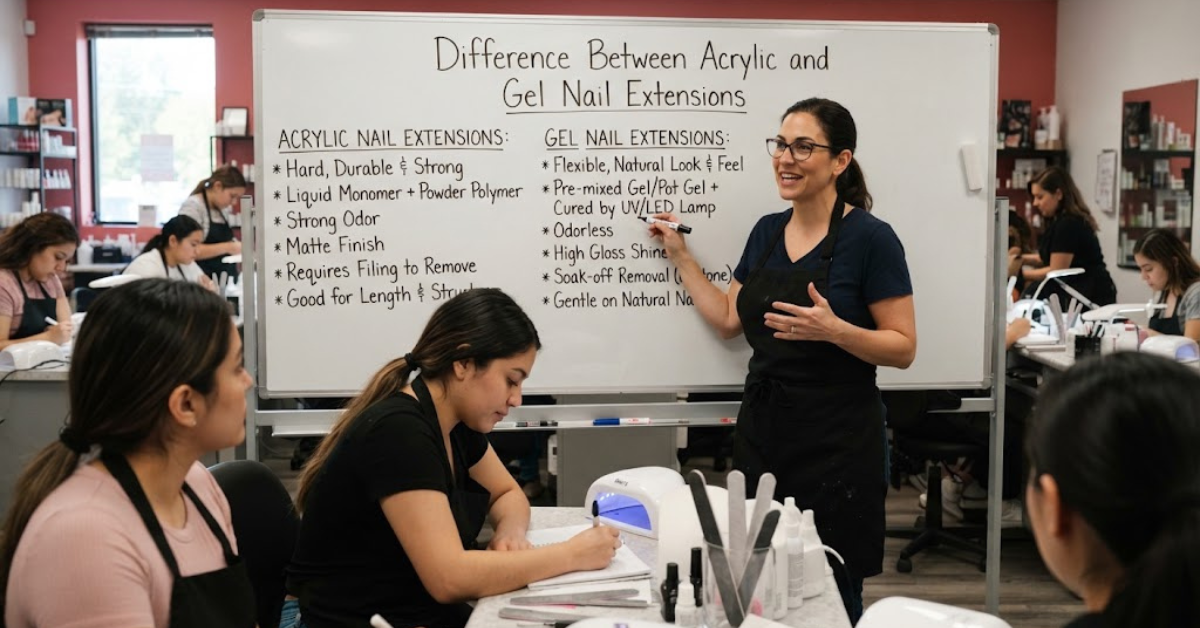
Longer, stronger, perfectly shaped nails can completely change the look of your hands. But when you sit down for a manicure, you’re often faced with one big question: What’s the difference between acrylic and gel nail extensions?
Both can add length, strength, and a polished finish, but they aren’t identical. Acrylic extensions are made by combining a liquid monomer with a powder polymer, while gel extensions use a gel product that is cured with UV or LED light.
The choice between gel extensions vs acrylic comes down to more than appearance. Durability, flexibility, application time, maintenance, removal, nail health, and even your lifestyle can all influence which option makes more sense.
Let’s break down the differences without all the salon jargon.
What Are Acrylic Nail Extensions?
Acrylic nail extensions are created using a mixture of liquid monomer and polymer powder. When the two are combined, they form a workable bead that a nail technician shapes over the natural nail or an extension tip.
The material hardens as it cures in the air, so acrylic doesn’t require a UV or LED lamp to set.
Acrylic is popular because it creates a strong, durable enhancement that can be shaped into different lengths and styles.
Depending on the technique and products used, acrylic nails can be relatively thin and natural-looking or thicker and more dramatic.
How Acrylic Extensions Are Applied
A typical acrylic application involves several steps:
- The natural nail is cleaned and prepared.
- The nail technician shapes the natural nail and prepares the surface.
- A nail tip or sculpting form may be used to create additional length.
- Acrylic powder and liquid are combined.
- The acrylic mixture is applied and shaped.
- The material is allowed to harden.
- The nail is filed and refined.
- Polish or gel color can be applied over the finished enhancement.
The technician’s preparation and application technique matter a lot. Poor application can lead to lifting, uneven surfaces, or unnecessary damage to the natural nail.
What Are Gel Nail Extensions?
Gel nail extensions are made with a gel-based nail enhancement product that is cured under a UV or LED lamp.
There are several types of gel systems used in salons. Some gel products are designed primarily as overlays, while others can be used to create additional length.
Modern gel extension systems can provide a lightweight appearance and a smooth, glossy finish.
The exact process varies depending on whether the salon uses a soft-gel extension system, builder gel, or another type of hard or soak-off gel.
How Gel Extensions Are Applied
Although the process varies, gel extensions commonly involve:
- Preparing the natural nail.
- Selecting or shaping an extension system.
- Applying the gel product.
- Building the desired shape and length.
- Curing the product under an appropriate lamp.
- Refining the surface if needed.
- Applying color or top coat.
Unlike traditional acrylic, gel requires light curing to harden.
Difference Between Acrylic and Gel Nail Extensions
So, what is the actual difference between acrylic and gel nail extensions?
The simplest distinction is the material and curing method.
Acrylic: Uses a liquid-and-powder system that hardens through a chemical reaction.
Gel: Uses a gel product that is hardened through UV or LED light.
But that’s only the starting point.
The two can also differ in flexibility, appearance, application experience, removal process, odor, maintenance, and how they feel on the natural nail.
Gel Extensions vs Acrylic: A Quick Comparison
| Feature | Acrylic Extensions | Gel Extensions |
|---|---|---|
| Main material | Liquid monomer + polymer powder | Gel-based product |
| Curing | Air/chemical curing | UV or LED light |
| Appearance | Can look natural when properly applied | Often glossy and natural-looking |
| Flexibility | Generally more rigid | Often more flexible, depending on gel type |
| Durability | Very durable | Durable, with some systems offering more flexibility |
| Odor during application | Can have noticeable monomer odor | Usually less odor during application |
| Removal | Usually requires filing and/or soaking, depending on system | Depends on whether the gel is soak-off or file-off |
| Maintenance | Regular fills or removal/reapplication | Regular maintenance and infills/replacement |
| Best known for | Strength and sculpting versatility | Lightweight feel and natural appearance |
There isn’t a universal winner. The best choice depends on what you want from your nail extensions.
Acrylic vs Gel: Which Looks More Natural?
If your priority is a natural-looking manicure, gel often gets the advantage.
Many gel systems create a smooth, glossy finish and can have a more flexible appearance on the nail.
But acrylic can look equally natural when it is applied correctly.
The biggest factor isn’t simply whether you choose acrylic or gel. Application technique, nail shape, product quality, thickness, and finishing all make a significant difference.
A poorly applied gel extension can look bulky, while a carefully sculpted acrylic nail can look remarkably natural.
Which Is Stronger: Acrylic or Gel?
This is one of the most common questions about gel extension nails vs acrylic.
The answer isn’t quite as simple as saying one is always stronger.
Traditional acrylic enhancements are known for being hard and durable. They can be a good option for people who want substantial structure or frequently choose longer nail shapes.
Gel systems vary considerably. Some are softer and more flexible, while hard gels can provide significant strength and structure.
So instead of asking only, “Which is stronger?” consider what kind of strength you actually need.
If your nails experience a lot of pressure or you prefer long, structured extensions, an experienced nail technician can help determine which system is appropriate.
Are Gel Extensions More Flexible Than Acrylic?
Generally, many gel systems feel more flexible than traditional acrylic.
That flexibility can make gel extensions feel more natural to some people, particularly during everyday activities.
However, not all gels behave the same way.
Soft gels, builder gels, and hard gels have different properties. The flexibility of the finished enhancement also depends on the thickness and construction of the nail.
That’s why it’s important to know what type of gel your salon is using rather than treating every “gel nail” as the same product.
Acrylic vs Gel: Which Lasts Longer?
Both can last for several weeks with proper application and maintenance, but neither is permanent.
Your natural nail continues to grow underneath the enhancement, which creates a visible gap near the cuticle. This is why clients typically need maintenance appointments.
How long an enhancement lasts depends on:
- Nail growth
- Product quality
- Application technique
- Nail length
- Daily activities
- Exposure to water and chemicals
- How well the nails are cared for
- Whether the enhancement has been properly maintained
Rather than focusing on an exact number of weeks, it’s better to follow the maintenance schedule recommended by your nail technician.
Gel Extensions vs Acrylic: Which Is Better for Weak Nails?
This question needs a little caution.
Neither acrylic nor gel should be considered a treatment that automatically makes damaged or weak natural nails healthier.
Extensions can protect the natural nail from certain types of physical wear, but improper preparation, excessive filing, picking, or aggressive removal can cause damage.
If your natural nails are already thin, peeling, painful, discolored, or otherwise damaged, it’s worth addressing the underlying problem before adding an enhancement.
A qualified nail professional can also assess whether extensions are appropriate.
Which Is Easier to Remove: Acrylic or Gel?
Removal depends heavily on the specific product.
Traditional acrylic can generally be removed using appropriate filing and soaking techniques. It should never be forcibly peeled or ripped from the natural nail.
Gel is more complicated because some gel products are soak-off while others are file-off.
This distinction matters.
A soak-off gel may be removed using the manufacturer’s recommended removal process, while a hard gel typically needs to be carefully filed down by a professional.
That’s why you shouldn’t assume that every gel extension can simply be soaked off.
Acrylic vs Gel Removal: Why Technique Matters
The removal stage is one of the biggest areas where natural nails can become damaged.
Problems can occur when someone:
- Peels off enhancements
- Bites or pulls at the product
- Files the natural nail excessively
- Uses improper removal techniques
- Attempts to remove professional products without knowing what type they are
The goal is to remove the enhancement while minimizing unnecessary stress to the natural nail.
If you’re unsure what product was used, ask the salon before attempting removal.
Which Has More Odor: Acrylic or Gel?
Traditional acrylic systems can have a noticeable chemical odor during application because of the liquid monomer.
Gel products generally produce much less odor during application.
However, low odor doesn’t automatically mean risk-free.
Both systems involve chemical ingredients, and proper ventilation, hygiene, and appropriate curing are important.
A reputable salon should also follow the manufacturer’s instructions for mixing, application, curing, and sanitation.
Are Gel Nail Extensions Safer Than Acrylic?
It’s difficult to say that one is universally “safer.”
The safety of either system depends heavily on:
- Proper preparation
- Correct product application
- Adequate curing
- Hygiene and sanitation
- Avoiding skin contact with uncured products
- Proper removal
- The condition of the natural nails
One important concern with gel products is skin exposure to uncured acrylate or methacrylate ingredients, which can contribute to allergic sensitization in some people.
That’s why uncured gel should not be allowed to sit on the surrounding skin.
A properly trained professional should work carefully to keep the product on the nail rather than on the surrounding skin.
UV and LED Lamps for Gel Nails
Because gel products need light to cure, the lamp is an important part of the process.
UV and LED nail lamps emit ultraviolet radiation, although the amount and exposure time can vary by device and product.
The most important thing is using the lamp recommended or approved for the particular gel system and following the manufacturer’s curing instructions.
Under-curing is not simply a cosmetic issue. Proper curing helps the product achieve its intended properties.
If you regularly receive gel manicures and are concerned about UV exposure, you can discuss protective options with your nail professional or dermatologist.
Acrylic vs Gel: Which Is More Expensive?
Prices vary considerably by salon, location, nail length, design, and the products used.
Generally, you may find that both acrylic and gel extensions fall into a similar broad price range, but there is no universal pricing rule.
Your total cost can also include maintenance appointments.
When comparing prices, look beyond the initial manicure.
Consider:
- Initial application
- Fill or maintenance appointments
- Removal
- Nail art
- Repairs
- Length and shape
- Product type
A cheaper initial service isn’t necessarily cheaper over several months if maintenance costs are significantly higher.
Which Is Better for Long Nails?
Both systems can be used to create long nail extensions.
Acrylic has a long history of being used for sculpted, structured nail enhancements, making it popular for dramatic lengths and shapes.
Certain hard-gel systems can also create strong, long extensions.
The important issue is structure.
As nail length increases, the extension needs appropriate architecture to withstand everyday stress. Your nail technician should choose a suitable product and build the extension correctly rather than simply adding more thickness.
Which Is Better for Short Nails?
Both acrylic and gel can work well on short nails.
If you want subtle reinforcement without dramatically increasing length, a gel overlay or builder-gel service may be worth discussing with your nail technician.
Acrylic can also be used for short enhancements or to repair and shape nails.
The best option depends on your natural nail condition, desired appearance, and the products available at your salon.
Gel Extension Nails vs Acrylic: Which Feels Better?
This comes down to personal preference.
Some people prefer the lightweight, slightly flexible feel of gel.
Others like the solid, structured feeling of acrylic.
You may also notice a difference depending on the length and thickness of the extensions.
A very long nail made from any enhancement system can feel different from a short, natural-looking extension.
If you’re getting extensions for the first time, starting with a moderate length can help you figure out what feels comfortable.
Can You Paint Acrylic and Gel Extensions?
Yes.
Both acrylic and many gel extensions can be finished with nail polish or gel polish, depending on the service and products being used.
Gel polish is especially common because it can provide a durable, glossy finish.
You can also find acrylic and gel extensions in many colors and finishes, including:
- French tips
- Chrome
- Glitter
- Matte
- Ombre
- Metallic finishes
- Nail art
- Solid colors
The enhancement material doesn’t limit you to one particular appearance.
Acrylic vs Gel: Which Should You Choose?
Instead of asking which product is universally better, ask which one matches your priorities.
Acrylic may suit you if you want:
- Strong, structured extensions
- Dramatic lengths and shapes
- A traditional nail-extension system
- A product that doesn’t require lamp curing
- Extensive sculpting possibilities
Gel may suit you if you want:
- A glossy, natural-looking finish
- A lighter or more flexible feel
- Less odor during application
- A variety of modern gel systems
- The convenience of light-curing technology
Remember that “gel” covers several different types of products. Ask your nail technician whether you’re getting a soft gel, builder gel, hard gel, or another system.
How to Keep Acrylic and Gel Extensions Looking Good
Regardless of which system you choose, good aftercare can make a noticeable difference.
Follow these simple habits:
- Don’t use your nails as tools. Avoid opening cans, scraping surfaces, or prying objects with your extensions.
- Protect your hands. Wear gloves when cleaning or handling harsh household chemicals.
- Keep the cuticle area moisturized. Cuticle oil can help keep the surrounding skin comfortable.
- Don’t pick or peel the product. This can pull away layers of the natural nail.
- Keep up with maintenance. Don’t wait until an extension is severely lifted or damaged.
- Use a professional for removal when possible. Especially if you aren’t sure what type of product was applied.
Proper maintenance isn’t just about making your manicure last. It’s also about reducing unnecessary stress on your natural nails.
Common Myths About Acrylic and Gel Nails
Myth 1: Gel is always healthier than acrylic.
Not necessarily.
Both systems can be applied safely when appropriate products and techniques are used. Poor preparation, improper curing, skin exposure, or aggressive removal can cause problems with either system.
Myth 2: Acrylic always damages your natural nails.
Acrylic itself isn’t automatically responsible for nail damage.
Damage is more often associated with improper preparation, excessive filing, picking, or incorrect removal.
Myth 3: Gel extensions never break.
They can.
Gel systems vary in flexibility and strength, and extensions can still crack, lift, or break if subjected to enough stress.
Myth 4: The thicker the extension, the stronger it is.
Not necessarily.
Proper nail structure and architecture matter more than simply adding excessive product.
Frequently Asked Questions
What is the main difference between acrylic and gel nail extensions?
Acrylic extensions are made from a liquid monomer and polymer powder that harden through a chemical reaction. Gel extensions use gel products that are cured under UV or LED light. They can also differ in flexibility, finish, application, and removal.
Is gel better than acrylic?
Neither is universally better. Gel may appeal to people who prefer a glossy, lightweight feel, while acrylic can be attractive to those who want strong, structured extensions. Your nail condition and preferred style also matter.
Which lasts longer, acrylic or gel extensions?
Both can provide durable, long-lasting enhancements when properly applied and maintained. Longevity depends on the product, application, nail growth, lifestyle, and aftercare rather than the material alone.
Are gel extensions more natural-looking than acrylic?
Gel extensions are often associated with a flexible, glossy, natural-looking finish. However, a skilled technician can make either gel or acrylic extensions look natural.
Which is stronger, gel extensions or acrylic?
Traditional acrylic is known for its hardness and strength, but gel products vary widely. Some hard gels can provide substantial strength, while softer gels are designed to have more flexibility.
Do gel extensions damage your nails?
Gel extensions don’t automatically damage natural nails. Problems can arise from excessive filing, improper curing, picking, peeling, or aggressive removal. Proper application and removal are important.
Are acrylic nails safe?
Acrylic nails can be used safely when properly applied and maintained. However, the products contain chemicals that can cause irritation or allergic sensitization in some people, particularly when uncured product contacts the skin.
Can you switch from acrylic to gel extensions?
In many cases, yes. However, the existing enhancement should be removed appropriately and the natural nail assessed before applying a new system. It’s best to have the transition handled by a trained nail professional.
Which is better for weak or brittle nails, acrylic or gel?
There isn’t a universal answer. Neither should be considered a treatment for an underlying nail problem. If your nails are significantly damaged, painful, peeling, or discolored, consider addressing the cause before applying extensions.
Conclusion: Gel Extensions vs Acrylic
The difference between acrylic and gel nail extensions isn’t simply that one is stronger or better than the other.
Acrylic uses a liquid-and-powder system that hardens chemically, while gel uses a light-cured product. From there, differences in flexibility, finish, odor, application, maintenance, and removal can influence your experience.
If you prefer a highly structured extension with plenty of sculpting possibilities, acrylic may be worth considering. If you like a glossy finish and a potentially lighter, more flexible feel, gel may be the better fit.
Ultimately, gel extensions vs acrylic comes down to your nails, your lifestyle, your preferred look, and the expertise of the nail technician applying them.
Before your next appointment, ask exactly what product system the salon uses, how it will be removed, what maintenance it requires, and which option suits your natural nails. That small conversation can make a much bigger difference than simply choosing “acrylic” or “gel” from a menu.