At first glance, a violin and a fiddle look exactly alike. They have the same four strings, the same basic shape, and are played with a bow. So, what’s the difference between a violin and a fiddle?
The surprising answer is that, in most cases, there isn’t a fundamental physical difference. A fiddle is essentially a violin being used to play a particular style of music. The distinction is mainly about musical tradition, playing technique, repertoire, and culture, rather than the instrument itself.
That doesn’t mean the two terms are completely interchangeable in every situation. A classical musician will usually say “violin,” while someone playing bluegrass, old-time, or traditional folk music may call the same instrument a “fiddle.”
Let’s take a closer look at why one instrument has two names.
What Is a Fiddle?
So, what is a fiddle?
A fiddle is a bowed string instrument used in various folk and traditional musical styles. In many traditions, the word “fiddle” simply refers to a violin when it is played in a folk, country, bluegrass, old-time, Celtic, or other traditional setting.
The word itself is much older than the modern idea of the violin as a classical concert instrument. Historically, related terms such as “fiddle” have been used for bowed string instruments across Europe and beyond.
Today, however, the meaning is usually straightforward:
A fiddle is generally a violin played in a traditional or folk-oriented musical style.
The distinction is therefore more cultural and musical than anatomical.
Is a Fiddle and a Violin the Same Thing?
For most modern purposes, yes.
If you put a typical classical violin next to a typical bluegrass fiddle, you may notice some differences in setup, strings, bridge shape, or playing preferences. But both are based on the same basic violin family design.
A standard violin has:
- Four strings
- A hollow wooden body
- A carved bridge
- A fingerboard
- Tuning pegs
- A bow
- A soundpost and bass bar inside the instrument
- A chin rest on most modern instruments
A fiddle uses the same fundamental architecture.
So when someone asks, “is a fiddle and a violin the same thing?”, the best short answer is:
They’re essentially the same type of instrument, but the words often describe different musical contexts.
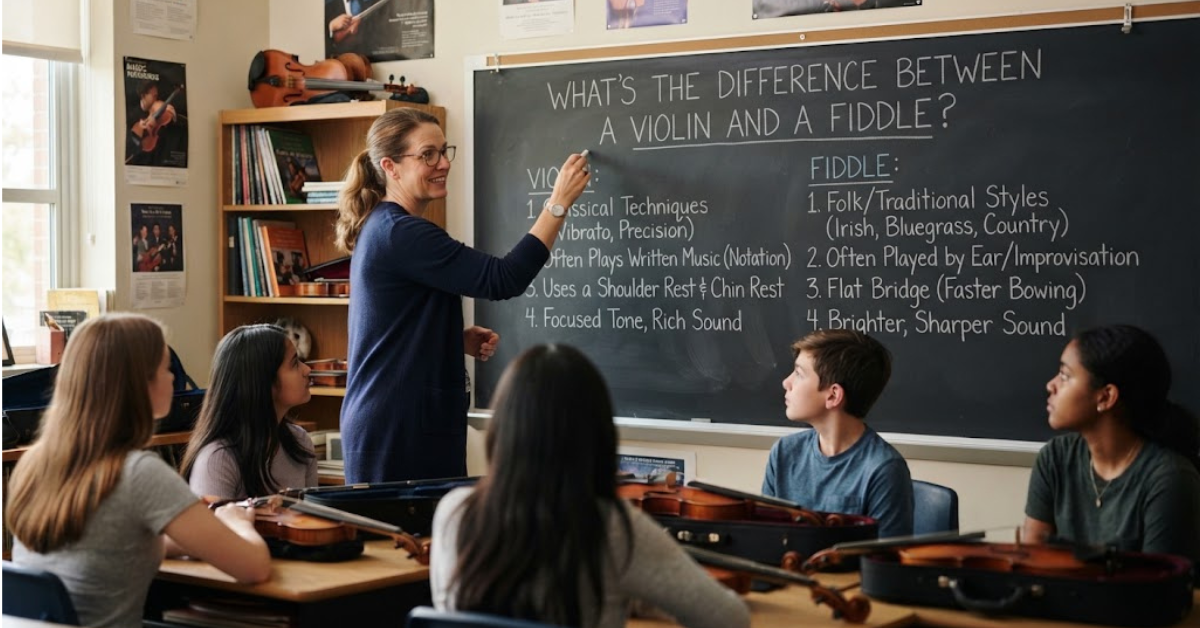
What’s the Difference Between a Violin and a Fiddle?
The biggest differences appear when we look at how the instrument is played and what kind of music it is used to perform.
1. Musical Style
This is probably the clearest distinction.
The word violin is strongly associated with classical music, including works by composers such as Bach, Mozart, Beethoven, and Tchaikovsky.
The word fiddle, meanwhile, is commonly associated with:
- Bluegrass
- Old-time music
- Country music
- Appalachian traditions
- Irish traditional music
- Scottish traditional music
- Cajun music
- Folk music
- Traditional dance music
Of course, these categories overlap. A violin can play folk music, and a fiddle can appear in arrangements that cross into classical or contemporary music.
The name often tells you more about the musical tradition than the physical instrument.
2. Playing Technique
The technique can also differ significantly.
Classical violinists generally spend years developing precise bow control, intonation, vibrato, shifting, articulation, and other techniques. Their playing often emphasizes sustained notes, controlled dynamics, complex melodies, and ensemble precision.
Fiddlers may use a different set of priorities.
Depending on the tradition, fiddle playing can emphasize:
- Rhythmic bowing
- Repeated patterns
- Quick ornaments
- Slides
- Double stops
- Open-string drones
- Shuffle patterns
- Strong rhythmic accents
A bluegrass fiddler, for example, may approach a melody very differently from a classical violinist performing a concerto.
Neither approach is inherently “better.” They’re simply designed for different musical purposes.
3. Vibrato
Vibrato is another area where the distinction becomes noticeable.
Classical violin playing often makes extensive use of vibrato, in which the player subtly varies the pitch of a sustained note to create warmth and expression.
Many traditional fiddle styles use less continuous vibrato.
Instead, fiddlers may rely more heavily on:
- Slides
- Grace notes
- Rhythmic bowing
- Ornamentation
- Double stops
- Open strings
That doesn’t mean fiddlers never use vibrato. Some absolutely do. The amount and style depend heavily on the musical tradition and the individual player.
4. Bowing Style
Bowing is one of the most important parts of the difference between fiddle and violin.
Classical violinists often use bowing techniques designed to produce particular tones, articulations, and dynamic effects.
Fiddlers frequently use bowing as a rhythmic tool.
In styles such as old-time and bluegrass, recognizable bowing patterns can become an important part of the groove. Some fiddle techniques are designed to emphasize the beat and make the melody work naturally with dancing or fast instrumental arrangements.
This is one reason a fiddle tune can feel dramatically different from a classical violin piece even though the same basic instrument is being played.
5. The Musical Repertoire
The repertoire is another major difference.
A classical violinist might perform:
- Concertos
- Sonatas
- Chamber music
- Orchestral repertoire
- Etudes
- Solo works
A fiddler might play:
- Dance tunes
- Reels
- Jigs
- Hornpipes
- Breakdown tunes
- Bluegrass songs
- Folk melodies
- Traditional regional pieces
There is plenty of crossover, but the musical traditions tend to have their own expectations and vocabulary.
Does a Fiddle Have a Different Shape Than a Violin?
Usually, no.
A common misconception is that a fiddle must have a different shape from a violin.
That’s not generally true.
Both instruments can have the familiar hourglass-shaped body, curved top and back, four strings, and two f-shaped sound holes.
However, the setup of the instrument can differ.
For example, a fiddler may prefer a bridge with a slightly different curvature or a particular string setup to make certain techniques easier.
These modifications don’t turn the instrument into a completely different type of instrument. They’re adjustments that suit the player’s musical needs.
Fiddle vs Violin: Are the Strings Different?
They can be, but they don’t have to be.
Both instruments are normally tuned:
G – D – A – E
from lowest to highest string.
Traditional violins may use a variety of string materials and constructions, including modern synthetic-core or steel-core strings.
Fiddlers also have different preferences depending on the musical style and desired sound.
Some prefer strings that produce a bright, powerful tone that cuts through a band. Others want a warmer, more complex sound.
So the strings aren’t what fundamentally separates a fiddle from a violin.
Why Do Violinists Call It a Violin and Fiddlers Call It a Fiddle?
Part of the answer comes down to musical identity.
The word “violin” carries strong associations with classical European art music. It brings to mind orchestras, concert halls, conservatories, chamber ensembles, and formal musical training.
“Fiddle,” on the other hand, has strong connections to folk traditions and informal musical communities.
A musician may even use the terminology to signal the tradition they’re participating in.
Someone might say:
“I play violin in an orchestra.”
Another person might say:
“I play fiddle in a bluegrass band.”
They could technically be holding nearly identical instruments.
The History Behind the Words
The story goes deeper than simply giving one instrument two nicknames.
Bowed string instruments have existed in many forms for centuries. European musical traditions developed numerous instruments that were related to or influenced the development of the modern violin.
The modern violin emerged in northern Italy during the 16th century, with important early makers working in places such as Brescia and Cremona.
Over time, the violin became a central instrument in European classical music.
At the same time, bowed string instruments traveled through communities, countries, and musical traditions. Folk musicians adapted them to local styles, dances, and melodies.
That’s part of why the word fiddle developed such a broad cultural identity.
The instrument became associated not only with concert music but also with social dancing, folk traditions, storytelling, and community music-making.
Classical Violin vs Fiddle: A Simple Comparison
Here’s a quick way to see the distinction:
| Feature | Classical Violin | Fiddle |
| Basic instrument | Violin | Usually a violin |
| Strings | Usually four | Usually four |
| Standard tuning | G-D-A-E | G-D-A-E |
| Common music | Classical | Folk, country, bluegrass, traditional |
| Vibrato | Often prominent | Often less continuous |
| Bowing | Focused on tone and articulation | Often strongly rhythmic |
| Repertoire | Concert and chamber music | Traditional and folk tunes |
| Setup | Classical preferences | May be adjusted for fiddle styles |
| Musical context | Orchestra, solo, chamber ensemble | Folk bands, dances, sessions |
The table highlights the key point: the distinction is mostly about musical tradition rather than basic construction.
Can a Violin Be Turned Into a Fiddle?
There’s no dramatic conversion required.
A violin doesn’t need to undergo a major transformation before it can be used as a fiddle.
A player may make adjustments to suit a particular style, such as changing strings or having the bridge setup adjusted. But a standard violin can already be used to play fiddle music.
Likewise, a fiddle can be used to play classical music if its setup and the player’s technique are appropriate.
The instrument itself doesn’t permanently belong to one category.
Can a Fiddler Play Violin?
Absolutely.
A skilled fiddler already has many of the fundamental skills needed to play the violin, including:
- Bow control
- Finger placement
- Intonation
- Rhythm
- Melody
- String crossing
- Musical phrasing
However, classical violin requires its own specialized techniques and repertoire.
A fiddler moving into classical music may need to develop skills such as more extensive vibrato control, classical bow techniques, shifting, formal articulation, sight-reading, and orchestral or chamber-music conventions.
The reverse is also true.
A classically trained violinist can learn fiddle music, but may need to develop different rhythmic and stylistic instincts.
Which Is Easier: Violin or Fiddle?
Neither is automatically easy.
Both require coordination between the left hand, right hand, ear, and sense of rhythm.
That said, some beginners may find certain fiddle traditions more approachable because traditional tunes can be learned by ear and repeated in relatively short musical patterns.
Classical violin training often involves reading notation and developing highly precise technical control.
But this doesn’t mean fiddle is “easy” and violin is “hard.”
An advanced bluegrass fiddler can have an extraordinary level of technical skill. The difficulty simply shows up in different ways.
Violin vs Fiddle: Which One Should You Learn?
The best choice depends on the music you want to play.
Choose a classical violin path if you want to:
- Play in an orchestra
- Study classical repertoire
- Perform concertos or sonatas
- Learn formal violin technique
- Join a chamber ensemble
- Pursue classical music education
Explore fiddle playing if you want to:
- Play bluegrass
- Learn country music
- Play old-time music
- Explore Celtic traditions
- Perform folk music
- Play traditional dance tunes
- Learn melodies by ear
- Jam with other musicians
You don’t necessarily have to choose one forever.
Many musicians move between classical violin and fiddle traditions throughout their lives.
Common Misconceptions About Fiddles and Violins
“A fiddle is a cheaper violin.”
Not necessarily.
A fiddle can be inexpensive or extremely valuable. Some antique and professional-level instruments used by fiddlers are worth substantial amounts.
Price doesn’t determine whether an instrument is called a fiddle.
“A fiddle has only three strings.”
No. A standard fiddle has four strings, just like a standard violin.
“A fiddle is a completely different instrument.”
Generally, no.
The term usually refers to a violin being used in a particular musical tradition.
“Only country musicians play fiddle.”
Not at all.
Fiddle traditions exist in bluegrass, old-time, Celtic, Cajun, Scandinavian, and many other musical cultures.
“Violin and fiddle are pronounced differently because they’re different instruments.”
The pronunciation difference comes from the words themselves, not from two different instrument designs.
FAQs: What’s the Difference Between a Violin and a Fiddle?
What’s the difference between a violin and a fiddle?
The basic instrument is usually the same. “Violin” is more commonly associated with classical and formal musical traditions, while “fiddle” is generally used for folk, country, bluegrass, and other traditional styles.
What is the difference between a fiddle and a violin in construction?
Usually, there is no fundamental construction difference. Both typically have four strings, a hollow wooden body, a bridge, fingerboard, tuning pegs, soundpost, and bass bar. Some fiddles may have setup adjustments suited to particular playing styles.
Is a fiddle and a violin the same thing?
For most practical purposes, yes. A fiddle is generally a violin used to play fiddle or traditional music. The terminology emphasizes musical style and tradition rather than a completely different instrument.
What is a fiddle?
A fiddle is a bowed string instrument, usually a violin, associated with folk and traditional musical styles such as bluegrass, old-time, country, Celtic, and other regional traditions.
Can you use a violin as a fiddle?
Yes. A standard violin can be used to play fiddle music. Depending on the style, a player may adjust the instrument’s setup, strings, or bridge to suit their preferences.
Can you use a fiddle as a violin?
Generally, yes. A fiddle can be used for violin repertoire as long as its setup is appropriate and the player has the required classical technique.
Why do people call a violin a fiddle?
The word “fiddle” has a long history in European and folk music. Today, it commonly signals that the instrument is being used in a folk, country, bluegrass, or traditional musical context.
Is fiddle music the same as violin music?
Not necessarily. The instrument may be essentially the same, but the musical traditions, techniques, repertoire, bowing patterns, ornamentation, and performance practices can be very different.
Conclusion: What Is the Difference Between a Fiddle and a Violin?
So, what is the difference between a fiddle and a violin?
The simplest answer is that a fiddle is generally a violin used in a folk or traditional musical context. The physical instrument can be virtually identical, but the playing style, repertoire, technique, setup, and cultural tradition may be very different.
A classical musician might pick up a violin to perform a concerto. A bluegrass musician might pick up a fiddle to play a fast breakdown. In both cases, they’re working with the same basic family of instrument.
That’s what makes the violin-versus-fiddle question so interesting: the difference isn’t necessarily in the wood, strings, or shape. It’s often in the music and the tradition behind the player.
If you’re thinking about learning one, start with the music you actually enjoy listening to. Your preferred style will tell you far more about the right learning path than the label “violin” or “fiddle” ever could.