
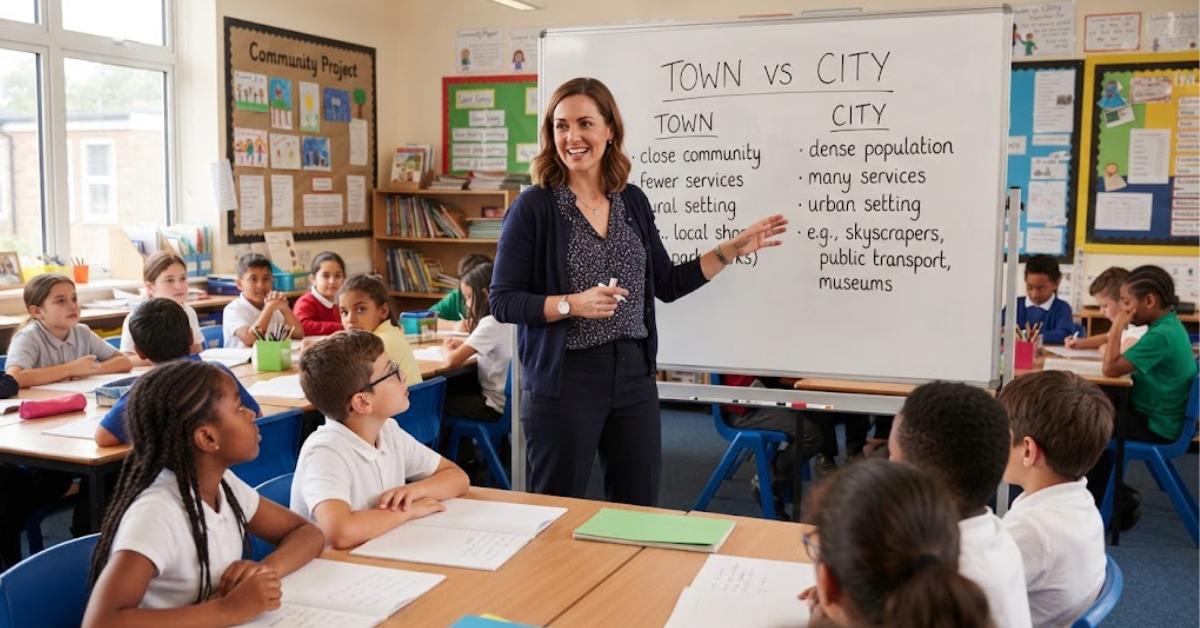
A place can have a busy main street, schools, shops, restaurants, and thousands of residents and still be called a town rather than a city. So what actually separates a town vs city?
The answer isn’t as simple as population. Different countries use different legal definitions, and even within the same country, historical status, local government, density, and regional traditions can influence whether a settlement is called a town or city.
In everyday language, a city is generally a larger and more densely developed urban settlement, while a town is usually smaller and less densely populated. But there are plenty of exceptions.
Understanding those differences also makes it easier to see where a village vs town vs city fits on the settlement spectrum.
Town vs City: What’s the Difference?
The basic distinction is usually based on size, population, density, services, infrastructure, and administrative status.
A town generally has a smaller population and a more limited range of services than a city. A city typically has a larger population, greater economic activity, more extensive infrastructure, and a wider range of institutions and services.
However, there is no universal worldwide population number that automatically turns a town into a city.
For example, one country might legally classify a settlement as a city at a relatively small population, while another might use a much higher threshold or rely primarily on legal designation.
Quick Comparison
| Feature | Town | City |
| Typical size | Smaller | Larger |
| Population | Generally lower | Generally higher |
| Population density | Usually lower | Often higher |
| Infrastructure | Moderate | Extensive |
| Public services | More limited | Broader range |
| Economic activity | Often locally focused | Often regional or national |
| Transportation | More limited | More developed |
| Land use | More mixed/open | More built-up |
| Administrative status | Varies | Often distinct legal status |
These are general patterns rather than universal rules.
What Is a Town?
A town is a human settlement that is generally larger and more developed than a village but smaller than a city.
Towns commonly serve as local centers for surrounding communities. People from nearby villages or rural areas may travel to a town for shopping, education, healthcare, employment, banking, government services, or transportation.
A typical town might contain:
- Grocery stores
- Restaurants and cafés
- Schools
- Clinics or a hospital
- Banks
- Local government offices
- Religious buildings
- Parks
- Small businesses
- Public transportation
- Residential neighborhoods
Some towns can be quite large and economically important, while others remain relatively small.
What Is a City?
A city is generally a larger, more densely developed urban settlement with a broader range of services, infrastructure, employment opportunities, and institutions.
Cities often function as economic and cultural centers for much larger surrounding regions.
Depending on its size, a city may have:
- Universities
- Major hospitals
- Large shopping districts
- Industrial areas
- Corporate offices
- Airports
- Rail networks
- Large public transportation systems
- Museums and cultural institutions
- Sports venues
- Government headquarters
- Specialized professional services
Large cities can also contain multiple distinct neighborhoods, business districts, suburbs, industrial zones, and commercial centers.
Town vs City Population: Is There a Set Number?
This is one of the most common questions about the town vs city distinction.
There is no single population threshold that applies everywhere in the world.
That’s because the classification of settlements depends on the laws and traditions of individual countries.
Population can certainly be an important factor, but it isn’t necessarily the deciding factor.
Other considerations can include:
- Legal status
- Local government structure
- Historical designation
- Population density
- Economic importance
- Infrastructure
- Administrative functions
- Regional definitions
This means a settlement with a relatively small population can sometimes have city status, while a much larger settlement elsewhere may still officially be called a town.
Why Population Alone Doesn’t Work
Imagine two settlements:
Settlement A
- 20,000 residents
- Dense urban center
- Extensive public services
- Regional government offices
- Strong commercial activity
Settlement B
- 40,000 residents
- Lower-density development
- More rural surroundings
- Limited public transportation
- Smaller service network
It wouldn’t necessarily make sense to classify Settlement B as a city simply because it has more residents.
This is why settlement classification requires more context than a population count.
Town vs City: Population Density
Population density is another useful way to understand the difference.
A town generally has less concentrated development than a large city. You may find more open land, lower-rise buildings, detached houses, and fewer extremely dense commercial districts.
Cities often have higher concentrations of people and buildings.
In major urban areas, it’s common to see:
- Apartment buildings
- Office towers
- Dense commercial streets
- Multi-story developments
- Heavy traffic
- Large transportation networks
- Closely packed neighborhoods
But density varies enormously. Some cities are relatively low-density, while some towns can have surprisingly dense centers.
Town vs City Infrastructure
Infrastructure is one of the most noticeable differences when you visit a larger city.
A small town may have a handful of major roads and local bus routes. A large city could have an extensive network of buses, trains, metro lines, highways, bridges, and other transportation infrastructure.
Cities also tend to require larger systems for:
- Water supply
- Waste collection
- Sewage
- Electricity
- Roads
- Public transportation
- Emergency services
- Healthcare
- Telecommunications
The larger the population and built-up area, the more complex these systems can become.
Town vs City Services
A town can provide most of the basic services people need for everyday life.
However, cities typically offer a greater variety and specialization of services.
For example, a town might have a general hospital, while a major city may have several hospitals with specialized departments and medical centers.
Similarly, a town might have a local college, while a city may contain multiple universities, research institutions, libraries, museums, and specialized training centers.
The important difference isn’t simply whether a service exists. It’s often the scale and variety of services available.
Town vs City Economy
Towns often have economies built around local businesses and services.
Common town-based economic activities include:
- Retail
- Restaurants
- Construction
- Agriculture-related businesses
- Local manufacturing
- Tourism
- Education
- Healthcare
- Professional services
Cities tend to have more diversified economies.
A large city may include:
- Finance
- Technology
- Manufacturing
- Media
- Government
- Education
- Healthcare
- Tourism
- International trade
- Professional services
- Corporate headquarters
This creates a broader employment market and can attract workers from surrounding towns and rural areas.
Town vs City Transportation
Transportation can be another obvious difference.
A smaller town might rely heavily on:
- Cars
- Motorcycles
- Local buses
- Walking
- Bicycles
Large cities often have more extensive public transportation systems.
Depending on the city, these can include:
- Buses
- Metro systems
- Subways
- Trams
- Commuter rail
- Regional trains
- Taxis
- Ride-sharing services
- Dedicated cycling infrastructure
Cities also tend to experience greater traffic congestion because many people are traveling through the same limited spaces.
Village vs Town vs City
The village vs town vs city comparison adds another level to the discussion.
A simplified settlement hierarchy looks like this:
Village → Town → City
However, real-world settlement systems can include many additional categories, such as hamlets, suburbs, municipalities, metropolitan areas, and megacities.
What Is a Village?
A village is generally a small settlement with a relatively small population and a more rural character.
Villages often have fewer services and businesses than towns.
Depending on the region, a village might have:
- Homes
- A small school
- Local shops
- A place of worship
- Small farms
- Community facilities
- Limited healthcare services
Some villages are primarily residential, while others are associated with farming, fishing, tourism, or other local industries.
What Is a Town?
A town generally sits between a village and a city.
It tends to have a larger population, more businesses, and a wider range of services than a village.
People living in surrounding rural areas may also depend on the town for services.
What Is a City?
A city generally has a larger and more complex urban system.
It may serve not only its residents but also people from surrounding towns and rural communities.
Large cities can become regional, national, or international centers for business, education, transportation, culture, and government.
Village vs Town vs City Comparison
| Feature | Village | Town | City |
| Typical population | Smallest | Moderate | Larger |
| Development | Mostly rural | Mixed | Predominantly urban |
| Density | Usually low | Moderate | Often higher |
| Shops | Few | Many | Extensive |
| Healthcare | Limited | Basic to moderate | Broad and specialized |
| Schools | Basic | Several | Many, including universities |
| Transportation | Limited | Local | Extensive |
| Employment | Often local | Local/regional | Regional/national/international |
| Infrastructure | Basic | Moderate | Extensive |
| Economic diversity | Lower | Moderate | Higher |
Again, this is a general framework rather than a universal legal definition.
Is a Town Always Smaller Than a City?
No—not necessarily.
In everyday usage, people generally expect a town to be smaller than a city. But official classifications can produce surprising examples.
A town in one country may have more residents than a city in another.
Historical status can also matter. A settlement may retain a particular designation even after its population changes significantly.
This is why it’s safer to treat town and city as classifications influenced by local rules rather than as strictly defined population categories.
Can a Town Become a City?
Yes, in places where city status is formally granted through a legal or administrative process.
The exact process varies by country.
A settlement may qualify based on factors such as:
- Population
- Infrastructure
- Economic significance
- Administrative importance
- Historical status
- Availability of public services
In some jurisdictions, city status is granted through government action or a formal charter.
Importantly, physical growth and legal status aren’t always the same thing. A settlement can become much larger without immediately changing its official designation.
What Is an Urban Area?
The term urban area is broader than simply “city.”
An urban area generally refers to a built-up settlement with relatively concentrated population and infrastructure.
An urban area may include:
- A central city
- Smaller towns
- Suburbs
- Industrial districts
- Residential developments
This is particularly important around major metropolitan regions, where the boundaries of a city don’t necessarily match the boundaries of the continuously built-up area.
City vs Metropolitan Area
These terms are also easy to mix up.
A city is a specific urban settlement or administrative area.
A metropolitan area generally refers to a larger region consisting of a central urban area and surrounding communities that are economically or socially connected to it.
For example, people may live in one municipality, work in another, and commute between them every day.
As a result, the metropolitan area can be much larger than the administrative city itself.
Town vs City: Advantages of Each
Neither a town nor a city is automatically better. The right environment depends on what you value.
Potential Benefits of Town Living
A town may offer:
- A quieter environment
- Less traffic
- Lower population density
- Shorter local travel distances
- Stronger small-community connections
- More access to surrounding rural areas
Potential Benefits of City Living
A city may offer:
- More employment opportunities
- Greater educational choices
- Specialized healthcare
- Extensive entertainment
- More restaurants and cultural attractions
- Larger public transportation networks
- Greater access to specialized services
Of course, these characteristics vary significantly from one place to another.
How to Tell Whether a Place Is a Town or City
If you’re trying to classify a particular settlement, don’t rely on population alone.
Instead, look at:
- Official designation — Check how the relevant government classifies it.
- Population — Consider the size of the population.
- Density — Look at how concentrated the development is.
- Infrastructure — Consider roads, transit, utilities, and public facilities.
- Services — Examine healthcare, education, retail, and government services.
- Economic role — Ask whether it serves mainly local residents or a much larger region.
- Historical context — Some places retain traditional classifications for historical reasons.
This approach gives you a much more accurate answer than simply counting residents.
Common Misconceptions About Towns and Cities
“A City Must Have More Than 100,000 People”
Not necessarily.
There is no worldwide rule requiring every city to have 100,000 residents.
Population thresholds differ between jurisdictions, and some classifications don’t depend exclusively on population.
“Every Town Is Rural”
Not necessarily.
A town can be highly developed and surrounded by urban or suburban areas.
“Cities Always Have Skyscrapers”
No.
Skyscrapers are common in some large cities but aren’t a requirement for city status.
“A Village Is Just a Small Town”
The terms overlap in everyday speech, but official definitions can differ.
A village generally has a smaller population and fewer services than a town, although local legal definitions vary.
“Town and City Mean the Same Thing Everywhere”
They don’t.
Settlement terminology is strongly influenced by local government systems, laws, history, and culture.
Town vs City Examples
Consider how the distinction works in everyday situations.
Example 1: Shopping
A village might have one or two small shops.
A town may have supermarkets, restaurants, banks, and local stores.
A city may have large shopping centers, department stores, specialty retailers, markets, and multiple commercial districts.
Example 2: Healthcare
A village may have limited medical services.
A town may have clinics and a general hospital.
A large city may have hospitals offering highly specialized medical care and multiple healthcare facilities.
Example 3: Employment
A village may have employment concentrated around agriculture, local businesses, or a small number of industries.
A town often has a wider local employment base.
A city usually has the most diverse employment market, particularly when it serves as a regional economic center.
Frequently Asked Questions About Town vs City
What is the main difference between a town and a city?
The main difference is generally scale and level of urban development. Cities tend to be larger and more densely developed, with more extensive infrastructure, services, and economic activity. However, official definitions vary by location.
Is a town smaller than a city?
Usually, yes, in everyday usage. But there is no universal population rule, so some towns can be larger than cities elsewhere.
How many people make a town a city?
There is no single worldwide population number. The threshold or classification system depends on the country, state, province, or local government involved.
What is the difference between a village, town, and city?
Generally, a village is the smallest and most rural of the three, a town is larger and provides more local services, and a city is typically larger and more complex. Legal definitions vary.
Is a city always more crowded than a town?
Not always. Cities often have higher population densities, but density varies greatly between different cities and towns.
Can a village become a town?
Yes, in jurisdictions where settlements can receive a different legal or administrative designation. The process depends on local law.
Can a town become a city?
Yes. Where city status is formally recognized, a town may receive city status through a legal or administrative process if it meets the applicable requirements.
Is a suburb a town or a city?
A suburb is not necessarily a separate town or city. It is generally a developed area associated with a larger urban center. Some suburbs are independent municipalities, while others fall within a larger city’s boundaries.
Is a metropolitan area bigger than a city?
Usually, yes. A metropolitan area can include a central city along with surrounding suburbs, towns, and other connected communities.
What is the easiest way to remember village vs town vs city?
Think of a general progression:
Village → Town → City
As you move along this spectrum, population, infrastructure, services, economic activity, and urban complexity generally increase. But local definitions can change the exact classification.
Conclusion: Town vs City
The difference between town vs city isn’t simply a matter of counting people.
A city is generally a larger, denser, and more complex urban settlement with extensive infrastructure, services, employment opportunities, and institutions. A town is typically smaller and more locally focused, although some towns can be surprisingly large and highly developed.
The same idea applies when comparing village vs town vs city. A village is generally smaller and more rural, a town occupies the middle ground, and a city usually represents a larger and more developed urban center.
The important caveat is that there is no universal definition of a town or city. Government rules, historical traditions, administrative systems, population, density, and economic importance can all influence how a settlement is classified.
So the next time you’re wondering whether a particular place is a village, town, or city, don’t look at population alone. Check its official status, infrastructure, services, density, and role within the surrounding region. That broader picture will give you a much clearer answer.