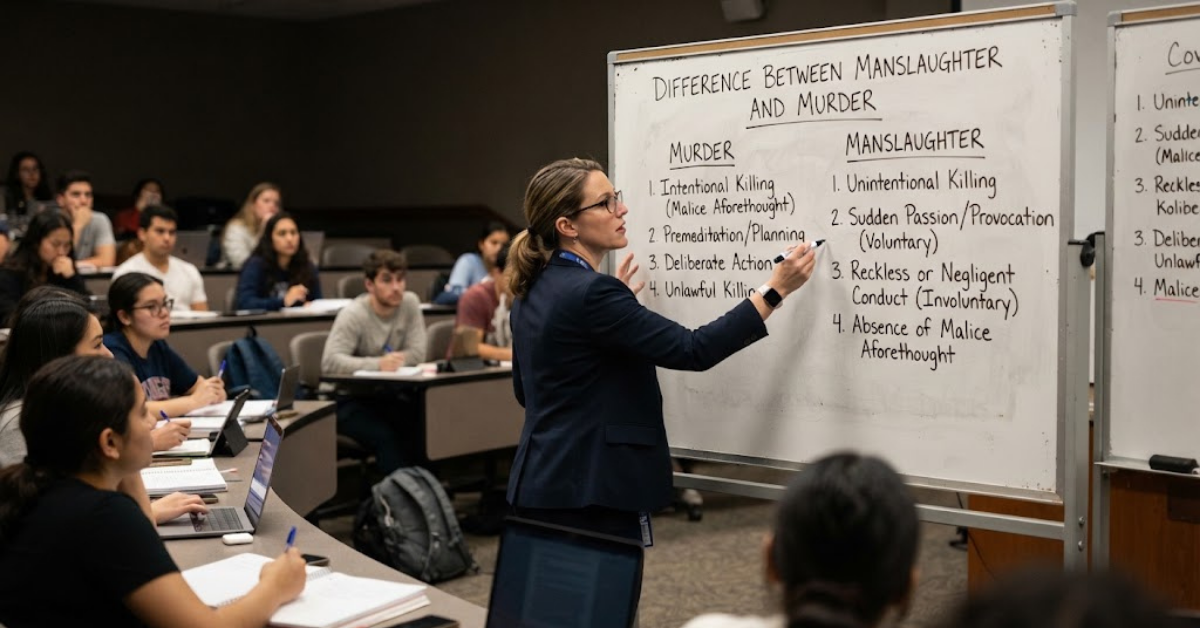
When one person causes another person’s death, the legal classification can make an enormous difference. That’s why understanding the difference between manslaughter and murder matters. Although both involve the unlawful killing of another person, they are not legally interchangeable.
The central distinction usually comes down to the defendant’s mental state and the circumstances surrounding the killing. Murder generally involves a higher level of culpability, while manslaughter generally covers unlawful killings where the required level of culpability for murder is absent or reduced by legally recognized circumstances.
However, there is no single definition that applies everywhere in the United States. Federal law, state statutes, and court decisions can use different terminology and standards.
Manslaughter vs Murder: What’s the Difference?
The easiest way to understand murder vs manslaughter is to compare the level of criminal responsibility involved.
Murder is generally an unlawful killing committed with the mental state required by the applicable murder statute. In federal law, murder is defined as the unlawful killing of a human being with malice aforethought. Federal law divides murder into first and second degrees. (18 U.S.C. § 1111)
Manslaughter is also an unlawful killing, but it generally involves less culpability than murder. Federal law defines manslaughter as an unlawful killing without malice and recognizes voluntary and involuntary manslaughter. (18 U.S.C. § 1112)
In simplified terms:
| Murder | Manslaughter |
|---|---|
| Generally involves a higher level of culpability | Generally involves a lower level of culpability |
| Can involve intentional killing | Can be intentional or unintentional, depending on the category |
| Federal law recognizes first- and second-degree murder | Federal law recognizes voluntary and involuntary manslaughter |
| Usually carries more severe penalties | Generally carries less severe penalties than murder |
These are broad principles rather than universal rules. The exact elements depend on the jurisdiction.
What Is Murder?
Murder is a criminal homicide involving the mental state and circumstances specified by the applicable law.
One important concept in U.S. federal law is malice aforethought. Federal law defines first-degree murder to include specified forms of intentional killing, including certain killings that are willful, deliberate, malicious, and premeditated. It also lists particular circumstances that qualify as first-degree murder. Other murders are classified as second-degree murder under federal law. (18 U.S.C. § 1111)
The word “murder” therefore does not simply mean “someone died because of another person.”
The prosecution generally must establish the elements required by the relevant murder statute.
First-degree murder
Under federal law, first-degree murder includes certain killings that are willful, deliberate, malicious, and premeditated, along with specified felony-related and other killings listed in the statute. (18 U.S.C. § 1111)
The exact definition of first-degree murder varies among states.
Second-degree murder
Federal law defines second-degree murder as murder that does not fall within the first-degree category. (18 U.S.C. § 1111)
States can use different definitions and classifications. Some distinguish between intentional killings and killings resulting from extremely reckless conduct, for example.
That’s why a general internet definition should not be treated as a substitute for the law in a particular state.
What Is Manslaughter?
Manslaughter generally refers to an unlawful killing that is less culpable than murder.
Under federal law, manslaughter is divided into two categories:
- Voluntary manslaughter
- Involuntary manslaughter
Federal law describes voluntary manslaughter as an unlawful killing upon a sudden quarrel or heat of passion. Involuntary manslaughter covers certain unlawful killings that occur without the level of culpability associated with voluntary manslaughter or murder. (18 U.S.C. § 1112)
State laws may use different definitions, and some states organize homicide offenses differently.
Voluntary Manslaughter vs Murder
This is one of the most important comparisons when discussing the difference between manslaughter and murder.
Voluntary manslaughter can involve an intentional killing. The key issue is that circumstances recognized by the applicable law can reduce the level of criminal culpability.
Under federal law, a sudden quarrel or heat of passion can be relevant to voluntary manslaughter. (18 U.S.C. § 1112)
Consider a simplified example.
Suppose two people become involved in an intense confrontation, and one person intentionally kills the other during circumstances that legally qualify as heat of passion.
That does not automatically make the killing manslaughter. The prosecution and court would have to apply the specific legal requirements of the relevant jurisdiction. But where the statutory requirements are satisfied, the killing may be classified as voluntary manslaughter rather than murder.
Involuntary Manslaughter vs Murder
Involuntary manslaughter generally involves a killing where the person did not intend to cause death, although the person’s conduct was sufficiently unlawful, reckless, negligent, or otherwise culpable under the applicable law.
Federal law provides several circumstances that can constitute involuntary manslaughter, including certain deaths resulting from unlawful conduct or from performing a lawful act in an unlawful manner or without due caution. (18 U.S.C. § 1112)
For example, imagine someone engages in dangerously unlawful conduct without intending to kill anyone, but another person dies as a result.
Whether that amounts to involuntary manslaughter depends on the exact facts and legal standard.
An accidental death by itself does not automatically constitute manslaughter.
What’s the Difference Between Murder and Manslaughter?
If you’re asking “what’s the difference between murder and manslaughter?”, the short answer is:
Murder generally involves a higher degree of criminal culpability, while manslaughter generally involves an unlawful killing with a lower degree of culpability or legally recognized mitigating circumstances.
The distinction can involve:
- Intent
- Malice
- Premeditation
- Recklessness
- Criminal negligence
- Provocation
- Heat of passion
- The circumstances immediately surrounding the killing
The exact factors depend on the jurisdiction.
This is also why saying “manslaughter is accidental” is too simplistic. Voluntary manslaughter can involve an intentional killing.
Intent: One of the Biggest Differences
When comparing murder vs manslaughter, intent is often one of the most important concepts.
But “intent” does not have one universal legal meaning.
A criminal statute may distinguish among mental states such as:
- Purpose
- Knowledge
- Recklessness
- Criminal negligence
The Model Penal Code, for example, uses these different mental states when defining criminal conduct. Its homicide framework distinguishes murder, manslaughter, and negligent homicide. (Cornell Law School)
This means the question isn’t simply:
“Did the person mean to kill?”
The more useful legal questions can include:
What did the person intend? What did they know? What risks did they consciously disregard? What level of negligence did they display? What circumstances surrounded the killing?
Those answers can affect the appropriate charge.
Can Manslaughter Be Intentional?
Yes.
This is a common misconception.
People often hear the word “manslaughter” and assume the death must have been completely accidental. That’s not necessarily true.
Voluntary manslaughter can involve an intentional killing. Under federal law, voluntary manslaughter includes an unlawful killing committed upon a sudden quarrel or heat of passion. (18 U.S.C. § 1112)
So the distinction between murder and manslaughter isn’t simply:
intentional = murder
accidental = manslaughter
Real criminal law is more complicated than that.
Does Premeditation Always Mean Murder?
Premeditation is important in jurisdictions that use it as part of their murder classifications, but the exact meaning varies.
Under federal law, certain willful, deliberate, malicious, and premeditated killings fall within first-degree murder. (18 U.S.C. § 1111)
But states don’t all use identical definitions of premeditation.
Some jurisdictions may interpret premeditation differently from others, and some homicide statutes use entirely different frameworks.
Therefore, premeditation should be understood as a jurisdiction-specific legal concept, not a universal test that automatically determines the charge.
Murder vs Manslaughter Penalties
Another major difference is the potential punishment.
Generally, murder carries more severe penalties than manslaughter because the law treats murder as involving greater culpability.
Under federal law, first-degree murder can be punished by death or life imprisonment, while second-degree murder can be punished by imprisonment for any term of years or for life. Federal voluntary manslaughter can result in imprisonment for up to 15 years, while involuntary manslaughter can result in imprisonment for up to 15 years. (18 U.S.C. §§ 1111–1112)
State penalties vary widely.
Factors that can affect sentencing include:
- The degree or classification of the offense
- Criminal history
- Aggravating circumstances
- Mitigating circumstances
- Whether a weapon was involved
- The victim’s circumstances
- Plea agreements
- Sentencing guidelines or statutory ranges
Because penalties can differ substantially, anyone facing a real criminal charge should consult a qualified criminal defense attorney in the relevant jurisdiction.
Manslaughter vs Murders in the U.S.
Searches for “manslaughter vs murders us” can be confusing because the United States does not have one single criminal code governing every murder and manslaughter case.
There are federal criminal laws, but most homicide prosecutions are handled under state law.
That means the definition of murder or manslaughter in California, Texas, New York, Florida, or another state may differ from the federal definitions described above.
Even terminology can vary.
One state may have specific degrees of manslaughter, while another may organize unlawful killings under different categories.
For accurate legal information, always identify the state or federal jurisdiction involved.
Simple Examples of Murder and Manslaughter
Examples can help illustrate the concepts, but they are deliberately simplified.
Example 1: Planned killing
A person deliberately plans to kill another person and carries out the plan.
If the prosecution proves the elements required by the jurisdiction’s murder statute, the conduct could constitute murder.
Example 2: Intentional killing during qualifying heat of passion
A person intentionally kills another during circumstances that legally satisfy the requirements for voluntary manslaughter.
Depending on the jurisdiction, the killing could be classified as voluntary manslaughter rather than murder.
Example 3: Unintentional criminally culpable killing
A person engages in conduct that meets the jurisdiction’s legal standard for involuntary manslaughter, and another person dies as a result.
The absence of an intent to kill does not necessarily eliminate criminal responsibility.
Example 4: Lawful killing
A person causes another person’s death while acting within a legally recognized justification, such as lawful self-defense.
The killing may not constitute a criminal homicide at all.
The specific requirements for self-defense and other justifications vary by jurisdiction.
Murder, Manslaughter, and Homicide: How They Connect
It’s helpful to place all three terms in context.
Homicide is the broadest term. It refers generally to one person causing the death of another.
Murder and manslaughter are categories of criminal homicide, although the precise classification depends on the jurisdiction.
A simplified way to visualize the relationship is:
Homicide → Criminal homicide → Murder / Manslaughter / Other offenses
The categories aren’t identical everywhere, but this framework explains why a homicide investigation does not automatically mean that someone committed murder.
Common Misunderstandings About Murder and Manslaughter
“Manslaughter is just an accidental murder.”
No.
Manslaughter has its own legal elements. Voluntary manslaughter, in particular, can involve an intentional killing.
“Every intentional killing is murder.”
Not necessarily.
Certain jurisdictions recognize circumstances that can reduce an intentional killing to voluntary manslaughter or make the killing legally justified.
“Every accidental death is manslaughter.”
No.
An accidental death is not automatically criminal. The person’s conduct must satisfy the legal requirements of the applicable offense.
“Murder always requires months of planning.”
Not necessarily.
While premeditation is part of certain murder classifications, the law does not universally require lengthy advance planning for a killing to constitute murder.
“Manslaughter isn’t a serious crime.”
It is.
Manslaughter is a serious criminal offense and can carry substantial prison sentences.
How Prosecutors Decide Between Murder and Manslaughter
A prosecutor doesn’t simply choose whichever label sounds appropriate.
The decision generally depends on whether the available evidence supports the elements of a particular offense.
Evidence can include:
- Witness statements
- Video footage
- Forensic evidence
- Medical and autopsy findings
- Digital communications
- Physical evidence
- Statements made by the accused
- Evidence concerning the events before the killing
Prosecutors must consider the applicable statute and whether the evidence is sufficient to prove the required elements beyond a reasonable doubt at trial.
A case can also change as an investigation develops.
What initially appears to be one type of killing may later be classified differently as additional evidence becomes available.
Frequently Asked Questions
What’s the difference between murder and manslaughter?
The difference between murder and manslaughter generally involves the level of criminal culpability and the circumstances surrounding the killing. Murder typically involves a higher level of culpability, while manslaughter generally involves a lower level of culpability or legally recognized mitigating circumstances.
What’s the difference between manslaughter and murder?
Manslaughter and murder are both forms of unlawful killing, but murder generally involves greater culpability. Voluntary manslaughter can involve an intentional killing, while involuntary manslaughter generally involves an unlawful killing without an intent to kill.
Is manslaughter a lesser form of murder?
It is better to say that manslaughter is generally a less severely culpable category of unlawful homicide, rather than simply calling it a lesser form of murder. The precise relationship depends on the jurisdiction.
Is manslaughter always accidental?
No. Voluntary manslaughter can involve an intentional killing when the circumstances satisfy the requirements of the applicable law.
Is murder always premeditated?
No. The exact requirements depend on the jurisdiction. Under federal law, premeditation is relevant to specified first-degree murder offenses, but second-degree murder does not require the same first-degree classification. (18 U.S.C. § 1111)
Which is worse, murder or manslaughter?
Generally, murder is treated as the more serious offense because it involves a higher level of culpability. However, the exact offenses and penalties vary by jurisdiction.
Can you be charged with manslaughter without intending to kill someone?
Yes. Involuntary manslaughter laws can cover certain unlawful killings where there was no intent to kill, depending on the applicable legal standard.
What is the difference between voluntary and involuntary manslaughter?
Voluntary manslaughter generally involves an intentional killing under circumstances that legally reduce culpability. Involuntary manslaughter generally involves an unlawful killing without an intent to kill, although the exact definitions vary.
Does manslaughter carry prison time?
It can. Manslaughter is a serious criminal offense, and both federal and state laws can impose substantial prison sentences. The applicable penalty depends on the jurisdiction and specific offense.
Are murder and manslaughter the same as homicide?
No. Homicide is the broader term for one person causing another person’s death. Murder and manslaughter are specific criminal classifications within the broader concept of homicide.
Conclusion: The Difference Between Manslaughter and Murder
The difference between manslaughter and murder is primarily about criminal culpability and the circumstances surrounding the killing.
Murder generally involves a greater level of culpability, while manslaughter generally involves an unlawful killing where the legal requirements for murder are not met or where recognized circumstances reduce the offense to manslaughter. Under U.S. federal law, voluntary and involuntary manslaughter are specifically distinguished from murder. (18 U.S.C. §§ 1111–1112)
The most important thing to remember is that manslaughter does not necessarily mean accidental, and murder does not always mean a lengthy period of planning. Intent, mental state, provocation, recklessness, negligence, and other circumstances can all matter.
If you’re researching murder vs manslaughter for general knowledge, the distinction above provides a useful foundation. If the question concerns an actual criminal case, however, the law of the specific state or federal jurisdiction should be examined with the help of a qualified legal professional.