Getting parole and probation confused is easy. Both involve supervision in the community, both come with rules, and violating either can lead to serious consequences. But they are not the same thing.
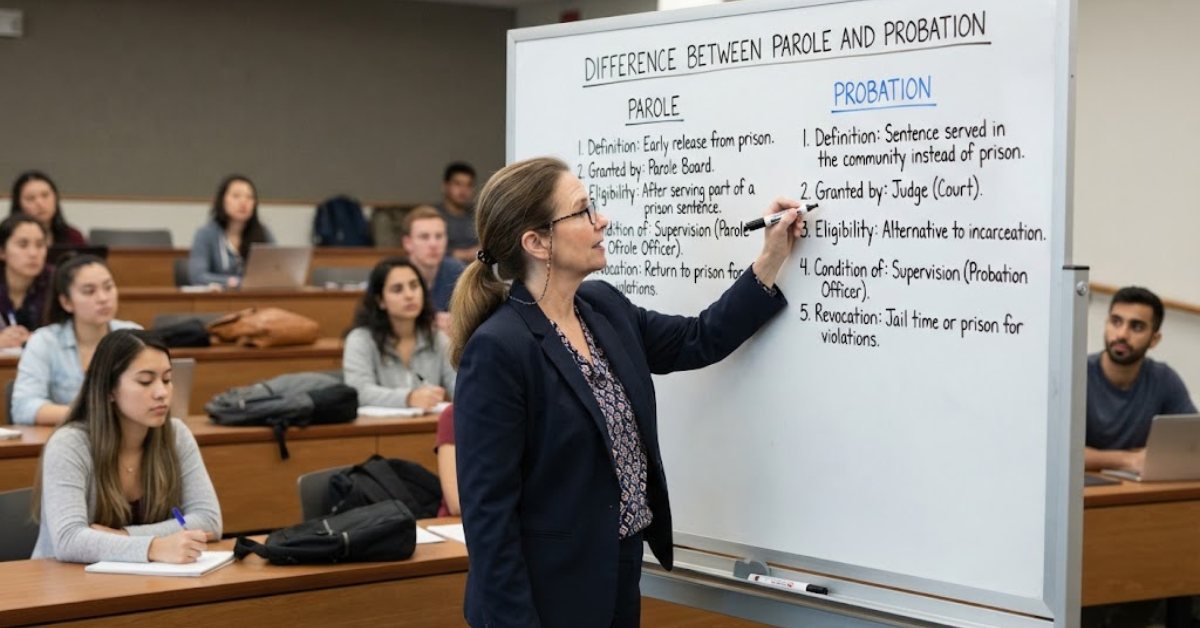
The biggest difference between parole and probation is when they occur. Probation is generally an alternative to incarceration or a sentence served in the community, while parole usually allows someone to serve part of a prison sentence outside prison under supervision. The exact rules vary by jurisdiction, so the terms should always be understood in the context of the applicable law.
Difference Between Parole and Probation at a Glance
A simple comparison makes the distinction easier to understand:
| Feature | Probation | Parole |
|---|---|---|
| When it generally occurs | Instead of incarceration or as part of a sentence served in the community | After a person has served part of a prison sentence |
| Main purpose | Community supervision and rehabilitation | Supervised release after incarceration |
| Who may supervise | Probation officer or supervising agency | Parole officer or supervising agency |
| Court involvement | Often ordered as part of sentencing | Often involves a parole authority, depending on jurisdiction |
| Conditions | Reporting, treatment, employment, travel restrictions, and other requirements | Reporting, treatment, employment, travel restrictions, and other requirements |
| Violation consequences | May result in sanctions or changes to the sentence | May result in sanctions, including possible return to custody |
These are general distinctions rather than universal rules. Criminal justice systems differ significantly between countries, states, and other jurisdictions.
What Is Probation?
Probation is a form of community supervision that allows a person to remain in the community while following specific conditions imposed by a court or authorized legal system.
In many cases, probation is used instead of incarceration. It can also be imposed after a person has served some time in custody, depending on the jurisdiction and sentence.
Typical probation conditions may include:
- Reporting regularly to a probation officer
- Avoiding new criminal offenses
- Attending counseling or treatment
- Maintaining employment or education
- Avoiding certain people or locations
- Submitting to drug or alcohol testing
- Paying fines, restitution, or other court-ordered amounts
- Following travel restrictions
The precise conditions depend on the offense, the person’s circumstances, and the law governing the case.
How probation works
A typical probation arrangement may involve several stages:
- Sentencing or court order: The court establishes probation and its conditions.
- Supervision: The person reports to the appropriate supervising authority.
- Compliance: The person must follow the conditions for the required period.
- Completion: If the conditions are satisfied, probation may end when the supervision period expires.
Probation is therefore closely connected to the sentencing process.
What Is Parole?
Parole generally refers to the supervised release of a person from prison before the completion of the full custodial portion of a sentence, subject to conditions.
Instead of remaining incarcerated for the entire period, an eligible person may be released into the community while continuing to be legally supervised.
Parole conditions can include:
- Regular meetings with a parole officer
- Restrictions on travel
- Employment requirements
- Drug or alcohol testing
- Participation in treatment programs
- Restrictions on weapons
- Restrictions on contact with certain people
- Compliance with laws and supervision rules
Parole is therefore generally associated with the transition from incarceration back into the community.
How parole works
The process varies considerably by jurisdiction. In systems where discretionary parole exists, a parole authority may evaluate whether an incarcerated person should be released under supervision.
In other systems, release may occur according to statutory rules rather than an individual parole decision.
Once released, the person must comply with the conditions of supervision. Serious or repeated violations can result in additional sanctions and, depending on the law, a return to custody.
Parole vs. Probation: The Main Difference
The clearest way to remember the distinction is to think about where the person is in the criminal justice process.
Probation generally involves supervision in the community as part of a sentence without requiring the person to serve the entire sentence in prison.
Parole generally involves supervised community release after the person has already spent time incarcerated.
In simple terms:
Probation usually comes instead of—or as an alternative to—incarceration, while parole generally comes after incarceration.
That is a useful rule of thumb, but it should not be treated as a universal legal definition because jurisdictions structure these systems differently.
What Is the Purpose of Probation?
Probation serves several purposes beyond simply monitoring someone’s behavior.
Rehabilitation
Probation can give people access to treatment, counseling, education, employment support, or other programs intended to reduce the likelihood of future offending.
Accountability
A person on probation remains subject to legally enforceable conditions. Failing to follow those requirements can result in consequences.
Community supervision
Probation allows authorities to monitor compliance while the person remains in the community rather than being incarcerated in every case.
Reducing unnecessary incarceration
For appropriate cases, community-based supervision can provide an alternative to confinement while still imposing legal restrictions and accountability.
What Is the Purpose of Parole?
Parole has a somewhat different role because it generally follows incarceration.
Reintegration
A person leaving prison may face challenges involving employment, housing, family relationships, healthcare, and other practical issues. Supervision can provide structure during the transition.
Public safety
Parole conditions can restrict behavior and provide mechanisms for responding to violations.
Continued accountability
Although a person has left prison, release under parole generally does not mean that all legal supervision has ended.
Gradual transition
Supervised release can provide a structured bridge between incarceration and unrestricted community life.
What Happens If Probation Is Violated?
A probation violation can occur when someone fails to comply with a condition of supervision.
Examples may include:
- Missing required appointments
- Failing a drug test
- Leaving the jurisdiction without permission
- Failing to complete a required program
- Committing a new offense
- Violating a no-contact condition
The consequences depend on the jurisdiction and seriousness of the violation.
Possible responses can include:
- A warning
- Additional supervision conditions
- Treatment or counseling requirements
- Increased reporting
- Fines or other sanctions
- Modification of probation
- Revocation of probation
- Incarceration in appropriate cases
A violation does not automatically mean that the person will be sent to prison. Courts may consider the nature of the violation and other circumstances.
What Happens If Parole Is Violated?
Parole violations can also result in significant consequences.
A parole authority or court, depending on the legal system, may respond to violations through measures such as:
- Increased supervision
- Additional conditions
- Counseling or treatment
- Formal warnings
- Other intermediate sanctions
- Revocation of parole
- Return to custody
The specific procedure and possible penalties vary by jurisdiction.
This is one reason people on parole should understand every condition of their release and seek qualified legal advice if they are accused of violating one.
Can You Be on Probation and Parole at the Same Time?
It can be possible for a person to have multiple forms of supervision, depending on the jurisdiction and the sentences involved.
For example, separate cases may produce different supervision requirements. A person could potentially have obligations arising from both a parole arrangement and a probation sentence.
However, whether this is legally possible—and how overlapping conditions are handled—depends on the applicable law and the specific case.
Parole and Probation Officers: What Do They Do?
Both types of supervision can involve officers who monitor compliance, although their precise duties vary.
A probation officer may:
- Monitor compliance with court orders
- Meet with the person under supervision
- Conduct or arrange drug testing
- Connect people with treatment programs
- Prepare reports for the court
- Verify compliance with specific conditions
A parole officer may perform many similar functions while focusing on someone who has been released from incarceration under parole supervision.
Both roles can involve enforcement as well as rehabilitation and support.
Common Misunderstandings About Parole and Probation
“They are basically the same thing.”
Not exactly. Both involve community supervision, but their place in the criminal justice process is usually different.
“Parole means the sentence is over.”
Generally, parole does not mean that all legal consequences have disappeared. A person released on parole may still be subject to enforceable conditions.
“Probation always means no prison.”
Not necessarily. Sentencing structures vary, and probation can sometimes be combined with a period of incarceration or other penalties.
“A violation automatically means prison.”
Not always. The response to a violation depends on the circumstances, applicable law, and available sanctions.
“The rules are identical everywhere.”
They are not. Definitions, eligibility rules, supervision periods, violation procedures, and release mechanisms can differ significantly between jurisdictions.
How to Remember the Difference Between Parole and Probation
If you need a quick memory trick, think about the timeline:
Probation → community supervision as part of sentencing
Prison → incarceration
Parole → supervised community release after prison
This isn’t a substitute for the legal definitions in a particular jurisdiction, but it provides a useful starting point.
Frequently Asked Questions
What is the difference between parole and probation?
The main difference between parole and probation is generally their place in the criminal justice process. Probation is usually community supervision imposed as part of a sentence instead of, or alongside, incarceration. Parole generally refers to supervised release from prison before the custodial sentence is fully completed.
Is parole better than probation?
Neither is automatically “better.” They serve different purposes and apply at different stages of a criminal sentence. The appropriate form of supervision depends on the person’s case and the law in the relevant jurisdiction.
Is probation the same as parole?
No. Although both involve supervision in the community, probation generally relates to sentencing and community-based supervision, while parole generally follows a period of incarceration.
Can probation lead to jail or prison?
It can. If probation is violated, a court may impose sanctions that can include incarceration where permitted by law and appropriate to the circumstances.
Can parole be revoked?
In jurisdictions that provide for parole revocation, serious violations can lead to parole being revoked and the person potentially being returned to custody. The exact procedure varies by jurisdiction.
Do parole and probation have the same conditions?
They can have similar conditions, such as reporting requirements, treatment, employment expectations, and travel restrictions. However, the exact conditions depend on the sentence, release terms, and applicable law.
Who supervises someone on probation?
Probation is commonly supervised by a probation officer or relevant community corrections agency. The exact structure depends on the jurisdiction.
Who supervises someone on parole?
Parole is commonly supervised by a parole officer or corrections agency. The specific authority responsible for supervision varies by jurisdiction.
Can someone refuse probation or parole?
The legal consequences of refusing or declining supervision depend on the jurisdiction and the specific sentence or release arrangement. Because this can have serious consequences, anyone facing that situation should obtain advice from a qualified attorney or appropriate legal professional.
Conclusion: Understanding Parole vs. Probation
Understanding the difference between parole and probation becomes much easier when you focus on timing.
Probation generally involves community supervision as part of a sentence, often instead of incarceration. Parole generally involves supervised release after a person has served time in prison. Both can impose strict conditions, and violating those conditions can result in significant consequences.
The terminology and procedures are not identical everywhere, so anyone dealing with an actual criminal case should look at the law and court or correctional documents governing that case.
For general knowledge, though, remember the simple distinction: probation is usually tied to sentencing and community supervision, while parole is usually tied to supervised release from prison.