
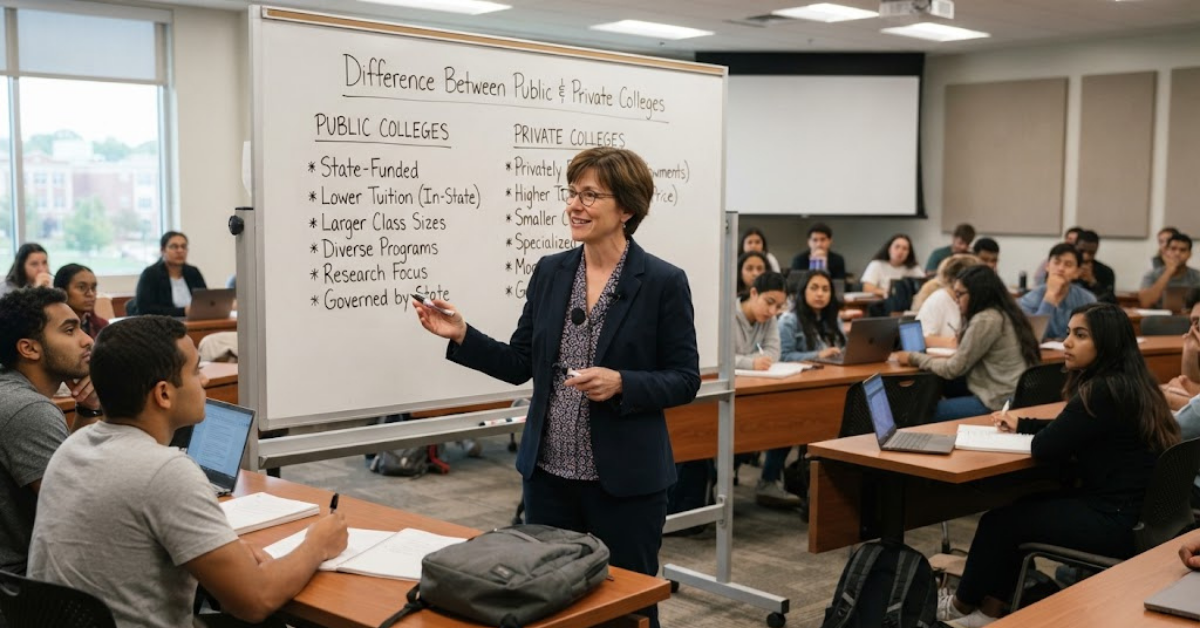
Choosing a college is a major decision, and the type of institution you attend can shape everything from your tuition bill to your campus experience. One of the first questions students face is the difference between public and private colleges.
At a basic level, public colleges are generally funded in part by state governments, while private colleges rely more heavily on tuition, endowments, donations, and other private sources. But that simple distinction doesn’t tell the whole story.
When comparing private vs public college, you’ll also want to consider tuition, financial aid, enrollment size, admissions, academic programs, campus culture, and whether you qualify for in-state tuition.
There is no universal winner. The better choice depends on your academic goals, finances, location, and what you want from your college experience.
What Is the Difference Between Public and Private Colleges?
The biggest distinction is how the institution is funded and governed.
Public colleges and universities are typically established and supported by state governments. They often receive some public funding and may be part of a statewide higher-education system.
Private colleges and universities are generally independent institutions. They may be nonprofit organizations governed by their own boards, although the broader category of private higher education also includes for-profit institutions.
Both types can offer undergraduate and graduate degrees, professional programs, research opportunities, student organizations, athletics, and extensive campus resources.
In other words, public does not automatically mean low quality, and private does not automatically mean expensive or better.
Public vs Private College at a Glance
Here’s a quick way to compare the two:
| Feature | Public College | Private College |
|---|---|---|
| Primary funding | State support, tuition, grants, other revenue | Tuition, endowment, donations, grants, other revenue |
| In-state tuition | Often substantially lower for eligible residents | Usually no state-resident tuition discount |
| Out-of-state tuition | Often higher | Generally the same published tuition regardless of state |
| Average enrollment | Often larger | Often smaller, though exceptions are common |
| Class sizes | Can range from small to very large | Often smaller on average |
| Financial aid | Federal, state, institutional, and other aid | Federal, state, institutional, and other aid |
| Campus setting | Frequently large campuses and systems | Wide variety of campus sizes and settings |
| Admissions | Varies significantly by institution | Varies significantly by institution |
| Research | Many major public research universities | Many major private research universities |
| Academic quality | Ranges widely | Ranges widely |
These are broad patterns, not rules. A particular public university may have smaller classes than a particular private college, and some private universities are much larger than public colleges.
Private vs Public University: How Funding Works
Funding is one of the most important differences.
How public colleges are funded
Public institutions commonly receive some funding from state governments. They also generate revenue through tuition, federal funding, research grants, athletics, housing, healthcare systems, and other activities.
Because taxpayers contribute to state funding, public institutions often offer lower tuition rates to eligible residents of that state.
This is why in-state tuition can be such an important factor when comparing public universities.
How private colleges are funded
Private colleges generally do not receive the same level of direct state operating support as public institutions.
Instead, they may rely more heavily on:
- Tuition
- Endowment income
- Alumni donations
- Private gifts
- Research grants
- Investment income
- Sponsored programs
- Other institutional revenue
Private schools may therefore have higher published tuition prices. However, the amount a student actually pays can be substantially lower after grants and scholarships.
That’s an important point: sticker price and net price are not the same thing.
Public vs Private College: Which Is Cheaper?
This is one of the biggest questions students ask, but there isn’t a simple answer.
Public colleges often have lower published tuition for in-state students. Out-of-state students may pay considerably more.
Private colleges generally charge the same published tuition regardless of whether a student comes from the same state as the institution.
However, private colleges may offer substantial institutional financial aid.
For example, a private school might have a higher advertised tuition price but provide a large scholarship that brings the student’s actual cost much closer to—or sometimes below—the cost of attending a public university.
Look at net price, not just tuition
When comparing schools, consider:
- Tuition and mandatory fees
- Housing
- Food
- Books and supplies
- Transportation
- Health insurance where applicable
- Scholarships and grants
- Work-study or employment
- Loans
- Other personal expenses
The number that matters most is the amount your family is actually expected to pay after grants and scholarships.
In-State vs Out-of-State Tuition
This is an especially important consideration when comparing public and private universities.
A public university may charge different tuition rates based on residency.
For example:
- In-state student: Lower tuition rate
- Out-of-state student: Higher tuition rate
Private colleges generally don’t use the same state-residency tuition model.
This means a student living near a public university may have a significant financial advantage if they qualify for in-state tuition.
But don’t assume that living close to campus automatically makes you an in-state student. Residency rules can be complicated and vary by state and institution.
Private vs Public University: Admissions
Admissions standards depend far more on the individual institution than on whether it is public or private.
Some public universities have extremely selective admissions processes. Some private colleges are also highly selective, while others admit a much larger percentage of applicants.
When evaluating admissions, look at factors such as:
- Acceptance rate
- Average academic profile
- Required courses
- Test policies
- Application deadlines
- Essays
- Recommendations
- Extracurricular activities
- Transfer policies
- Program-specific requirements
Don’t assume that “private” means selective or that “public” means easy to get into.
The specific college matters more than the label.
Class Size: Public vs Private College
Class size is another area where generalizations can be misleading.
Large public universities may offer introductory courses with hundreds of students, particularly in popular subjects.
Private colleges often have smaller undergraduate enrollments, which can make smaller classes more common.
But there are exceptions.
A public university may offer small seminars and discussion-based classes, while a private university may have large lecture courses.
If class size matters to you, investigate the actual department and course structure rather than relying solely on the institution’s public or private status.
Student-to-Faculty Ratio
Private colleges often advertise lower student-to-faculty ratios, which can suggest greater access to professors.
But this number should be interpreted carefully.
A low student-to-faculty ratio does not necessarily mean every class is tiny or that every professor teaches the same number of students.
Look beyond the headline number and ask:
- How large are introductory courses?
- How accessible are professors?
- Are classes taught mainly by professors or teaching assistants?
- Can undergraduates participate in research?
- How easy is it to meet with instructors?
These details provide a much clearer picture of the academic experience.
Academic Programs and Majors
Both public and private colleges can offer excellent academic programs.
Large public universities may have an advantage in the breadth of majors and specialized programs because of their size.
You may find extensive options in areas such as:
- Engineering
- Business
- Agriculture
- Computer science
- Medicine
- Education
- Public policy
- Sciences
- Communications
Private colleges can also offer extensive academic choices, particularly at large private universities.
Smaller private liberal arts colleges may offer fewer majors but provide broad undergraduate education and close faculty interaction.
The best approach is to compare the exact major you want at each school.
Research Opportunities
Public universities and private universities can both be major research institutions.
Large research universities often have extensive laboratories, graduate programs, medical centers, and externally funded research projects.
This can create opportunities for undergraduates to work with faculty members or participate in research programs.
Private institutions can have equally strong research environments.
If research matters to you, look at:
- Faculty research areas
- Undergraduate research programs
- Research funding
- Laboratory facilities
- Internship opportunities
- Access to professors
- Whether undergraduates can earn research credit
The public/private label alone doesn’t tell you how strong the research experience will be.
Campus Size and Student Life
Campus experience can feel very different from one institution to another.
Large public universities may have:
- Large student populations
- Extensive athletic programs
- Many student organizations
- Large libraries and recreation facilities
- Big campus events
- Diverse academic communities
Private colleges may offer:
- Smaller student communities
- More intimate campus environments
- Smaller residence communities
- Close alumni networks
- More centralized student activities
But again, there are plenty of exceptions.
Some private universities have tens of thousands of students, while some public colleges are relatively small.
Public vs Private College: Financial Aid
Financial aid is one of the areas where students should avoid assumptions.
Students at both public and private institutions may qualify for:
- Federal grants
- Federal student loans
- Work-study
- State financial aid
- Institutional scholarships
- Merit scholarships
- Need-based grants
- Outside scholarships
Private colleges sometimes have larger institutional aid budgets, allowing them to provide substantial grants to certain students.
Public universities can also offer significant scholarships and financial assistance.
The best comparison is the financial aid offer from each school, not the school’s category.
Merit Scholarships
Merit aid is another factor worth investigating.
Some colleges award scholarships based on academic performance, leadership, athletics, artistic ability, or other achievements.
Scholarship policies vary considerably.
A student who receives a large merit award from one college might receive little or no merit aid from another.
If you’re comparing costs, check:
- Eligibility requirements
- Automatic versus competitive scholarships
- Minimum GPA requirements
- Renewal conditions
- Whether the scholarship covers tuition only or other expenses
- How long the award lasts
A scholarship that requires you to maintain a certain GPA can affect your financial planning throughout college.
Public vs Private University: Alumni Networks
Both public and private colleges can have powerful alumni networks.
Large public universities often have enormous alumni populations spread across industries and geographic regions.
Private colleges, especially smaller institutions, may have highly connected alumni communities.
But the value of an alumni network depends on how actively students use it.
Look for:
- Internship programs
- Alumni mentoring
- Career fairs
- Networking events
- Career counseling
- Industry connections
- Graduate outcomes
A prestigious-sounding network isn’t particularly useful if students have difficulty accessing it.
Which Has Better Career Opportunities?
There is no universal answer.
Employers generally care about the combination of your education, skills, experience, internships, communication abilities, professional network, and the reputation of the specific program.
For some careers, the institution’s reputation can matter significantly. In other fields, your portfolio, certifications, internships, research, or practical experience may carry more weight.
Instead of asking whether public or private colleges have better career opportunities, compare:
Program → Internship access → Career services → Employer connections → Alumni outcomes
That’s much more useful.
Advantages of Public Colleges
Public institutions can be particularly attractive if you want:
Lower in-state tuition
Residents may receive substantial tuition discounts at their state’s public institutions.
More academic choices
Large universities can offer hundreds of majors, minors, certificates, and concentrations.
Large-campus experience
Students who enjoy major sporting events, large organizations, and a busy campus environment may prefer a big public university.
Strong research infrastructure
Many public research universities operate extensive laboratories, research centers, hospitals, and graduate programs.
Advantages of Private Colleges
Private institutions can offer their own strengths.
Smaller communities
Some private colleges provide a more intimate campus environment.
Potentially strong institutional aid
Certain private schools have significant financial-aid resources and may provide generous grants to qualifying students.
Specialized academic environments
A private college may have a particular strength in liberal arts, business, engineering, arts, religion, or another field.
Close-knit alumni communities
Smaller institutions sometimes develop strong long-term relationships among graduates.
Disadvantages of Public Colleges
Public colleges can have drawbacks depending on the institution.
Potential challenges include:
- Large introductory classes
- Less individualized attention in some courses
- Higher out-of-state tuition
- Large or crowded campuses
- More complex administrative systems
These aren’t universal problems. Many public institutions provide excellent student support.
Disadvantages of Private Colleges
Private colleges can also present challenges.
Potential concerns include:
- Higher published tuition
- Smaller selection of majors at some institutions
- Smaller campuses
- Limited course availability at smaller schools
- Less state-based tuition assistance
Again, these vary substantially by college.
Public vs Private College: Which Is Better?
There is no single “better” category.
A public university may be the better choice for one student because it offers an excellent engineering program at an affordable in-state price.
A private college might be better for another student because it offers a smaller campus, a strong scholarship, and close faculty relationships.
Instead of asking public vs private college, ask:
Which specific college gives me the strongest combination of education, affordability, opportunities, and personal fit?
That’s the question that actually matters.
How to Choose Between a Public and Private College
Use this process when comparing schools.
1. Identify your priorities
Write down your top five priorities.
For example:
- Major
- Cost
- Location
- Campus size
- Class size
2. Compare the actual programs
Don’t compare universities based only on overall reputation.
Look at the department you would actually attend.
3. Calculate your estimated net cost
Compare financial-aid offers and total expenses.
4. Consider location
Think about whether you want to live close to home or move farther away.
5. Investigate student life
Look at housing, clubs, sports, campus activities, and the surrounding community.
6. Consider career opportunities
Research internships, employers, alumni networks, and career services.
7. Visit when possible
A campus tour can reveal things that rankings and brochures can’t.
Pay attention to:
- Classroom atmosphere
- Student interactions
- Housing
- Dining
- Facilities
- Transportation
- Overall campus feel
Common Mistakes Students Make
Looking only at tuition
A higher sticker price doesn’t necessarily mean a higher final cost.
Choosing based solely on rankings
Rankings can be useful, but they don’t tell you whether a college fits your goals.
Assuming private means better
Private status doesn’t guarantee better academics.
Assuming public means cheaper
It can be cheaper for in-state students, but out-of-state tuition can change the calculation.
Ignoring financial aid
A college’s financial-aid package can dramatically change affordability.
Choosing a school without researching the major
The quality and opportunities within your specific department can matter more than the overall institution.
Frequently Asked Questions
What is the difference between public and private colleges?
The main difference is funding and governance. Public colleges are generally supported in part by state governments, while private colleges are generally independently governed and rely more heavily on tuition, endowments, donations, grants, and other private revenue.
Is a public or private college cheaper?
It depends. Public colleges often have lower tuition for in-state students, while private colleges may provide substantial institutional scholarships and grants. Compare each school’s actual net cost rather than relying on published tuition.
Is a private university better than a public university?
Not necessarily. Both public and private universities can have excellent academic programs, faculty, research opportunities, and career outcomes. The best choice depends on the specific institution and your goals.
What is the difference between a public and private university?
The primary distinction is ownership, governance, and funding. Public universities are generally associated with state governments, while private universities operate independently. Both can be large research institutions offering undergraduate and graduate degrees.
Do private colleges have smaller classes?
Private colleges often have smaller enrollments and may have smaller classes on average, but this isn’t guaranteed. Some private universities have very large lecture courses, while many public universities offer small classes.
Do public colleges offer financial aid?
Yes. Students at public colleges may qualify for federal, state, institutional, and other forms of financial aid, including grants, scholarships, work-study, and loans.
Do private colleges offer more scholarships?
Some private colleges have substantial institutional aid programs, but there is no universal rule. Scholarship availability varies by institution, academic profile, financial need, and other factors.
Is public college better for an undergraduate degree?
Not automatically. A public college may be an excellent choice for undergraduate students who value lower in-state tuition, a broad selection of programs, or a large-campus environment. A private college may be preferable for students seeking a smaller community or a particular academic program.
Is private college worth the extra cost?
It can be, but only if the additional cost provides meaningful value for you. Compare financial aid, academic programs, career opportunities, class sizes, location, and total net price before deciding.
Which is better for financial aid, public or private college?
Neither is automatically better. Financial-aid policies vary significantly from one school to another. Compare the actual aid offers you receive from each institution.
Do public and private colleges have different admission requirements?
They can, but there is no universal admissions standard for either category. Requirements depend on the individual college, program, and applicant.
Conclusion: Public vs Private College
Understanding the difference between public and private colleges is a useful starting point, but it shouldn’t be the final factor in your decision.
Public colleges are generally supported in part by state funding and can offer significant tuition advantages to eligible in-state students. Private colleges operate independently and may have higher published tuition, but some offer substantial institutional scholarships and grants.
When comparing private vs public university options, look beyond the sticker price. Consider the exact academic program, financial aid, class sizes, campus environment, career opportunities, location, and your expected net cost.
Ultimately, the best college isn’t simply the one with a public or private label. It’s the institution that gives you the right combination of education, opportunity, affordability, and environment.
Take the time to compare several schools side by side, calculate the real cost after financial aid, and investigate the program you actually want to study. That approach will give you a much better answer than simply asking whether a public or private college is “better.”