
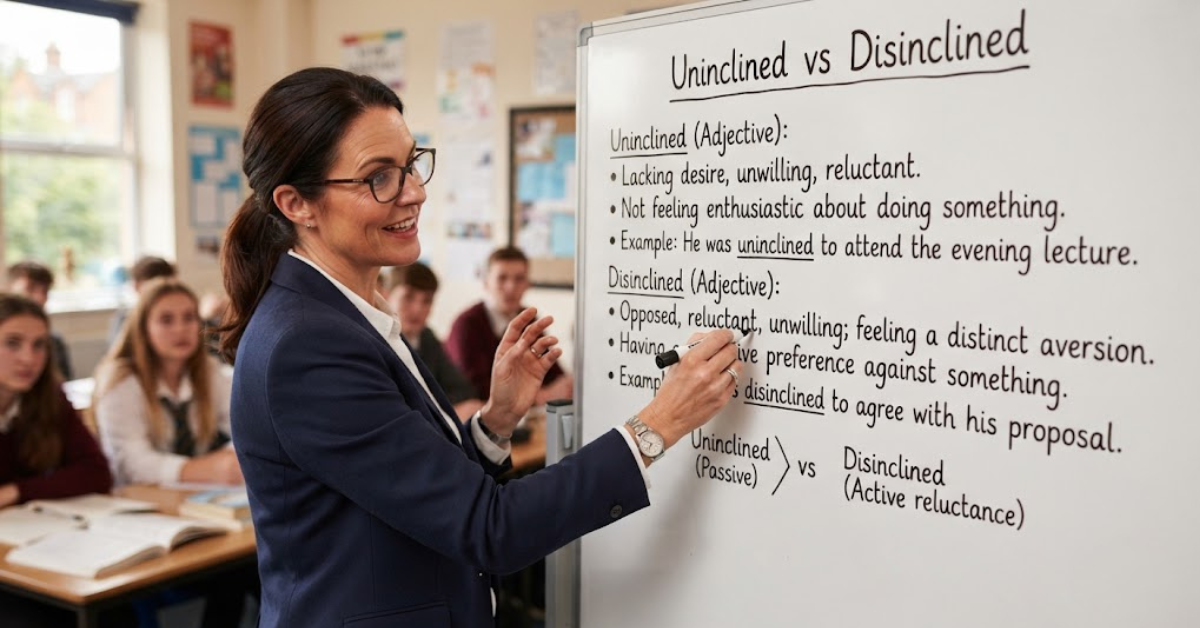
Sometimes two words look like they should mean exactly the same thing, yet there is a small difference in how they are used. Uninclined vs disinclined is a good example. Both words can describe someone who is not willing or eager to do something, but they can carry slightly different shades of meaning.
Uninclined generally means not disposed or not willing to do something, often suggesting a lack of inclination or interest. Disinclined also means unwilling or reluctant, but it can more strongly suggest reluctance or an active lack of desire.
In many everyday sentences, the two words can be used interchangeably. However, understanding their subtle differences can help you choose the word that best matches your intended meaning.
Uninclined vs Disinclined: What’s the Difference?
The basic meanings are very close:
- Uninclined: Not having an inclination, desire, or tendency to do something.
- Disinclined: Unwilling or reluctant to do something.
Consider these examples:
I am uninclined to argue about it.
This suggests that the speaker simply doesn’t feel inclined or interested in arguing.
Now compare:
I am disinclined to argue about it.
This can suggest a more deliberate reluctance or unwillingness to argue.
The difference is subtle, and in many contexts, either word can work.
| Word | Basic Meaning | Typical Sense | Example |
| Uninclined | Not inclined or disposed | Lack of desire or tendency | She was uninclined to participate. |
| Disinclined | Unwilling or reluctant | Hesitation or resistance | She was disinclined to participate. |
What Does Uninclined Mean?
Uninclined means not inclined toward something or not having a desire or tendency to do something.
The word is formed from un-, meaning “not,” and inclined, meaning disposed or likely to do something.
For example:
He was uninclined to discuss the matter further.
This means he did not feel willing or interested in discussing it.
Another example:
After the long journey, I was uninclined to go out again.
Here, the speaker doesn’t necessarily strongly object to going out. They simply don’t feel like doing it.
Examples of Uninclined
- She was uninclined to accept the offer.
- I am uninclined to make a decision today.
- He seemed uninclined to change his plans.
- They were uninclined to participate in the discussion.
- After dinner, we were uninclined to leave the house.
In each case, the word describes a lack of inclination or willingness.
What Does Disinclined Mean?
Disinclined means unwilling, reluctant, or not wanting to do something.
For example:
She was disinclined to answer the question.
This suggests that she was reluctant or unwilling to answer.
The word can sometimes sound a little stronger than uninclined, although the distinction isn’t absolute.
Another example:
He was disinclined to accept their explanation.
This suggests that he was reluctant to accept it, perhaps because he had doubts or reservations.
Examples of Disinclined
- I am disinclined to believe that explanation.
- She was disinclined to discuss the issue.
- He seemed disinclined to cooperate.
- They were disinclined to take unnecessary risks.
- The manager was disinclined to approve the proposal.
These examples often suggest some degree of hesitation, reluctance, or resistance.
Uninclined vs Disinclined: Meaning in Context
The easiest way to understand the difference is to consider the attitude behind the words.
Uninclined often focuses on the absence of desire or inclination.
I am uninclined to go to the party.
This can simply mean:
I don’t particularly want to go.
Disinclined can emphasize reluctance or unwillingness.
I am disinclined to go to the party.
This may imply:
I don’t want to go, and I have reasons for being reluctant.
Again, these aren’t strict definitions that apply to every sentence. The context determines the exact shade of meaning.
Is Uninclined the Same as Disinclined?
For many purposes, yes.
Both words can mean that someone doesn’t want to do something or is not willing to do something.
For example:
She was uninclined to comment.
and:
She was disinclined to comment.
Both sentences tell us that she wasn’t willing or eager to comment.
The difference is mostly one of nuance and tone, rather than completely different dictionary meanings.
When the Words Are Interchangeable
You can often replace one with the other without significantly changing the meaning.
For example:
He was uninclined to complain.
He was disinclined to complain.
Both communicate that he didn’t want to complain.
However, disinclined may sound slightly more deliberate or formal, particularly when it describes reluctance.
Uninclined vs Disinclined in Tone
Tone is one of the most useful ways to distinguish these words.
Uninclined
Uninclined can sound relatively neutral.
It often describes someone’s lack of interest, desire, or tendency.
She was uninclined to join the conversation.
The sentence doesn’t necessarily imply strong opposition. She simply wasn’t inclined to participate.
Disinclined
Disinclined can sound somewhat more formal or deliberate.
It often works well when someone has reservations about something.
The committee was disinclined to approve the proposal.
This sounds as though the committee had reasons for being reluctant.
Neither word is inherently negative, but disinclined can carry a stronger sense of reluctance.
Uninclined vs Disinclined Examples
Looking at the words side by side makes the distinction easier.
Example 1: Going Out
Uninclined:
After working all day, I was uninclined to go out.
The speaker simply didn’t feel like going out.
Disinclined:
After the argument, I was disinclined to go out with them.
Here, the speaker’s reluctance seems connected to a reason or reservation.
Example 2: Accepting an Offer
Uninclined:
She was uninclined to accept the invitation.
This emphasizes her lack of desire to accept.
Disinclined:
She was disinclined to accept the invitation after hearing the conditions.
This suggests reluctance based on concerns about the conditions.
Example 3: Giving an Opinion
Uninclined:
He was uninclined to comment.
Disinclined:
He was disinclined to comment because he didn’t trust the reporter.
The second example makes the reluctance more explicit.
How to Use Uninclined Correctly
Uninclined is commonly followed by to + verb.
Examples:
- uninclined to agree
- uninclined to participate
- uninclined to respond
- uninclined to accept
- uninclined to discuss
For example:
The employee was uninclined to challenge the decision.
You can also use it with toward or towards when describing a general inclination.
For example:
He was uninclined toward confrontation.
However, uninclined to + verb is often the most straightforward construction when discussing a specific action.
How to Use Disinclined Correctly
Disinclined is also commonly followed by to + verb.
Examples include:
- disinclined to agree
- disinclined to cooperate
- disinclined to participate
- disinclined to respond
- disinclined to accept
For example:
The board was disinclined to approve the proposal.
It can also describe a general attitude:
She was disinclined toward social gatherings.
The exact construction depends on what you want to express.
Uninclined vs Disinclined: Which Sounds More Natural?
The answer depends heavily on the sentence.
In casual conversation, people are often more likely to say:
I don’t feel like going.
or:
I don’t really want to go.
Both uninclined and disinclined are somewhat more formal than these everyday alternatives.
Of the two, uninclined can feel slightly more neutral, while disinclined can sound more formal or deliberate.
For example, in a formal report, you might write:
The committee was disinclined to support the proposal.
In ordinary conversation, you might simply say:
The committee didn’t want to support the proposal.
Uninclined vs Disinclined: Synonyms
Several words overlap with both uninclined and disinclined.
Synonyms for Uninclined
Depending on context, alternatives include:
- Unwilling
- Reluctant
- Uninterested
- Disposed against
- Not inclined
- Hesitant
- Unenthusiastic
Synonyms for Disinclined
Possible alternatives include:
- Reluctant
- Unwilling
- Hesitant
- Resistant
- Unenthusiastic
- Unwillingly disposed
- Not eager
These aren’t perfect substitutes in every situation. Reluctant, for example, often emphasizes hesitation, while uninterested focuses more on a lack of interest.
Uninclined vs Unwilling
These words are related, but they aren’t always identical.
Unwilling usually makes the lack of willingness more direct.
She was unwilling to cooperate.
This strongly states that she did not want to cooperate.
Uninclined can be softer:
She was uninclined to cooperate.
This may simply suggest that cooperation wasn’t something she was inclined toward.
In other words, uninclined can leave more room for a neutral lack of interest, while unwilling tends to sound more definite.
Disinclined vs Reluctant
Disinclined and reluctant are particularly close in meaning.
Compare:
He was disinclined to accept the offer.
He was reluctant to accept the offer.
Both suggest that he did not want to accept it.
However, reluctant often highlights hesitation or uncertainty, whereas disinclined can simply indicate an unwilling attitude.
The distinction is subtle, and context usually does more work than the individual word.
Common Mistakes With Uninclined and Disinclined
These words don’t have complicated grammar, but a few mistakes are worth avoiding.
Mistake 1: Treating Them as Completely Different
The meanings overlap considerably.
It’s unnecessary to assume that uninclined always means mild reluctance and disinclined always means strong refusal. The context determines the degree.
Mistake 2: Using Them When You Mean “Uninterested”
Someone can be uninclined to do something without being completely uninterested in the subject.
For example:
She was uninclined to attend the meeting.
This doesn’t necessarily mean she had no interest in the meeting. She may simply not have wanted to attend.
Mistake 3: Assuming Disinclined Means “Unable”
Neither word means unable.
Compare:
He was disinclined to attend.
This means he didn’t want to attend or was reluctant.
He was unable to attend.
This means he couldn’t attend, perhaps because of circumstances.
These meanings are very different.
Are Uninclined and Disinclined Negative Words?
Not necessarily.
Both words describe a lack of inclination or willingness, but neither automatically expresses hostility or strong negativity.
For example:
I was uninclined to order dessert.
This doesn’t mean the speaker disliked dessert. They simply didn’t want any at that moment.
Similarly:
She was disinclined to participate.
This doesn’t necessarily mean she was angry. She may simply have preferred not to participate.
The surrounding context determines the emotional tone.
When Should You Use Uninclined?
Choose uninclined when you want to emphasize that someone doesn’t feel inclined or doesn’t have a particular desire to do something.
It works especially well when the lack of interest is relatively neutral.
Examples:
- I was uninclined to argue.
- She was uninclined to discuss the subject.
- He felt uninclined to leave early.
- They were uninclined to make changes.
When Should You Use Disinclined?
Choose disinclined when you want to emphasize reluctance, unwillingness, or reservations.
Examples:
- I am disinclined to trust him.
- She was disinclined to accept the offer.
- The board was disinclined to change its policy.
- He was disinclined to take the risk.
It can be particularly useful in formal writing where a more precise or restrained expression is appropriate.
Uninclined vs Disinclined: Quick Comparison
| Feature | Uninclined | Disinclined |
| Basic meaning | Not inclined or disposed | Unwilling or reluctant |
| Suggests lack of desire | Yes | Yes |
| Can suggest reluctance | Sometimes | Often |
| Formality | Neutral to formal | Often formal |
| Common construction | Uninclined to + verb | Disinclined to + verb |
| Example | She was uninclined to attend. | She was disinclined to attend. |
The distinction isn’t absolute. In many sentences, both words are perfectly acceptable.
Frequently Asked Questions
What is the difference between uninclined and disinclined?
Both mean that someone is not willing or eager to do something. Uninclined often emphasizes a lack of inclination or desire, while disinclined can suggest stronger reluctance or unwillingness.
Are uninclined and disinclined synonyms?
Yes. They are closely related synonyms and can often be used interchangeably, although they may have slightly different nuances depending on context.
Is uninclined a real word?
Yes. Uninclined is a standard English adjective meaning not inclined, disposed, or willing to do something.
Is disinclined a negative word?
Not necessarily. Disinclined describes reluctance or a lack of willingness, but it does not automatically imply anger, hostility, or strong negativity.
Which is stronger, uninclined or disinclined?
There is no strict rule that makes one universally stronger. However, disinclined can sometimes suggest more deliberate reluctance, while uninclined may sound more neutral.
What is an example of uninclined?
She was uninclined to discuss the issue.
This means she did not feel inclined or willing to discuss it.
What is an example of disinclined?
He was disinclined to accept the proposal.
This means he was reluctant or unwilling to accept it.
What is the opposite of uninclined?
Depending on context, possible opposites include inclined, willing, eager, or disposed.
For example:
She was inclined to help.
This contrasts with:
She was uninclined to help.
What is the opposite of disinclined?
Possible opposites include inclined, willing, eager, and enthusiastic.
For example:
He was disinclined to participate.
versus:
He was eager to participate.
Is “uninclined to” grammatically correct?
Yes. Uninclined to + verb is a standard construction.
For example:
I am uninclined to make a decision right now.
Is “disinclined to” grammatically correct?
Yes. Disinclined to + verb is also a standard construction.
For example:
The committee was disinclined to approve the request.
Conclusion: Uninclined vs Disinclined
The difference between Uninclined vs Disinclined is subtle because the two words overlap heavily in meaning.
Uninclined generally means that someone lacks the inclination, desire, or tendency to do something. Disinclined also means unwilling or reluctant and can sometimes emphasize a stronger sense of hesitation or resistance.
In many situations, either word will work:
She was uninclined to participate.
She was disinclined to participate.
Both tell us that she didn’t want to participate. The choice comes down to the tone and nuance you want.
If you want a more neutral description of a lack of inclination, uninclined may fit naturally. If you want to emphasize reluctance or unwillingness, disinclined can be a useful choice.
The best way to master the distinction is to notice these words in real writing and pay attention to the context surrounding them. Once you do, the subtle difference between uninclined and disinclined becomes much easier to recognize and use.