
Memory problems can be confusing, especially when terms like Alzheimer’s and dementia are often used as though they mean the same thing. They don’t.
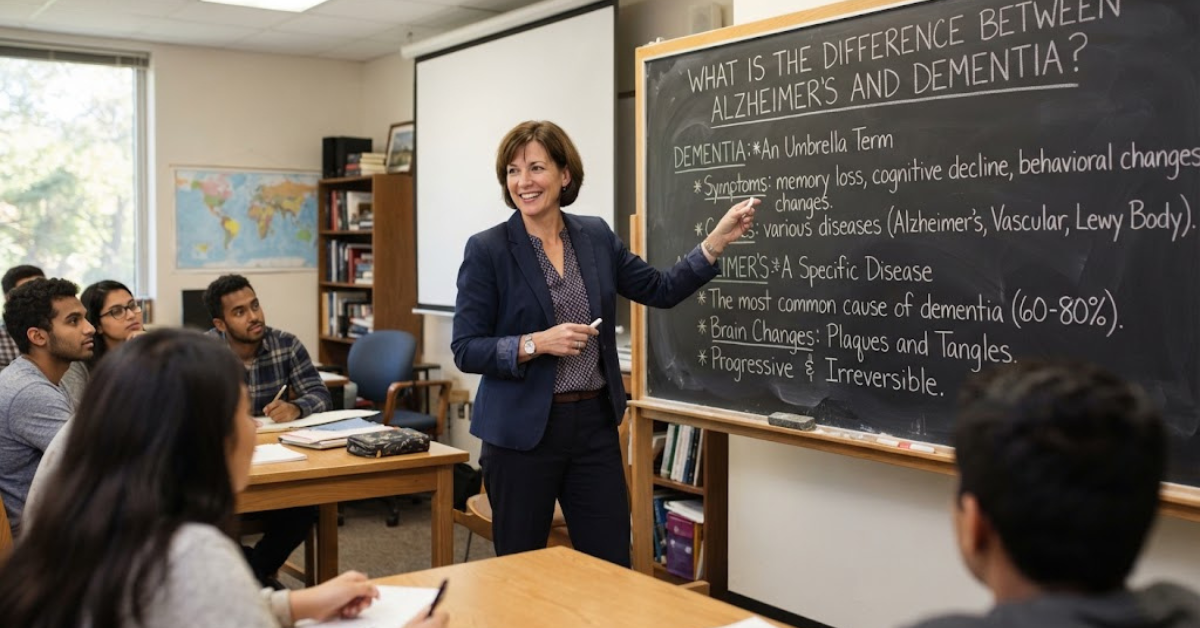
So, what is the difference between Alzheimer’s and dementia? The simplest answer is that dementia is a broad term describing a decline in memory, thinking, reasoning, and other cognitive abilities that interferes with daily life, while Alzheimer’s disease is a specific brain disease and the most common cause of dementia.
That distinction is important. Someone can have dementia without having Alzheimer’s disease, because several different diseases and brain conditions can cause dementia symptoms.
Let’s take a closer look at what each term means, how they are connected, and why knowing the difference matters.
What Is Dementia?
Dementia is not one specific disease. It is a general term used to describe a group of symptoms involving cognitive and behavioral changes that become serious enough to interfere with everyday life.
These changes can affect several areas of thinking and functioning, including:
- Memory
- Reasoning
- Problem-solving
- Language
- Attention
- Judgment
- Visual-spatial abilities
- Behavior and personality
- Ability to perform everyday activities
Dementia can develop from different underlying diseases or types of brain damage. Alzheimer’s disease is one of them, but it isn’t the only one.
Is Dementia a Disease?
This is one of the most important distinctions to understand.
Dementia itself is a clinical term or syndrome, rather than a single disease. It describes the effects of significant cognitive decline on a person’s daily functioning.
The underlying cause may be Alzheimer’s disease, vascular disease, Lewy body disease, frontotemporal degeneration, or another condition. In some people, more than one type of brain change contributes to their symptoms; this is known as mixed dementia.
What Is Alzheimer’s Disease?
Alzheimer’s disease is a specific brain disease. It gradually damages brain cells and affects memory, thinking, reasoning, behavior, and eventually the ability to perform everyday activities.
It is the most common cause of dementia, accounting for an estimated 60% to 80% of dementia cases according to the Alzheimer’s Association.
In many people, memory problems are among the earliest noticeable symptoms. However, Alzheimer’s can also affect language, judgment, problem-solving, and visual-spatial abilities, and the pattern can vary from person to person.
Alzheimer’s is not simply another name for dementia. Rather, it is one disease that can cause dementia.
Alzheimer’s vs Dementia: The Main Difference
The easiest way to remember the relationship is:
Dementia is the umbrella term. Alzheimer’s is one disease underneath that umbrella.
Here’s a straightforward comparison:
| Feature | Dementia | Alzheimer’s Disease |
|---|---|---|
| What is it? | A general term describing significant cognitive decline | A specific brain disease |
| Is it one disease? | No | Yes |
| Can it affect memory? | Yes | Yes, commonly |
| Can it affect thinking? | Yes | Yes |
| Can it affect behavior? | Yes | Yes |
| Can it interfere with daily activities? | Yes | Yes |
| Does it have multiple causes? | Yes | Alzheimer’s has its own disease process |
| Is Alzheimer’s a cause of dementia? | — | Yes |
| Are there other causes of dementia? | Yes | — |
The terms overlap, but they aren’t interchangeable.
What Is the Difference Between Alzheimer’s and Dementia in Simple Terms?
Imagine dementia as a category.
Inside that category are several different diseases and conditions that can cause significant cognitive decline.
Alzheimer’s disease is one of the most common causes within that category.
Other causes include:
- Vascular dementia
- Lewy body dementia
- Frontotemporal dementia
- Mixed dementia
- Other neurological diseases and conditions
So saying someone has “dementia” doesn’t necessarily tell you which underlying disease is responsible.
A diagnosis of Alzheimer’s, on the other hand, identifies a particular disease process.
Different Types of Dementia
There isn’t just one type of dementia.
Different diseases can damage different parts of the brain and produce different patterns of symptoms.
Alzheimer’s Disease
Alzheimer’s is the most common cause of dementia. Memory problems are often prominent early in the disease, although changes in language, reasoning, judgment, and visual-spatial abilities can also occur.
Vascular Dementia
Vascular dementia is associated with conditions that damage or disrupt blood flow to the brain, including strokes and other vascular problems.
Symptoms can vary depending on which areas of the brain are affected.
Lewy Body Dementia
Lewy body dementia is associated with abnormal deposits of a protein called alpha-synuclein, known as Lewy bodies.
It can involve changes in thinking, attention, movement, behavior, mood, sleep, and visual perception.
Frontotemporal Dementia
Frontotemporal dementia involves damage affecting the frontal and temporal regions of the brain.
Changes in behavior, personality, language, planning, and social conduct can be particularly noticeable, depending on the specific form of the disease.
Mixed Dementia
Some people have brain changes associated with more than one type of dementia.
For example, a person may have both Alzheimer’s-related changes and vascular brain disease. This is referred to as mixed dementia.
Alzheimer’s and Dementia Symptoms
Because Alzheimer’s can cause dementia, there is considerable overlap between their symptoms.
However, the exact symptoms and order in which they appear can vary depending on the underlying disease.
Common symptoms of dementia can include:
- Increasing forgetfulness
- Difficulty finding words
- Problems with reasoning
- Trouble solving familiar problems
- Difficulty managing money or medications
- Getting lost in familiar places
- Problems with attention
- Changes in judgment
- Changes in personality or behavior
- Difficulty completing everyday activities
Dementia is diagnosed when cognitive and behavioral changes become significant enough to interfere with daily functioning.
Common Early Signs of Alzheimer’s
Memory problems are often among the first noticeable symptoms of Alzheimer’s disease.
A person might:
- Repeatedly ask the same question
- Forget recently learned information
- Misplace objects
- Have difficulty paying bills
- Struggle with familiar tasks
- Become confused about dates or locations
- Have trouble finding certain words
- Experience changes in judgment or reasoning
These symptoms don’t automatically mean someone has Alzheimer’s. Other medical conditions can cause memory or thinking problems, which is one reason professional evaluation is important.
Is Memory Loss Always Dementia?
No.
Everyone occasionally forgets a name, misplaces something, or walks into a room and forgets why they went there.
Some degree of forgetfulness can occur with normal aging.
Dementia is different because the cognitive changes are significant enough to interfere with everyday life.
For example, occasionally forgetting where you put your keys isn’t necessarily concerning.
Repeatedly being unable to manage familiar financial tasks, getting lost in familiar surroundings, or forgetting important recently learned information may warrant medical evaluation.
It’s the overall pattern, severity, progression, and impact on daily life that matter.
Does Alzheimer’s Always Cause Dementia?
Alzheimer’s disease can exist before a person develops noticeable dementia symptoms.
Modern research recognizes that Alzheimer’s-related biological changes can begin years before obvious cognitive impairment appears. This means the disease process and the clinical symptoms don’t necessarily start at exactly the same time.
A person may therefore have Alzheimer’s-related brain changes without yet having dementia.
As the disease progresses and cognitive problems become severe enough to interfere with daily activities, dementia can develop.
What Causes Alzheimer’s Disease?
Scientists don’t believe Alzheimer’s has one simple cause in most people.
Research suggests that a combination of factors may contribute, including:
- Increasing age
- Genetics
- Certain genetic variants
- Cardiovascular and metabolic health
- Environmental factors
- Lifestyle factors
- Other health conditions
Age is the greatest known risk factor for Alzheimer’s, although Alzheimer’s is not a normal part of aging.
Scientists are also studying changes involving proteins such as amyloid and tau, along with damage to connections between neurons and other changes in the brain.
What Causes Dementia?
Because dementia is a broad term, its causes are also broad.
Different diseases can damage the brain in different ways.
Some major causes or contributors include:
- Alzheimer’s disease
- Vascular disease
- Lewy body disease
- Frontotemporal disorders
- Certain other neurological diseases
- Multiple brain diseases occurring together
The underlying cause matters because different types of dementia can have different symptoms, progression patterns, and treatment approaches.
How Are Alzheimer’s and Dementia Diagnosed?
There isn’t one single test that can determine every case of dementia or Alzheimer’s.
Doctors typically consider several pieces of information.
An evaluation may include:
- Medical history: Changes in memory, thinking, behavior, and daily activities are discussed.
- Cognitive testing: Memory, attention, language, reasoning, and problem-solving may be assessed.
- Physical and neurological examination: Doctors look for signs that might point toward another condition.
- Laboratory testing: Blood or other tests may help identify other potential causes of cognitive symptoms.
- Brain imaging: CT, MRI, or PET scans may be used in appropriate circumstances.
- Biomarker testing: In some situations, blood or cerebrospinal-fluid tests can provide information about biological changes associated with Alzheimer’s.
The specific evaluation depends on the person’s symptoms and medical situation.
Why the Difference Matters
Knowing what is the difference between Alzheimer’s and dementia isn’t just a matter of terminology.
Identifying the underlying cause can help doctors and families understand what might be happening and what types of treatment, planning, support, or monitoring may be appropriate.
Different forms of dementia can have different symptom patterns.
For example, memory problems may be especially prominent early in Alzheimer’s, while movement problems, visual hallucinations, fluctuations in alertness, or early behavioral and language changes may suggest other forms of dementia.
That doesn’t mean symptoms alone can establish a diagnosis. A proper medical assessment is needed.
Alzheimer’s vs Dementia Treatment
Treatment depends heavily on the underlying condition.
For Alzheimer’s disease, doctors may use medications and non-drug approaches to manage symptoms or, in appropriate patients, treatments that target aspects of the disease process.
For other dementias, treatment may focus on the underlying disease, symptom management, safety, rehabilitation, cardiovascular risk factors, caregiver support, or a combination of approaches.
There is currently no universal cure for Alzheimer’s disease or the major neurodegenerative dementias.
Because treatment options and recommendations can change as research develops, anyone experiencing concerning cognitive changes should discuss them with a qualified healthcare professional.
Is Dementia a Normal Part of Aging?
No.
Some changes in memory and thinking can occur with normal aging, but dementia is not considered a normal part of getting older.
The distinction is important because significant or progressive cognitive changes shouldn’t simply be dismissed as “old age.”
Some causes of memory problems may be treatable or reversible, while others require evaluation and long-term management.
Getting an assessment can help determine what’s actually happening.
When Should Someone See a Doctor?
Consider speaking with a healthcare professional when memory or thinking problems are:
- Becoming more frequent
- Getting progressively worse
- Interfering with work or household responsibilities
- Affecting finances or medication management
- Causing problems with driving or navigation
- Affecting communication
- Changing behavior or personality
- Making everyday tasks unusually difficult
A medical evaluation doesn’t automatically mean the person has Alzheimer’s or another dementia.
There can be many reasons for changes in memory or thinking, so identifying the cause is the important first step.
Alzheimer’s vs Dementia: A Simple Memory Trick
If the terminology gets confusing, remember this:
Dementia = the umbrella.
Alzheimer’s = one disease under the umbrella.
You can also think of it this way:
Dementia describes the problem. Alzheimer’s identifies one of the diseases that can cause it.
That simple distinction can make conversations about memory loss and cognitive decline much easier to understand.
Frequently Asked Questions
What is the difference between Alzheimer’s and dementia?
Dementia is a broad term describing significant decline in cognitive abilities that interferes with everyday life. Alzheimer’s disease is a specific brain disease and the most common cause of dementia.
Is Alzheimer’s the same thing as dementia?
No. Alzheimer’s is a cause of dementia, not another word for dementia. There are several other diseases that can cause dementia symptoms.
Can you have dementia without Alzheimer’s?
Yes. Dementia can result from conditions such as vascular disease, Lewy body disease, frontotemporal disorders, and other neurological conditions. Some people also have mixed dementia.
Which is worse, Alzheimer’s or dementia?
This isn’t a useful comparison because Alzheimer’s is a specific disease, while dementia is a broad clinical term. The severity of cognitive impairment depends on the underlying condition and its stage.
What are the first signs of Alzheimer’s?
Memory problems are often among the earliest signs, particularly difficulty remembering recently learned information. Other early changes can involve language, reasoning, judgment, or visual-spatial abilities.
Is dementia just memory loss?
No. Dementia can affect memory, but it can also affect language, reasoning, attention, judgment, visual-spatial abilities, behavior, and the ability to perform everyday activities.
Can Alzheimer’s happen without dementia?
Yes. Alzheimer’s-related biological changes can occur before a person develops symptoms severe enough to meet the clinical definition of dementia.
Does everyone with dementia have Alzheimer’s?
No. Alzheimer’s is the most common cause, but dementia can result from several different diseases and combinations of brain changes.
Is dementia hereditary?
Some forms of dementia have genetic components, but having a family member with dementia doesn’t necessarily mean you will develop it. The genetic contribution varies substantially depending on the specific disease.
Is Alzheimer’s a normal part of aging?
No. Increasing age is the greatest known risk factor for Alzheimer’s, but Alzheimer’s disease is not a normal consequence of getting older.
How is Alzheimer’s diagnosed?
Doctors may use medical history, cognitive testing, physical and neurological examinations, laboratory tests, brain imaging, and—in appropriate circumstances—biomarker testing to evaluate whether Alzheimer’s or another condition may be responsible for cognitive symptoms.
Can someone have more than one type of dementia?
Yes. When brain changes associated with more than one disease occur together, the condition is often called mixed dementia. Alzheimer’s-related changes and vascular brain disease, for example, can occur together.
Conclusion: What Is the Difference Between Alzheimer’s and Dementia?
Understanding what is the difference between Alzheimer’s and dementia starts with one simple distinction: dementia is a broad term, while Alzheimer’s disease is a specific disease.
Dementia describes a level of cognitive decline that interferes with daily life. Alzheimer’s disease is the most common cause of dementia, but other diseases—including vascular dementia, Lewy body dementia, and frontotemporal disorders—can produce dementia as well.
It’s also important to remember that memory loss isn’t automatically dementia, and dementia isn’t simply an unavoidable part of aging. Persistent or worsening changes in memory, thinking, behavior, or everyday functioning deserve a proper medical evaluation.
The easiest takeaway is:
Dementia is the umbrella term. Alzheimer’s is one disease under that umbrella.
Understanding that difference is a useful first step toward learning about symptoms, diagnosis, treatment options, and the support available to people experiencing cognitive changes and to the families who care for them.