Your cells are constantly moving substances in and out of their membranes. Oxygen needs to get in, carbon dioxide needs to get out, nutrients have to be distributed, and waste products need to be removed. But how do cells control all of this movement?
The answer comes down to several forms of cellular transport.
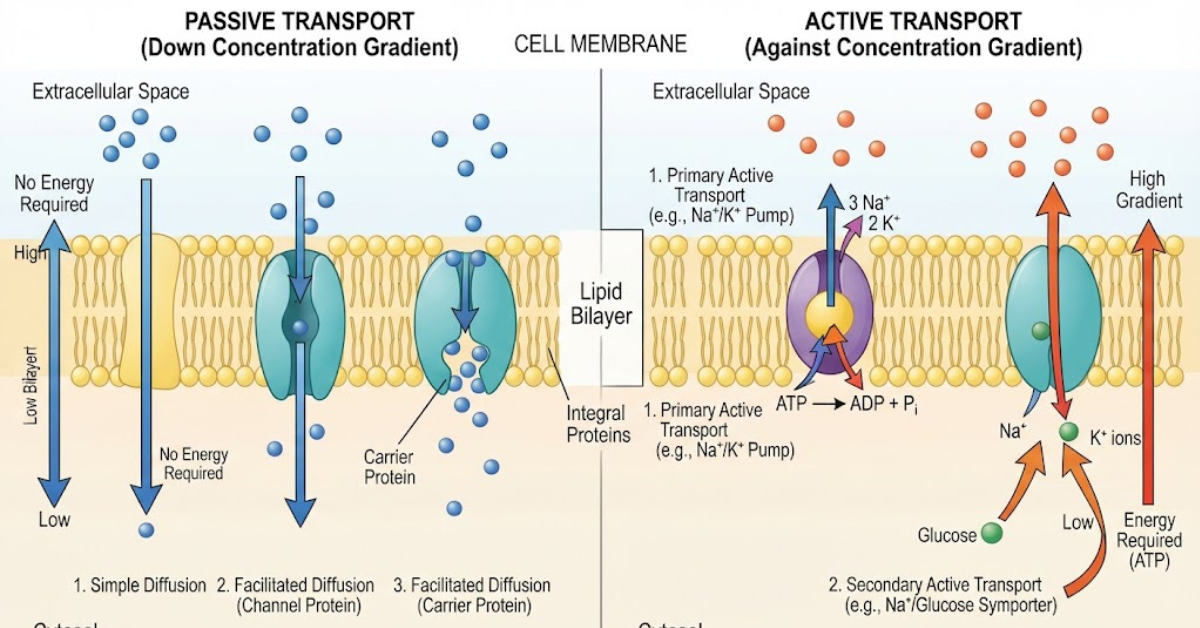
If you’re wondering what is the difference between active and passive transport, the simplest answer is this: passive transport moves substances across a cell membrane without requiring cellular energy, while active transport requires energy to move substances, often against their concentration gradient.
That basic distinction is important, but there is more to it. Diffusion, osmosis, facilitated diffusion, protein pumps, and endocytosis all involve different mechanisms. Understanding how they work makes cell biology much easier to follow.
What Is Cell Membrane Transport?
Before comparing active and passive transport, it helps to understand what the cell membrane does.
The cell membrane, also called the plasma membrane, surrounds the cell and separates its internal environment from the outside. It is selectively permeable, meaning that some substances can cross it more easily than others.
The membrane is mainly made of a phospholipid bilayer with proteins embedded throughout it. These membrane proteins can act as channels, carriers, receptors, and pumps.
Together, the membrane and its transport proteins help maintain homeostasis, or the relatively stable internal conditions cells need to survive.
Substances may move across the membrane through:
- Simple diffusion
- Osmosis
- Facilitated diffusion
- Active transport
- Endocytosis
- Exocytosis
The first three are generally classified as passive transport, while active transport requires cellular energy.
What Is Passive Transport?
Passive transport is the movement of substances across a cell membrane without the direct use of cellular energy, usually from an area of higher concentration to an area of lower concentration.
In other words, the substance is moving down its concentration gradient.
Think about dropping a little food coloring into a glass of water. At first, the dye is concentrated in one small area. Over time, the molecules spread throughout the water.
No external energy is needed to make the molecules spread. Their random motion naturally produces this movement.
Cells take advantage of the same basic principle.
Types of Passive Transport
There are three major forms of passive transport commonly discussed in biology:
- Simple diffusion
- Osmosis
- Facilitated diffusion
Let’s look at each one.
Simple Diffusion
Simple diffusion occurs when molecules move directly through the membrane from an area of higher concentration to an area of lower concentration.
Small, nonpolar molecules can often cross the lipid portion of the membrane relatively easily.
Examples include:
- Oxygen
- Carbon dioxide
- Some small lipid-soluble molecules
The movement continues until the molecules become more evenly distributed, although individual molecules continue moving because of their random motion.
Osmosis
Osmosis is the movement of water across a selectively permeable membrane.
Water moves toward the side with a higher concentration of solutes, or more precisely, toward the side with lower free-water concentration.
For example, if a cell is placed in a solution containing a higher concentration of solutes than the cell interior, water may move out of the cell. Depending on the type of cell and the surrounding solution, this can cause the cell to shrink.
Osmosis is especially important for maintaining water balance in cells and tissues.
Facilitated Diffusion
Some molecules cannot easily pass through the lipid bilayer on their own.
This is where facilitated diffusion comes in.
Membrane proteins help substances cross the membrane, but the cell still does not directly spend ATP to move them. The substances move down their concentration or electrochemical gradient.
Two common types of membrane proteins involved are:
- Channel proteins, which form pathways through the membrane
- Carrier proteins, which bind substances and change shape to move them across
For example, certain ions and glucose can cross membranes through protein-mediated pathways.
What Is Active Transport?
Active transport is the movement of substances across a cell membrane using energy supplied by the cell.
Unlike passive transport, active transport can move substances against their concentration or electrochemical gradients.
That means a substance can be moved from an area where it is less concentrated to an area where it is more concentrated.
This requires an energy input.
The energy commonly comes from ATP, the molecule cells use to power many energy-requiring processes.
A familiar example is the sodium-potassium pump, which helps maintain different concentrations of sodium and potassium ions across the plasma membrane of animal cells.
Primary Active Transport
In primary active transport, a membrane protein uses energy directly, usually from ATP, to move substances across the membrane.
The sodium-potassium pump is a classic example.
For each cycle, the pump moves:
- Three sodium ions out of the cell
- Two potassium ions into the cell
This process uses ATP and contributes to the electrical and chemical gradients that are essential for many cellular functions.
Secondary Active Transport
Secondary active transport is slightly different.
Instead of using ATP directly at the transport protein, it uses energy stored in an electrochemical gradient that was established by another energy-dependent process.
There are two common patterns:
- Symport: two substances move in the same direction.
- Antiport: two substances move in opposite directions.
For example, a sodium gradient can provide the driving force for transporting glucose into certain cells.
So although the transporter itself may not directly break down ATP, the process still depends indirectly on energy supplied by the cell.
Active vs. Passive Transport: The Key Differences
Now we can answer the main question more directly.
What is the difference between active and passive transport?
The biggest differences involve energy use, the direction of movement, and the proteins involved.
| Feature | Passive Transport | Active Transport |
|---|---|---|
| Energy required | No direct cellular energy required | Requires energy |
| Direction | Usually down a concentration/electrochemical gradient | Can move against a gradient |
| ATP use | No direct ATP use | Primary active transport uses ATP |
| Transport proteins | Sometimes | Usually |
| Examples | Diffusion, osmosis, facilitated diffusion | Sodium-potassium pump, secondary active transport |
| Main purpose | Allow substances to move toward equilibrium | Maintain or create concentration gradients |
One important detail is worth remembering: not every type of active transport uses ATP directly. Secondary active transport relies on gradients created by other energy-dependent processes.
Active and Passive Transport Examples
Examples often make the difference much easier to remember.
Examples of Passive Transport
Common examples include:
- Oxygen moving into cells by diffusion
- Carbon dioxide leaving cells by diffusion
- Water crossing membranes through osmosis
- Ions moving through channels down their electrochemical gradients
- Glucose moving through certain facilitated-diffusion transporters
In each case, the substance moves without the transport process directly consuming ATP.
Examples of Active Transport
Examples include:
- Sodium-potassium pumping
- Calcium pumps
- Proton pumps
- Some nutrient transport systems
- Transport processes involved in maintaining ion gradients
Active transport is especially important when cells need to maintain concentrations that would not occur through passive movement alone.
Why Do Cells Need Both Types of Transport?
It might seem as though passive transport would be preferable because it does not require energy.
But cells cannot rely on passive movement for everything.
Imagine a cell that needs to maintain a high concentration of potassium inside and a high concentration of sodium outside. Simply allowing ions to diffuse freely would eventually reduce those differences.
Active transport helps the cell establish and maintain these gradients.
Those gradients then become useful for other processes, including:
- Electrical signaling
- Muscle contraction
- Nutrient absorption
- Water balance
- Cell volume regulation
- Secondary active transport
Passive transport, meanwhile, allows substances to move naturally when a suitable gradient already exists.
In a healthy cell, both mechanisms work together.
Concentration Gradient vs. Electrochemical Gradient
One concept that often causes confusion is the difference between a concentration gradient and an electrochemical gradient.
A concentration gradient refers to a difference in the concentration of a substance between two regions.
For example, if there are many sodium ions outside a cell and fewer inside, there is a sodium concentration gradient.
An electrochemical gradient considers both:
- The concentration difference
- The electrical charge difference across the membrane
This matters particularly for ions because they are electrically charged.
As a result, an ion may be influenced by both its concentration gradient and the electrical potential across the membrane.
Do Passive Transport Processes Always Need Transport Proteins?
No.
Some substances can cross the membrane directly through the lipid bilayer. This is simple diffusion.
Other substances need membrane proteins.
For example, charged ions generally cannot pass freely through the hydrophobic interior of the phospholipid bilayer. They typically require channels or transport proteins.
Facilitated diffusion therefore remains passive even though it uses a membrane protein.
This is an important distinction:
Using a transport protein does not automatically mean that a process is active transport.
The key question is whether cellular energy is required to drive the transport.
Active Transport and the Sodium-Potassium Pump
The sodium-potassium pump is one of the most commonly used examples when learning about active transport.
It is a membrane protein found in animal cells that uses ATP to move sodium and potassium ions against their electrochemical gradients.
The simplified cycle works like this:
- Three sodium ions bind to the pump inside the cell.
- ATP transfers a phosphate group to the pump.
- The pump changes shape and releases the sodium ions outside.
- Two potassium ions bind from outside the cell.
- The phosphate group is released.
- The pump returns to its original shape.
- The potassium ions are released inside the cell.
This cycle helps maintain ion gradients that are important for cellular physiology.
Endocytosis and Exocytosis
Active transport is not limited to small ions and molecules.
Cells also move large particles and bulk materials using membrane-based processes called endocytosis and exocytosis.
Endocytosis
During endocytosis, the cell membrane surrounds material outside the cell and brings it inside in a vesicle.
Major forms include:
- Phagocytosis: uptake of large particles or cells
- Pinocytosis: uptake of extracellular fluid and dissolved substances
- Receptor-mediated endocytosis: selective uptake involving specific receptors
These processes require energy and are therefore considered forms of active, vesicular transport.
Exocytosis
Exocytosis works in the opposite direction.
A vesicle inside the cell moves toward the plasma membrane and fuses with it, releasing its contents outside.
Cells use exocytosis to release substances such as:
- Hormones
- Neurotransmitters
- Digestive enzymes
- Other secreted proteins
Active vs. Passive Transport in Everyday Terms
Here’s an easy analogy.
Imagine a crowded shopping mall with people moving between two rooms.
If people naturally move from the crowded room into the less crowded room, that’s similar to passive transport. No one has to push them uphill against the crowd.
Now imagine someone deliberately moving people from the less crowded room into the crowded room. That takes effort.
That’s similar to active transport.
The analogy isn’t perfect because real cells operate through molecular motion, chemical gradients, electrical forces, and specialized proteins. But it captures the central idea: passive transport follows available gradients, while active transport can use energy to move substances against them.
How to Remember the Difference
A simple memory trick can help:
Passive = no cellular energy required.
Active = energy required.
You can also remember the direction:
Passive transport generally moves down a gradient.
Active transport can move against a gradient.
If you see words such as ATP, pump, against the gradient, or energy, you’re probably dealing with active transport.
If you see diffusion, osmosis, facilitated diffusion, or down the gradient, you’re probably dealing with passive transport.
Common Misconceptions About Active and Passive Transport
Misconception 1: Passive transport means the cell does nothing
Not exactly.
The cell membrane can regulate passive transport through channels and other proteins. The movement itself does not require direct cellular energy, but the cell can control which pathways are available.
Misconception 2: Facilitated diffusion is active transport
It isn’t.
Facilitated diffusion uses membrane proteins but does not directly require ATP. The substance moves down its gradient.
Misconception 3: All active transport directly uses ATP
Not necessarily.
Primary active transport uses ATP directly. Secondary active transport uses the energy stored in an ion gradient that was established through energy-dependent transport.
Misconception 4: Diffusion stops when equilibrium is reached
Molecules continue moving randomly even at equilibrium.
What changes is that there is no longer a net movement in one direction because movement occurs in both directions at approximately balanced rates.
Why Active and Passive Transport Matter in Biology
Membrane transport is fundamental to life.
Cells need precise control over their internal environment. They must obtain nutrients, remove waste, regulate water, maintain ion concentrations, and communicate with other cells.
Transport mechanisms help make all of this possible.
For example, nerve cells depend heavily on ion gradients. Muscle cells rely on carefully regulated calcium concentrations. Kidney cells use specialized transport systems to control the composition of body fluids.
Without controlled membrane transport, normal cellular function would not be possible.
Quick Comparison: Active vs. Passive Transport
If you need a quick review, remember these points:
Passive Transport
- Does not require direct cellular energy
- Generally moves substances down a concentration or electrochemical gradient
- Includes simple diffusion
- Includes osmosis
- Includes facilitated diffusion
- Can involve membrane proteins
Active Transport
- Requires an energy input
- Can move substances against their gradients
- Includes primary active transport
- Includes secondary active transport
- Uses specialized transport proteins
- Includes energy-requiring vesicular transport such as endocytosis and exocytosis
Frequently Asked Questions
What is the difference between active and passive transport?
The main difference is energy use. Passive transport moves substances across a membrane without direct cellular energy input, usually down a concentration or electrochemical gradient. Active transport requires energy and can move substances against their gradients.
What are three examples of passive transport?
Three major examples are simple diffusion, osmosis, and facilitated diffusion.
What are examples of active transport?
Examples include the sodium-potassium pump, calcium pumps, proton pumps, secondary active transport, endocytosis, and exocytosis.
Does passive transport require ATP?
No. Passive transport does not directly require ATP to drive the movement of substances across the membrane.
Does active transport always use ATP?
No. Primary active transport uses ATP directly, while secondary active transport uses energy stored in an electrochemical gradient.
Is facilitated diffusion active or passive?
Facilitated diffusion is passive transport. Although it uses membrane proteins, substances move down their concentration or electrochemical gradients without direct ATP use.
Is osmosis active or passive transport?
Osmosis is a passive transport process because water moves across a selectively permeable membrane without direct cellular energy expenditure.
Which type of transport moves substances against a concentration gradient?
Active transport can move substances against their concentration or electrochemical gradients by using an energy input.
Why is active transport important?
Active transport allows cells to establish and maintain concentration and electrochemical gradients. These gradients are essential for many cellular processes, including electrical signaling, nutrient uptake, and regulation of cell volume.
What is the easiest way to remember active and passive transport?
Think of passive transport as moving with a gradient and active transport as using energy to move against a gradient. Remember that this is a simplified rule, and secondary active transport uses an existing gradient as its energy source.
Conclusion
So, what is the difference between active and passive transport? It mainly comes down to how substances move across the cell membrane and where the energy comes from.
Passive transport does not require direct cellular energy and generally moves substances down their concentration or electrochemical gradients. Diffusion, osmosis, and facilitated diffusion are common examples.
Active transport requires an energy input and can move substances against their gradients. Primary active transport uses ATP directly, while secondary active transport takes advantage of gradients created by energy-dependent processes.
Once you understand those two ideas, the rest becomes much easier. The next time you study cell membranes, look at the direction of movement, the presence of a transport protein, and whether energy is required. Those three clues can usually tell you which transport mechanism you’re looking at.