
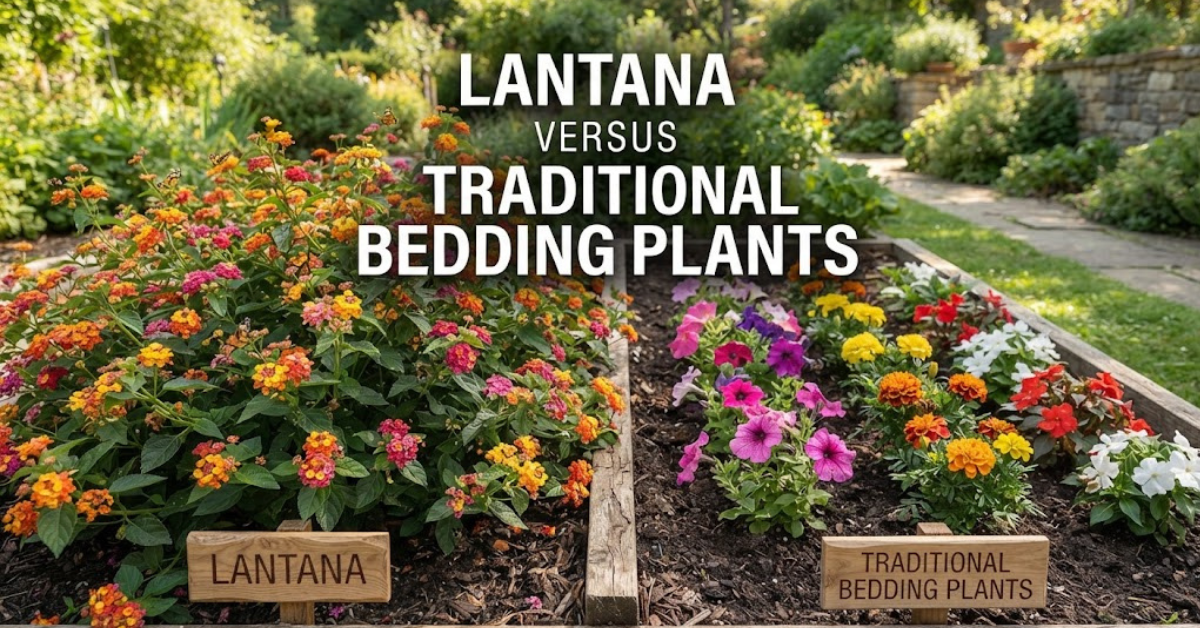
When summer arrives and the garden starts asking for more water, fertilizer, and attention, some flowers cope better than others. That is where lantana versus traditional bedding plants becomes an interesting comparison. While familiar annuals such as petunias, marigolds, impatiens, and begonias have long been popular choices for flower beds, lantana offers a different combination of toughness, long-lasting color, and pollinator appeal.
That does not automatically make lantana the right choice for every garden. Traditional bedding plants can provide specific colors, forms, and growing habits that lantana cannot always match.
So, which should you plant?
The answer depends on your climate, sunlight, soil, watering habits, garden style, and how much maintenance you are willing to provide. Let’s compare the two side by side.
What Is Lantana?
Lantana is a flowering plant in the verbena family, commonly grown for its clusters of small, brightly colored flowers. Depending on the variety and climate, lantana can grow as a compact mound, spreading groundcover, or larger shrub-like plant.
Its flowers may appear in combinations of yellow, orange, pink, red, white, or purple. One of its most recognizable features is that individual flower clusters can contain multiple shades as the flowers mature.
Lantana is especially popular in warm climates because many varieties tolerate heat, sun, and relatively dry conditions once established.
It also has a long flowering season when growing conditions are favorable. Rather than producing one short burst of flowers, lantana can continue blooming for months with appropriate care.
What Are Traditional Bedding Plants?
The term “traditional bedding plants” covers a broad group of ornamental flowers commonly planted in garden beds, borders, containers, and seasonal displays.
Common examples include:
- Petunias
- Marigolds
- Impatiens
- Begonias
- Geraniums
- Pansies
- Snapdragons
- Alyssum
These plants are popular partly because they offer an enormous range of flower colors, sizes, textures, and growth habits.
Some perform particularly well in full sun, while others prefer partial shade. Some are excellent for cool seasons, whereas others thrive during warm weather.
That variety is important because there really is no single “traditional bedding plant.” Different species have dramatically different requirements.
Lantana Versus Traditional Bedding Plants: The Main Differences
The easiest way to understand the comparison is to look at the characteristics gardeners usually care about most.
| Feature | Lantana | Traditional Bedding Plants |
| Heat tolerance | Generally excellent | Varies considerably |
| Full-sun performance | Usually very good | Depends on species |
| Drought tolerance | Often good once established | Usually varies |
| Flowering period | Often long | Depends on plant |
| Pollinator value | Generally high | Varies by species |
| Shade tolerance | Limited | Some species perform well |
| Color choices | Good | Often exceptional |
| Maintenance | Generally moderate to low | Low to high depending on species |
| Container growing | Good for suitable varieties | Excellent selection |
| Cold tolerance | Generally limited | Varies widely |
The important word here is varies. A lantana plant should not be compared with every bedding plant as though they all behave identically.
A heat-loving marigold, for example, has different requirements from a shade-loving impatiens. Your garden conditions should ultimately determine the comparison.
Lantana and Heat Tolerance
One of lantana’s biggest advantages is its ability to handle hot, sunny conditions.
Many lantana varieties perform well in full sun and warm weather. This makes them particularly useful in landscapes where summer temperatures put stress on more delicate flowers.
Traditional bedding plants can struggle under the same conditions.
Petunias, marigolds, and other sun-loving annuals can tolerate substantial heat, but their performance depends on the variety, soil moisture, and local climate. Plants adapted to cooler or shadier conditions may wilt, stop flowering, or become stressed when exposed to intense summer heat.
If your flower bed receives strong afternoon sun, lantana deserves consideration.
However, “heat tolerant” does not mean “impossible to kill.” Newly planted lantana still needs adequate moisture while its root system becomes established.
Water Requirements: Which Needs Less?
Watering is another major consideration when comparing lantana versus traditional bedding plants.
Established lantana can generally tolerate periods of relatively dry soil better than many moisture-demanding bedding plants. Its drought tolerance is one reason it is frequently used in warm-climate landscapes.
That does not mean you should plant it and forget about it.
During establishment, lantana needs regular watering. Even mature plants may require supplemental irrigation during prolonged heat or drought.
Traditional bedding plants vary widely.
For example:
- Impatiens generally prefer consistently moist soil.
- Petunias need regular moisture but dislike constantly soggy roots.
- Marigolds are comparatively tolerant once established.
- Begonias have different moisture requirements depending on type and growing conditions.
So if reducing irrigation is one of your priorities, lantana can be a practical option, particularly in a sunny location.
Flowering Performance and Garden Color
If your main goal is nonstop summer color, both categories can perform well—but they create different visual effects.
Lantana produces rounded clusters of small flowers that can create a dense, colorful display. Many cultivars combine contrasting colors, giving the plant a lively appearance even from a distance.
Traditional bedding plants offer greater variety in flower shape.
You can use:
- Large petunia trumpets
- Rounded begonia flowers
- Marigold pom-poms
- Flat pansy faces
- Delicate alyssum clusters
- Tall snapdragon spikes
This makes traditional bedding plants particularly useful for gardeners who want a carefully designed color scheme.
Lantana tends to deliver a more relaxed, natural-looking display. Bedding plants can provide a more formal, coordinated appearance.
Lantana for Pollinators
Pollinator gardening has become an increasingly popular reason to rethink conventional flower-bed design.
Lantana flowers can attract butterflies and other flower-visiting insects, making the plant useful in gardens designed with pollinators in mind.
That said, not every ornamental bedding plant is equally valuable to pollinators.
If supporting pollinators is a priority, consider choosing flowers based on:
- Whether they produce accessible nectar or pollen.
- Their flowering period.
- Whether they provide flowers at different times of the season.
- Whether they are suitable for local pollinators.
- Whether you can avoid unnecessary pesticide use.
A garden containing several flowering species can offer a more diverse food source than a bed planted with only one ornamental plant.
Lantana vs Petunias
Petunias are among the most recognizable bedding plants, and they have one major advantage over lantana: variety.
Petunias are available in an enormous range of colors and flower forms. Trailing varieties can also spill beautifully over containers and hanging baskets.
Lantana, however, generally has an advantage when hot weather and drought tolerance are major concerns.
Choose lantana when you want:
- Strong performance in hot sun
- Long-lasting seasonal color
- A plant that can tolerate some dry conditions
- Butterfly-friendly flowers
Choose petunias when you want:
- Extensive color options
- Large, showy flowers
- Trailing growth
- Hanging basket displays
- A more traditional bedding-plant appearance
Neither is universally better. They simply solve different gardening problems.
Lantana vs Marigolds
Marigolds and lantana can both be good choices for sunny flower beds.
Marigolds generally provide a more compact, traditional bedding display, with flowers commonly appearing in shades of yellow, orange, and gold.
Lantana offers clusters of smaller flowers and often creates a more spreading or shrubby appearance.
Marigolds are also available in different sizes, making them useful for borders and mixed beds.
If you want a classic, orderly flower-bed look, marigolds can fit that design particularly well. If you want a tougher-looking plant with strong summer performance and pollinator appeal, lantana may be worth considering.
Lantana vs Impatiens
This comparison is very different because the plants prefer different environments.
Lantana generally wants plenty of sunlight.
Impatiens are much better known for performing in shady or partially shaded locations.
That means your garden’s light level can settle the debate before you even consider flower color.
For a bright, sunny border, lantana may be appropriate.
For a shady bed beneath trees or on the north side of a building, shade-tolerant bedding plants such as impatiens may make much more sense.
In gardening, putting the right plant in the right place is often more important than choosing the plant with the longest list of advantages.
Maintenance and Pruning
Lantana is often considered relatively easy to maintain once established, but it is not completely maintenance-free.
Occasional pruning can help control size and shape. Removing damaged growth can also improve the plant’s appearance.
Some varieties may need trimming if they become too large or sprawling for their location.
Traditional bedding plants also vary.
Some are extremely easygoing, while others benefit from:
- Deadheading
- Regular feeding
- Frequent watering
- Pinching
- Pest monitoring
- Seasonal replacement
One advantage of annual bedding plants is that you can redesign the garden regularly. One disadvantage is that replacing seasonal plants can become a recurring chore.
Lantana can provide a more permanent landscape presence in climates where it survives the winter.
Lantana and Cold Weather
This is one area where gardeners in colder climates need to be careful.
Many lantanas are sensitive to freezing temperatures. In areas with cold winters, plants may die back or fail to survive outdoors, depending on the species, cultivar, and local conditions.
Some lantanas are grown as annuals in cooler climates.
Traditional bedding plants offer much more flexibility because the category includes both warm-season and cool-season species.
For example, pansies can provide color during cooler periods, while warm-season annuals can take over when temperatures rise.
This seasonal flexibility is a significant advantage of using a variety of bedding plants.
Is Lantana Invasive?
This question deserves more attention than a simple yes or no.
Lantana includes numerous species and cultivars, and their behavior can vary significantly by region. Some lantana species have become invasive in certain parts of the world, while cultivated varieties may have different characteristics.
Before planting lantana, check local invasive-species guidance and consider the specific species or cultivar you are buying.
Do not assume that every plant sold under the name “lantana” behaves exactly the same way.
This is particularly important if you live in a region where lantana has naturalized.
How Much Sun Does Lantana Need?
Lantana generally performs best in full sun.
A location receiving several hours of direct sunlight can encourage stronger growth and flowering. In insufficient light, flowering may decrease and the plant may become less compact.
When selecting a location, look for:
- Good sunlight
- Well-drained soil
- Adequate air circulation
- Enough room for the mature plant
Avoid planting lantana in an area where water regularly collects.
Good drainage is especially important because consistently waterlogged soil can damage roots.
Soil Requirements for Lantana
Lantana is not particularly demanding about soil as long as drainage is adequate.
A reasonably fertile, well-drained garden soil is usually suitable. If your soil is heavy clay, improving drainage can be more useful than simply adding fertilizer.
Before planting, consider:
- How quickly water drains after rain.
- Whether the soil becomes compacted.
- Whether organic matter needs to be incorporated.
- Whether the planting area receives enough sunlight.
Healthy roots are the foundation of healthy flowering.
Adding excessive fertilizer is not necessarily the answer to poor growth. Correcting light, drainage, watering, or planting conditions may have a much larger impact.
Which Is Better for Containers?
Both lantana and traditional bedding plants can work beautifully in containers.
Compact lantana varieties can provide a colorful centerpiece or spiller effect in large pots. Their tolerance of sunny conditions can also be useful on patios and balconies that receive strong afternoon sunlight.
Traditional bedding plants offer even more options.
A container could combine:
- A tall central plant
- A mounding flower
- A trailing plant
This creates the classic “thriller, filler, spiller” approach to container design.
For smaller pots, however, pay attention to mature plant size. A plant that looks perfectly proportioned at the garden center may eventually outgrow a small container.
Lantana vs Traditional Bedding Plants for Beginners
For a beginner, the best choice usually depends less on gardening experience and more on the growing environment.
A gardener with a hot, sunny yard and limited time for watering may appreciate lantana’s tolerance for challenging summer conditions.
Someone with a shaded garden may have better results with traditional bedding plants selected specifically for low-light conditions.
Before buying anything, ask yourself:
- How much sunlight does the planting area receive?
- How often can I water?
- Is the soil well drained?
- Do I want annual or longer-term plants?
- How much pruning am I willing to do?
- Do I want to attract pollinators?
- What colors and flower forms do I prefer?
- Will the plant survive my winter?
Those questions will narrow your choices quickly.
Can You Plant Lantana With Traditional Bedding Plants?
Absolutely.
There is no rule saying your garden must choose one or the other.
In fact, combining plants can create a more interesting landscape.
For example, lantana could provide a durable flowering foundation in a sunny bed while lower-growing annuals add contrasting colors around it.
The key is to group plants with similar requirements.
Avoid pairing a drought-tolerant lantana with a plant that requires constantly moist soil and expecting both to thrive under exactly the same watering schedule.
Instead, combine plants that enjoy similar amounts of:
- Sunlight
- Water
- Drainage
- Soil fertility
- Temperature
This approach makes garden maintenance easier and usually produces healthier plants.
Pros and Cons of Lantana
Advantages of Lantana
- Performs well in sunny locations
- Generally tolerates heat
- Can handle periods of dry conditions once established
- Provides a long flowering season in suitable climates
- Attracts butterflies and other flower visitors
- Available in several flower colors
- Works in landscapes and containers
- Can require relatively little maintenance once established
Potential Drawbacks
- Not ideal for heavily shaded locations
- Many types are sensitive to freezing weather
- Some species can spread or become invasive in certain regions
- Plants can become larger than expected
- Watering is still important during establishment
- Not every lantana cultivar has the same growth habit
Pros and Cons of Traditional Bedding Plants
Advantages
- Huge selection of colors
- Many flower shapes and textures
- Options for sun and shade
- Excellent for seasonal garden designs
- Many compact varieties work well in containers
- Easy to replace or redesign from season to season
- Some species tolerate cooler weather better than lantana
Potential Drawbacks
- Some varieties need frequent watering
- Certain plants require regular deadheading
- Annuals may need replacement each season
- Performance can decline during extreme heat
- Some bedding plants are more vulnerable to pests and diseases
- Maintenance requirements vary considerably between species
How to Choose Between Lantana and Bedding Plants
If you’re standing in a garden center trying to decide what belongs in your cart, don’t start with the flower color.
Start with the growing conditions.
Choose Lantana When:
- Your garden receives abundant sunlight.
- Summers are hot.
- You want a long flowering period.
- You prefer plants that can tolerate some drought after establishment.
- You want to include pollinator-friendly flowers.
- You have enough space for the plant’s mature growth.
Consider Traditional Bedding Plants When:
- Your planting area is shaded.
- You want highly specific flower colors or forms.
- You want to change the display seasonally.
- You need plants adapted to cooler conditions.
- You are designing a container with several different textures.
- You want a very compact or formal flower-bed arrangement.
A Better Approach: Match Plants to the Garden
The biggest lesson from the lantana versus traditional bedding plants comparison is that gardening isn’t really about finding one universally superior flower.
It is about matching a plant’s characteristics with the conditions you can provide.
A plant that thrives in your yard with minimal intervention is often more useful than a supposedly perfect plant that requires constant attention.
Think about the garden as a small ecosystem rather than a collection of individual flowers.
Sunlight, water, soil, temperature, pollinators, plant size, and maintenance all interact.
When those factors line up, even relatively simple flower beds can look impressive.
Frequently Asked Questions
Is lantana easier to grow than traditional bedding plants?
Lantana can be relatively easy to grow in warm, sunny conditions with well-drained soil. However, traditional bedding plants include many different species, so their difficulty varies. A shade-loving annual may actually be easier than lantana if your garden is heavily shaded.
Does lantana bloom longer than bedding plants?
Lantana can flower for an extended period in suitable climates, particularly during warm weather. However, flowering duration depends on the variety, climate, sunlight, watering, and general plant care. Some annual bedding plants also provide months of continuous color.
Does lantana need full sun?
Lantana generally performs best in full sun. Plenty of direct sunlight encourages flowering and compact growth, although exact light requirements can vary somewhat among cultivars.
Is lantana drought tolerant?
Established lantana is generally more drought tolerant than many moisture-demanding ornamental plants. Newly planted lantana still needs regular watering while its roots become established.
Does lantana attract butterflies?
Yes. Lantana flowers are commonly visited by butterflies and other nectar-seeking insects. If pollinators are a priority, lantana can be one component of a diverse flowering garden.
Can lantana grow in pots?
Yes. Compact lantana varieties can perform well in containers, particularly when they receive sufficient sunlight and the pot provides good drainage.
Is lantana a perennial or annual?
That depends largely on climate and the particular plant. In warm regions, lantana can behave as a perennial. In areas with freezing winters, it may be grown as an annual or require winter protection.
Can lantana and petunias grow together?
They can, provided the selected varieties have compatible requirements for sunlight, watering, and container or bed space. Both can appreciate sunny conditions, but their growth habits should be considered when planning the planting arrangement.
What should I plant instead of lantana?
There are many alternatives, including marigolds, petunias, salvias, zinnias, begonias, impatiens, and other ornamental plants. The right alternative depends on your climate, light conditions, soil, and desired maintenance level.
Final Thoughts on Lantana Versus Traditional Bedding Plants
The lantana versus traditional bedding plants debate doesn’t have one universal answer.
Lantana stands out for its warm-weather performance, flowering potential, sun tolerance, and appeal to pollinators. Traditional bedding plants, meanwhile, offer an enormous range of colors, forms, growing conditions, and seasonal possibilities.
The smartest approach is to look beyond the label and consider what your garden actually provides.
If you have a hot, sunny location and want a flowering plant that can handle challenging summer conditions, lantana may fit naturally into the landscape. If you need shade tolerance, highly specific colors, seasonal flexibility, or compact forms, traditional bedding plants give you plenty of alternatives.
Before your next planting trip, check the plant tag, consider the mature size, and match the plant to your sunlight, soil, and watering conditions.
A beautiful garden isn’t created by choosing the same plant everyone else uses. It’s created by choosing plants that can genuinely thrive where you put them.