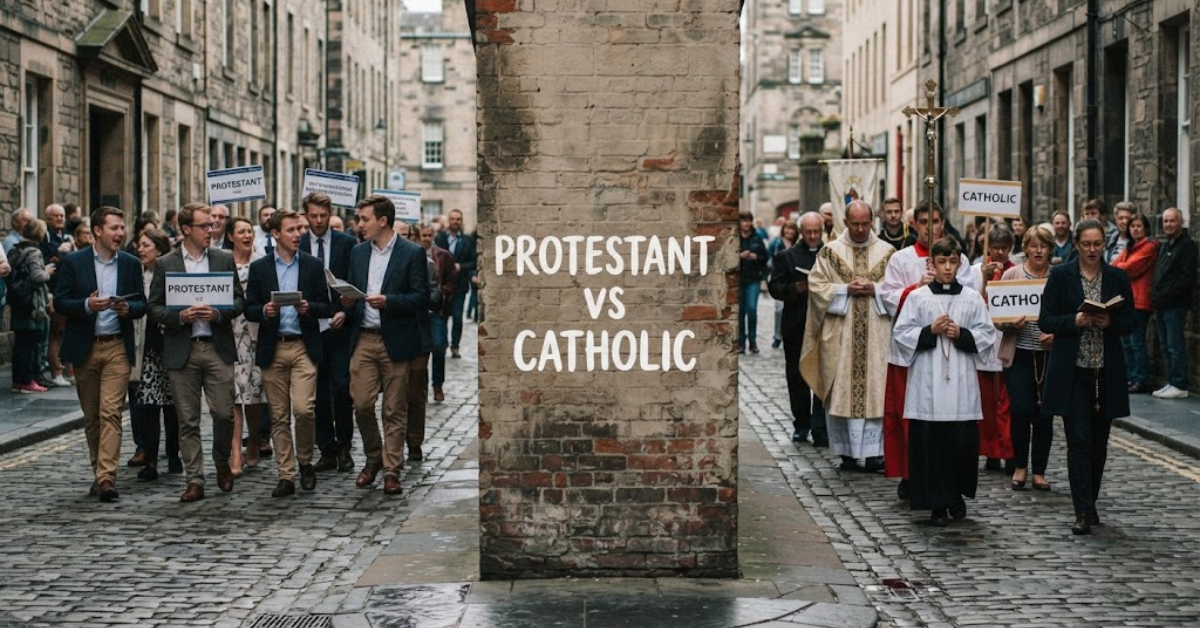
Imagine walking into a Catholic church and then a Protestant church. Both may have a cross, a Bible, hymns, prayers, and people worshipping Jesus Christ. Yet beneath those similarities are important differences in authority, sacraments, church structure, salvation, and the role of tradition.
Understanding Protestant vs Catholic Christianity can be confusing because neither term describes just one single set of beliefs. Catholicism is one worldwide church with a defined teaching structure, while Protestantism includes many denominations, including Lutherans, Baptists, Presbyterians, Methodists, Anglicans, Reformed churches, and many evangelical traditions.
So, what actually separates them?
The biggest differences developed during the Protestant Reformation of the 16th century. Reformers challenged certain Catholic teachings and practices, particularly concerning church authority, the papacy, salvation, and the role of Scripture. Over time, these disagreements contributed to the development of numerous Protestant traditions.
Let’s break down Protestant vs Catholic beliefs, compare their Bibles and worship practices, and then look at the particularly complicated history of Irish Protestant vs Catholic identity.
Protestant vs Catholic at a Glance
Before getting into the details, here’s a quick comparison.
| Topic | Catholicism | Protestantism |
|---|---|---|
| Origin | Ancient Christian tradition; Roman Catholic Church developed its distinctive Western structure over centuries | Emerged from the 16th-century Reformation |
| Central authority | Scripture, Sacred Tradition, and the Church’s Magisterium | Scripture has ultimate authority in most Protestant traditions, though interpretations vary |
| Pope | Recognized as the Bishop of Rome and universal pastor of the Catholic Church | Not recognized as having universal authority over Protestant churches |
| Bible | Usually 73 books | Most Protestant Bibles contain 66 books |
| Sacraments | Seven | Usually two — Baptism and the Lord’s Supper/Eucharist |
| Salvation | God’s grace received through faith, expressed through a life of faith and works | God’s grace through faith; precise formulations differ among denominations |
| Clergy | Bishops, priests, and deacons | Structure varies considerably by denomination |
| Mary | Honored with specific doctrines concerning her role and privileges | Views vary, but generally without Catholic Marian doctrines |
| Saints | Venerated and asked to intercede | Most Protestants do not pray to saints as Catholic practice understands it |
| Worship | Strongly sacramental and liturgical | Ranges from highly liturgical to informal and contemporary |
This table provides a general overview, but there is an important warning: Protestantism is extremely diverse. A Lutheran church can look and worship quite differently from a Baptist or Pentecostal church.
What Is Catholic Christianity?
Catholic Christianity traces its institutional and theological history through the early Christian Church and recognizes the Bishop of Rome, the pope, as its visible universal pastor.
Catholic teaching gives authority to both Sacred Scripture and Sacred Tradition, with the Church’s Magisterium responsible for authentic interpretation. The Catechism explains that Scripture and Tradition together form the Church’s sacred deposit of faith.
Catholic Christianity therefore isn’t based on the idea that Christians should interpret the Bible completely independently of the historic Church.
Instead, Catholic theology sees Scripture, Tradition, and the teaching authority of the Church as closely connected.
That distinction becomes one of the most important points in any discussion of Protestant vs Catholic beliefs.
What Is Protestant Christianity?
Protestantism refers to a broad family of Christian traditions that emerged from the Reformation.
The movement is associated with figures such as Martin Luther, John Calvin, and Huldrych Zwingli, although the Reformation wasn’t a single movement with one leader or one universal theology.
The term “Protestant” itself became associated with Christians who supported reform within Western Christianity during the 16th century.
Over the centuries, Protestant Christianity developed into many denominations and theological traditions.
These include:
- Lutheran
- Reformed
- Presbyterian
- Anglican
- Baptist
- Methodist
- Congregational
- Evangelical
- Pentecostal
- Non-denominational churches
Because of this diversity, it’s more accurate to say “most Protestants believe…” rather than assuming every Protestant believes exactly the same thing.
Protestant vs Catholic Beliefs: The Main Differences
The differences between Catholic and Protestant Christianity aren’t limited to church buildings or worship styles. They involve fundamental questions about how Christians understand authority, salvation, Scripture, sacraments, and the Church.
1. Church Authority
One of the most important differences concerns authority.
Catholicism recognizes three closely connected sources in its understanding of revealed faith:
- Sacred Scripture
- Sacred Tradition
- The Magisterium, or teaching authority of the Church
The Catholic Catechism states that authentic interpretation of God’s Word is entrusted to the Church’s Magisterium, exercised by the pope and bishops in communion with him.
Most Protestant traditions instead emphasize sola scriptura, commonly translated as “Scripture alone.”
This does not necessarily mean Protestants reject all tradition. Protestant churches have confessions, historic creeds, teachers, pastors, and theological traditions. Rather, Scripture is generally regarded as the highest or final authority for doctrine.
This was one of the major issues raised during the Reformation.
Why does this matter?
Suppose Catholics and Protestants encounter a disagreement over an important doctrine.
A Catholic answer will normally involve Scripture as interpreted within the Church’s Tradition and Magisterium.
A Protestant answer will generally give Scripture the decisive authority, although different Protestant denominations can reach different conclusions when interpreting it.
Protestant vs Catholic Bible Differences
The phrase Protestant vs Catholic Bible often leads people to one simple question:
Why don’t Catholic and Protestant Bibles contain exactly the same books?
The New Testament is the same 27 books in both traditions. The major difference concerns the Old Testament.
Most Protestant Bibles contain 66 books total:
- 39 Old Testament books
- 27 New Testament books
Catholic Bibles contain 73 books:
- 46 Old Testament books
- 27 New Testament books
The additional Catholic books are commonly called the Deuterocanonical books. Protestant traditions often refer to these writings as the Apocrypha.
The additional books include:
- Tobit
- Judith
- Wisdom
- Sirach
- Baruch
- 1 Maccabees
- 2 Maccabees
There are also additional passages associated with Esther and Daniel in Catholic editions.
Why are the Bible canons different?
The disagreement has a long history involving ancient Jewish scriptural collections, the Greek Septuagint, early Christian usage, and decisions made during the Reformation.
The Reformers generally followed the Hebrew canon for the Old Testament and placed the additional books in a separate category. Catholic Christianity ultimately affirmed the broader canon as authoritative Scripture.
So saying that one side simply “added” or “removed” books oversimplifies a complicated historical question.
It’s more accurate to say that Catholic and Protestant traditions developed different understandings of the Old Testament canon.
Salvation and Faith: Protestant vs Catholic Beliefs
Salvation is another major area where people often assume the Catholic-Protestant disagreement is simpler than it really is.
Protestant perspective
Most Protestant traditions emphasize salvation by God’s grace through faith in Jesus Christ.
This is closely associated with the Reformation principle of sola fide, or “faith alone.”
However, Protestant denominations differ in how they explain the relationship between faith, works, sanctification, and perseverance.
For example, Protestants generally do not understand good works as something that allows people to purchase or earn God’s grace. Instead, good works are commonly understood as the fruit or consequence of genuine faith.
Catholic perspective
Catholic teaching also emphasizes that salvation begins with God’s grace. Catholicism does not teach that people can independently earn salvation through good deeds.
Instead, Catholic theology understands Christian life as a response to God’s grace involving faith, love, obedience, the sacraments, and cooperation with grace.
This is one reason the phrase “faith versus works” can be misleading.
Both traditions teach the importance of faith and Christian living. The deeper disagreement concerns how faith, grace, justification, sanctification, and works relate to one another.
Sacraments: Catholic vs Protestant
The number and understanding of sacraments is another major difference.
Catholicism recognizes seven sacraments:
- Baptism
- Confirmation
- Eucharist
- Penance
- Anointing of the Sick
- Holy Orders
- Matrimony
The Catholic Catechism describes these seven as sacraments instituted by Christ and places them at the center of Christian life.
Most Protestant churches recognize two ordinances or sacraments:
- Baptism
- The Lord’s Supper, also called Communion or the Eucharist
But even here, Protestant beliefs differ.
For example, Lutheran and Anglican traditions generally have a stronger sacramental theology than many Baptist or evangelical churches.
So the word Protestant doesn’t automatically tell you exactly how a church understands Communion.
Communion and the Eucharist
The Eucharist is particularly significant in the Catholic-Protestant comparison.
Catholic teaching holds that the Eucharist is truly the Body and Blood of Christ, with the doctrine of transubstantiation explaining the change in substance of the bread and wine.
Many Protestants reject transubstantiation, but their views aren’t identical.
For example:
- Some believe Christ is spiritually present.
- Some hold that Christ is truly present in a distinctive sacramental way.
- Others understand Communion primarily as a memorial of Christ’s death.
This is a good example of why saying “the Protestant view” can be too broad.
The Pope and Church Leadership
The pope is one of the clearest institutional differences between Catholic and Protestant Christianity.
Catholics recognize the pope as the Bishop of Rome and the successor of Peter within the Church’s structure.
Catholic teaching gives the pope and bishops in communion with him a specific teaching authority.
Protestant churches do not recognize the pope as having universal authority over their churches.
Instead, Protestant church government varies.
Depending on the denomination, leadership may involve:
- Bishops
- Elders
- Pastors
- Congregational voting
- Regional church bodies
- Synods or assemblies
This is why a Presbyterian church can have a very different leadership structure from a Baptist or Anglican church.
Mary and the Saints
Another noticeable difference concerns Mary and the saints.
Catholic Christianity gives Mary a unique place in Christian theology. Catholic doctrine includes teachings concerning her role as the Mother of God and doctrines such as the Immaculate Conception and Assumption.
Catholics also venerate saints and may ask them to intercede with God.
This is different from worship, which Catholics reserve for God.
Most Protestant traditions do not practice prayer to saints in the Catholic sense. Protestants generally emphasize direct prayer to God through Jesus Christ.
However, Protestants may still respect historical Christian figures and recognize saints in different ways.
Worship Differences
Walk into a Catholic Mass and a Protestant service, and the contrast may be immediately noticeable.
Catholic worship is strongly structured around the liturgy, Scripture readings, prayers, and Eucharist.
Protestant worship ranges much more widely.
One Protestant congregation may have:
- Formal liturgy
- Traditional hymns
- Weekly Communion
- Clergy wearing vestments
Another might have:
- Contemporary music
- An extended sermon
- Informal prayer
- Little or no liturgical structure
So if you’re comparing Protestant vs Catholic beliefs, it’s important not to confuse one Protestant denomination’s worship style with Protestantism as a whole.
Protestant vs Catholic: Key Differences in a Table
| Belief or Practice | Catholic | Protestant |
|---|---|---|
| Authority | Scripture, Tradition, Magisterium | Scripture as supreme/final authority in most traditions |
| Pope | Universal pastor within Catholic Church | No universal Protestant authority |
| Bible | 73 books | Usually 66 books |
| Old Testament | 46 books | Usually 39 books |
| New Testament | 27 books | 27 books |
| Sacraments | Seven | Usually two |
| Baptism | Sacrament | Generally practiced, but theology varies |
| Communion | Eucharist is central and sacramental | Theology varies considerably |
| Mary | Special doctrines and veneration | Honored as Jesus’ mother, but generally without Catholic Marian doctrines |
| Saints | Venerated; intercession requested | Generally not invoked in prayer |
| Clergy | Bishops, priests, deacons | Varies by denomination |
| Worship | Generally liturgical | Ranges from liturgical to informal |
| Confession | Sacrament of Penance | Usually direct confession to God; practices vary |
| Church structure | Globally unified under pope and bishops | Multiple independent denominations and structures |
How the Protestant Reformation Changed Christianity
To understand Protestant vs Catholic, you need to understand the Reformation.
During the early 16th century, reformers challenged aspects of Western Catholic Christianity.
Martin Luther became one of the most influential figures in this movement. His criticisms included the sale of indulgences and broader questions concerning papal authority, priesthood, Scripture, and salvation.
Other reformers developed their own approaches.
John Calvin became associated with Reformed Christianity, while Zwingli led reform in Zurich.
The result wasn’t simply “Catholicism versus Protestantism.”
Instead, Western Christianity became divided into multiple traditions.
The Catholic Church responded through its own reform movement, including the Council of Trent, which clarified Catholic doctrine in response to Protestant challenges.
The consequences were religious, cultural, political, and social, and they shaped European history for centuries.
Irish Protestant vs Catholic: Why Ireland Is Different
The phrase Irish Protestant vs Catholic needs special historical context.
In Ireland, religious identity became closely connected to political history, land, community identity, and British rule. Those connections were particularly significant in the history of Northern Ireland.
That means the terms “Catholic” and “Protestant” in an Irish context can sometimes refer to more than theology.
Historically, religious affiliation could overlap with different national, political, and community identities.
However, it is important not to assume that every Irish Catholic or Protestant holds the same political beliefs today.
Religion and political identity are not interchangeable.
Protestant vs Catholic Ireland Today
Modern Ireland is also much more religiously diverse than it was in previous generations.
According to Ireland’s 2022 Census, about 69% of the population identified as Roman Catholic, while more than 736,000 people reported no religion. The Church of Ireland/England, Anglican and Episcopalian grouping was the second-largest religious category, with 124,749 people.
Northern Ireland has a different religious profile.
The joint Ireland-Northern Ireland census publication reports that in the relevant 2021/2022 census data, 42% of Northern Ireland’s population identified as Roman Catholic, while 37% identified as Protestant and other Christian denominations. Another 17% reported no religion.
These figures are important because “Ireland” and “Northern Ireland” are separate jurisdictions and have different census systems.
Ireland vs Northern Ireland religious profile
| Area | Roman Catholic | Protestant & Other Christian | No Religion |
| Ireland, 2022 | 69% | 7%* | 15% |
| Northern Ireland, 2021 | 42% | 37% | 17% |
*The joint census publication combines Protestant and other Christian categories for comparability, so the figures should not be interpreted as a simple count of every Protestant denomination.
The important takeaway is that modern Irish religious identity is more complicated than the traditional Catholic-Protestant divide suggests.
Why “Irish Protestant” Doesn’t Mean One Thing
Irish Protestantism includes several traditions.
Examples include:
- Church of Ireland
- Presbyterianism
- Methodism
- Baptist traditions
- Other evangelical churches
The Church of Ireland is part of the Anglican tradition, while Presbyterianism belongs to the Reformed Protestant tradition.
These churches share Protestant roots but don’t necessarily agree on every theological issue.
Similarly, Irish Catholicism is part of the worldwide Catholic Church, but individual Irish Catholics can have very different levels of religious practice and personal belief.
That’s why census data about religious affiliation should not automatically be treated as a measurement of personal theological commitment.
Common Misunderstandings About Protestant vs Catholic
Several popular explanations make the Catholic-Protestant divide sound much simpler than it actually is.
“Catholics don’t believe in the Bible.”
This is incorrect.
Catholicism strongly affirms the authority of Sacred Scripture. The disagreement concerns how Scripture relates to Sacred Tradition and the Church’s teaching authority.
“Protestants don’t have traditions.”
Also incorrect.
Protestant denominations have confessions, creeds, historical traditions, theological schools, and established practices.
The major difference is the authority assigned to tradition compared with Scripture.
“All Protestants believe exactly the same thing.”
Definitely not.
A Lutheran, Baptist, Presbyterian, Anglican, Pentecostal, and non-denominational evangelical may disagree on baptism, Communion, predestination, church government, spiritual gifts, and other subjects.
“Catholics believe they can buy salvation with good works.”
That is an inaccurate description of Catholic teaching.
Catholic theology teaches that salvation begins with God’s grace and involves faith and a life transformed by that grace.
Protestant vs Catholic: What Do They Have in Common?
Despite the differences, Catholics and Protestants share an enormous amount of Christian heritage.
Both traditions generally affirm:
- One God
- The Trinity
- Jesus Christ as Lord and Savior
- Jesus’ incarnation
- Jesus’ death and resurrection
- The importance of Scripture
- Baptism
- Christian prayer
- The resurrection
- The importance of Christian moral living
- The centrality of Jesus Christ
This common ground is important.
The Protestant Reformation created serious divisions, but it did not create two completely unrelated religions.
Catholicism and Protestant Christianity both belong to the broader Christian tradition.
Are Catholics and Protestants Still Divided?
Yes, important theological differences remain.
At the same time, relations between Catholics and many Protestant communities have changed considerably over the centuries.
Modern ecumenical dialogue has produced agreements and greater understanding on some issues, even though major disagreements remain.
For example, Catholics and some Protestant traditions have engaged in substantial theological discussions about justification, Scripture, sacraments, and Christian unity.
The modern relationship therefore cannot be described simply using the conflicts of the 16th century.
How to Compare Protestant and Catholic Christianity Fairly
If you’re researching Protestant vs Catholic beliefs, don’t rely on a single denomination or a single church website.
Instead, compare the traditions systematically.
Look at:
- Authority — What determines Christian doctrine?
- Bible — Which books are considered Scripture?
- Salvation — How are grace, faith, justification, and works understood?
- Sacraments — What are they and what do they accomplish?
- Church — How is the Church structured?
- Leadership — What authority do pastors, priests, bishops, or popes have?
- Worship — How are Communion, prayer, preaching, and liturgy understood?
- Mary and saints — What role do they have?
- Baptism — Who is baptized and what does baptism mean?
- Denomination — Which particular Protestant tradition are you comparing with Catholicism?
That last point is especially important.
Comparing “Catholicism” with “Protestantism” is a little like comparing one large denomination with an entire family of denominations.
Frequently Asked Questions
Is Catholicism Protestant?
No. Catholicism and Protestantism are separate major traditions within Western Christianity.
Protestantism emerged from the 16th-century Reformation, while Catholicism continued within the established Western Catholic Church.
What is the main difference between Protestant and Catholic?
One of the central differences is authority.
Catholicism recognizes Scripture, Sacred Tradition, and the Church’s Magisterium as interconnected sources in transmitting and interpreting the faith. Most Protestant traditions give Scripture the highest or final doctrinal authority.
Other major differences involve the pope, sacraments, biblical canon, justification, Mary, saints, and church structure.
Do Catholics and Protestants use the same Bible?
They share the same 27 New Testament books, but most Protestant Bibles have 66 books in total while Catholic Bibles have 73.
The main difference is in the Old Testament canon.
Why does the Catholic Bible have more books?
Catholic Bibles include seven Old Testament books that most Protestant Bibles do not treat as canonical, along with additional passages in Esther and Daniel.
Catholics generally call these books Deuterocanonical, while many Protestants call them part of the Apocrypha.
Do Catholics believe in salvation by faith?
Yes.
Catholic teaching emphasizes God’s grace and the necessity of faith, while also understanding Christian salvation as involving a transformed life of love and obedience.
The Catholic-Protestant disagreement is therefore more nuanced than simply “faith versus works.”
Do Protestants believe in the Trinity?
Yes. Mainstream historic Protestant denominations affirm the Trinity: one God in three persons — Father, Son, and Holy Spirit.
This is also a central Catholic belief.
Do Protestants believe in Mary?
Yes. Protestants recognize Mary as the mother of Jesus and an important biblical figure.
However, most Protestant traditions do not accept the distinct Marian doctrines and devotional practices found in Catholicism.
Are Irish Protestants and Catholics different ethnic groups?
Not necessarily.
Religious identity, national identity, cultural background, and political identity have historically overlapped in Ireland, but they are not identical categories.
Modern Ireland and Northern Ireland are also religiously diverse, and individual identities cannot be reliably determined simply from someone’s religious affiliation.
Is Northern Ireland Catholic or Protestant?
Northern Ireland contains substantial Catholic and Protestant populations.
In the 2021 census, the joint Ireland-Northern Ireland publication reports 42% identifying as Roman Catholic and 37% as Protestant and other Christian denominations. Seventeen percent reported no religion.
Can Catholics and Protestants attend the same church?
They can attend each other’s services, although participation in Communion or other sacraments can be subject to the rules of the particular church.
Whether someone may receive Communion depends on the denomination and circumstances.
Final Takeaway: Protestant vs Catholic
The Protestant vs Catholic distinction is much more than a difference in church style.
The deepest differences involve authority, Scripture and tradition, the biblical canon, salvation, sacraments, church leadership, the papacy, and the role of Mary and the saints.
At the same time, Catholics and Protestants share many foundational Christian beliefs, including faith in Jesus Christ, the Trinity, Scripture, baptism, and the resurrection.
The Protestant vs Catholic Bible difference is also specific rather than absolute: most Protestant Bibles contain 66 books, while Catholic Bibles contain 73, with the principal difference occurring in the Old Testament.
And when looking at Irish Protestant vs Catholic history, theology is only part of the story. Ireland’s religious identities have also been shaped by centuries of political and social history, particularly in Northern Ireland. Modern census data show that religious affiliation continues to change, with substantial Catholic, Protestant, and nonreligious populations across the island.
If you want to explore the subject further, the most useful next step is to compare specific traditions — for example, Catholic vs Lutheran, Catholic vs Baptist, or Catholic vs Presbyterian — because “Protestant” covers a remarkably wide range of Christian beliefs and practices.