
A small difference in the way interest is calculated can make a surprisingly big difference to your money over time. Whether you’re saving, borrowing, investing, or comparing loans, understanding how interest works can help you make sense of the numbers.
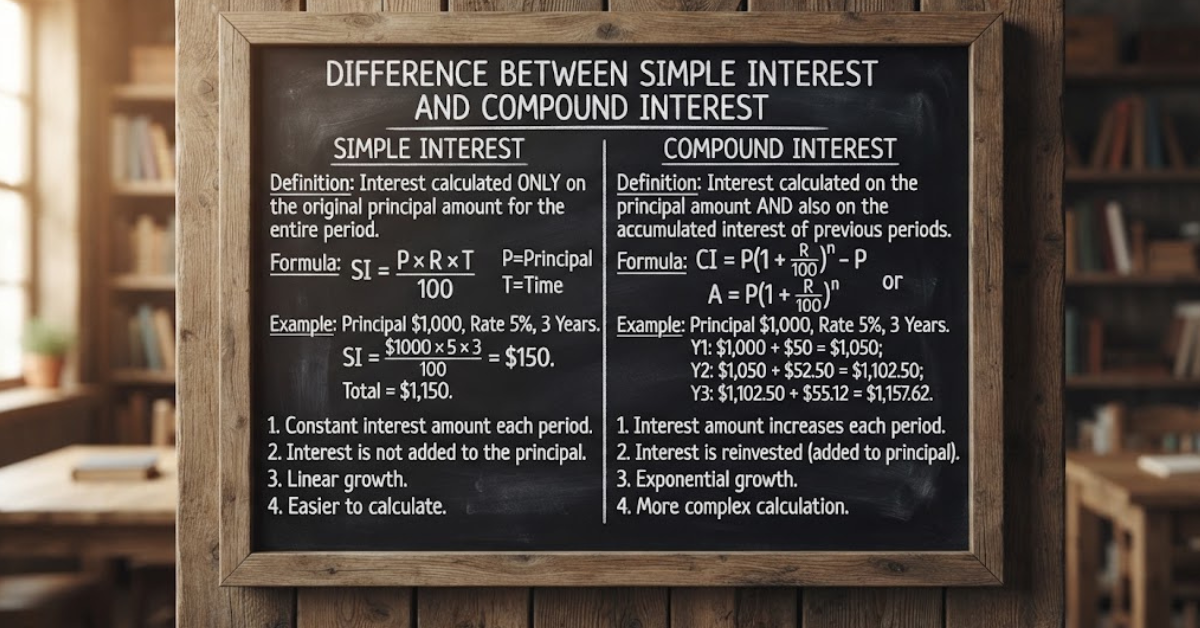
The difference between simple interest and compound interest comes down to how interest is calculated. Simple interest is calculated only on the original principal, while compound interest is calculated on the principal plus previously accumulated interest.
That one distinction can have a major effect over several years. Let’s look at how both types work, how their formulas differ, and where you’re likely to encounter them.
What Is Simple Interest?
Simple interest is interest calculated only on the original amount of money, known as the principal.
The interest doesn’t become part of the principal for future interest calculations.
The basic simple interest formula is:
Simple Interest = P × R × T
Where:
- P = Principal
- R = Annual interest rate expressed as a decimal
- T = Time, usually measured in years
The total amount after interest is:
A = P + I
where I represents the simple interest.
Simple Interest Example
Suppose you borrow $1,000 at an annual simple interest rate of 5% for three years.
Using the formula:
I = $1,000 × 0.05 × 3
I = $150
So the total amount owed would be:
$1,000 + $150 = $1,150
The important point is that the 5% is calculated against the original $1,000 each year.
The interest doesn’t generate additional interest.
What Is Compound Interest?
Compound interest works differently.
Instead of calculating interest only on the original principal, compound interest calculates interest on the principal plus interest that has already accumulated.
This is sometimes described as earning interest on interest.
The standard compound interest formula is:
A = P(1 + r/n)^(nt)
Where:
- A = Final amount
- P = Principal
- r = Annual interest rate as a decimal
- n = Number of times interest is compounded per year
- t = Number of years
Because previously earned interest can become part of the amount on which future interest is calculated, compound growth can accelerate over time.
Difference Between Simple Interest and Compound Interest
So, what is the difference between simple interest and compound interest in practical terms?
The key difference is the base used to calculate interest.
With simple interest, the calculation continues to use the original principal.
With compound interest, the calculation uses the principal plus accumulated interest.
| Simple Interest | Compound Interest |
| Calculated on original principal | Calculated on principal plus accumulated interest |
| Growth is generally linear | Growth can accelerate over time |
| Easier to calculate | Formula is more involved |
| Does not earn interest on accumulated interest | Accumulated interest can generate additional interest |
| Often used for certain loans and financial calculations | Commonly used for savings, investments, and some loans |
The difference may seem small during the first year or two, but it can become much more noticeable over longer periods.
Simple Interest vs Compound Interest Example
Let’s compare the two using the same starting amount.
Suppose you have:
- Principal: $1,000
- Annual interest rate: 5%
- Time: 10 years
With Simple Interest
Using:
I = P × R × T
We get:
I = $1,000 × 0.05 × 10
I = $500
The final amount is:
$1,500
With Annual Compound Interest
Using annual compounding:
A = $1,000(1.05)^10
The result is approximately:
$1,629
So after 10 years, the compound-interest balance is about $129 higher than the simple-interest balance in this example.
The difference becomes larger as the time period increases.
Why Compound Interest Can Grow Faster
The easiest way to understand compound interest is to follow what happens to the balance.
Imagine you deposit $1,000 and earn 5% annually.
After the first year, you have:
$1,050
In the second year, the 5% is no longer calculated on just $1,000. It’s calculated on $1,050.
That produces:
$1,102.50
The following year’s interest is then calculated on $1,102.50.
The process continues.
This creates a compounding effect.
The Power of Time
Time is one of the most important factors in compound growth.
The longer money remains invested or saved while earning compound interest, the more opportunity accumulated interest has to generate additional interest.
That’s why even relatively modest interest rates can produce meaningful differences over long periods.
Simple Interest Formula vs Compound Interest Formula
The formulas look different because the underlying calculations are different.
Simple Interest Formula
I = PRT
For example:
- P = $2,000
- R = 4%
- T = 5 years
The interest is:
$2,000 × 0.04 × 5 = $400
Compound Interest Formula
A = P(1 + r/n)^(nt)
The additional variable n represents how frequently interest compounds.
For example, interest might compound:
- Annually
- Semiannually
- Quarterly
- Monthly
- Daily
The more frequently interest compounds, the different the final result can be, assuming the stated rate and terms are otherwise comparable.
What Does Compounding Frequency Mean?
Compounding frequency refers to how often accumulated interest is added to the account balance and included in subsequent interest calculations.
For example:
Annual Compounding
Interest is added once per year.
Monthly Compounding
Interest is calculated and added each month.
Daily Compounding
Interest is calculated and added much more frequently.
A higher compounding frequency can produce a somewhat higher effective return than annual compounding at the same stated nominal rate, although the exact difference depends on the rate and terms.
Simple Interest and Loans
Simple interest is often easier to understand when looking at certain borrowing arrangements.
Suppose you borrow $5,000 at a simple annual interest rate of 6% for two years.
The interest would be:
$5,000 × 0.06 × 2 = $600
The total would therefore be:
$5,600
However, real-world loans can use different calculation methods, including amortization and daily or monthly interest calculations.
That’s why you shouldn’t assume that every loan advertised with an interest rate uses the simple-interest formula above.
Always check the actual loan terms.
Compound Interest and Loans
Compound interest can also work against you when you’re borrowing money.
If unpaid interest is added to a balance and future interest is calculated on the larger balance, the amount owed can grow faster.
This is one reason it’s important to understand how interest is applied to:
- Credit card balances
- Certain loans
- Delinquent debts
- Investment accounts
- Savings products
The same mathematical principle that can help savings grow can increase borrowing costs when applied to debt.
Compound Interest for Savings and Investments
Compound growth is particularly important when thinking about long-term saving.
Suppose you earn returns on an investment and those returns remain invested.
Future returns can then be earned on the original money and on the accumulated returns.
This is one reason financial educators often emphasize starting long-term saving early.
It’s not simply about how much money you put away. The amount of time that money remains invested can also matter.
Of course, actual investments don’t necessarily provide a fixed interest rate, and investment returns can fluctuate or be negative. Compound-interest formulas are most directly applicable to products where a defined compounding rate applies.
Simple Interest vs Compound Interest for Borrowers
If you’re borrowing money, the distinction can be just as important.
Before accepting a loan, look beyond the headline interest rate.
Check:
- How interest is calculated
- How often it accrues
- Whether unpaid interest is added to the balance
- Whether payments reduce principal
- Fees and other charges
- The repayment schedule
- The total amount payable
Two loans with similar advertised rates can have different costs depending on their terms.
Simple Interest vs Compound Interest for Savers
For savers, compound interest can be particularly powerful over long periods.
Consider two hypothetical accounts with the same initial deposit and interest rate.
One pays simple interest.
The other compounds annually.
The simple-interest account adds the same amount of interest each year because the principal remains the calculation base.
The compound account can add progressively larger amounts because its balance includes previously accumulated interest.
That difference is the mathematical foundation of compound growth.
Factors That Affect Interest Growth
Whether you’re dealing with simple or compound interest, several factors influence the outcome.
1. Principal
The larger the initial amount, the larger the potential interest calculation.
2. Interest Rate
A higher rate generally produces more interest, assuming other terms remain the same.
3. Time
A longer period provides more opportunities for interest to accumulate.
4. Compounding Frequency
For compound interest, how often interest compounds affects the final amount.
5. Additional Contributions
If you regularly add money to a savings or investment account, those additional contributions can also participate in future growth.
Simple Interest and Compound Interest: Which Is Easier?
Simple interest is generally easier to calculate.
You can use:
Principal × Rate × Time
Compound interest requires more information, particularly when interest compounds multiple times per year.
However, calculators and spreadsheets make both calculations relatively straightforward.
The important thing isn’t memorizing complicated formulas. It’s understanding what the formula is actually doing.
A Real-Life Way to Remember the Difference
Here’s an easy mental shortcut:
Simple interest = interest on the original money.
Compound interest = interest on the original money plus accumulated interest.
Imagine planting one tree.
With simple interest, you’re essentially measuring growth based on the original tree.
With compound interest, the growth from the original tree helps create more growth, and that additional growth contributes to future growth.
It’s not a perfect financial analogy, but it captures the basic idea of compounding.
Common Mistakes When Comparing Interest
Looking Only at the Interest Rate
A rate alone doesn’t always tell you the full story.
You also need to consider the time period, compounding frequency, fees, and other terms.
Forgetting the Time Factor
Compound interest becomes increasingly important over longer periods.
A small difference may be barely noticeable over a short period but much more significant over decades.
Confusing APR With APY
These terms are related but aren’t identical.
APR, or annual percentage rate, is commonly used to express borrowing costs and may include certain fees depending on the context and jurisdiction.
APY, or annual percentage yield, reflects the effect of compounding on an interest-earning account.
The exact definitions and disclosures can vary by financial product and jurisdiction, so always check the provider’s terms.
Assuming Every Investment Compounds at a Fixed Rate
Investment returns aren’t necessarily the same as bank-account interest.
Stocks and other investments can fluctuate in value, and past performance doesn’t guarantee future results.
How to Calculate Simple Interest
You can calculate simple interest in a few steps.
Step 1: Identify the Principal
Determine the original amount.
Step 2: Convert the Rate
Turn the percentage into a decimal.
For example:
6% = 0.06
Step 3: Determine the Time
Use years if the annual rate is being used.
Step 4: Apply the Formula
I = P × R × T
For a $3,000 principal at 6% for four years:
I = $3,000 × 0.06 × 4
I = $720
The final amount would be:
$3,720
How to Calculate Compound Interest
For compound interest, use:
A = P(1 + r/n)^(nt)
Suppose:
- P = $3,000
- r = 6% or 0.06
- n = 1
- t = 4 years
Then:
A = $3,000(1.06)^4
The final amount is approximately $3,787.43.
The compound interest earned is approximately:
$787.43
That’s more than the $720 generated by simple interest under the same hypothetical conditions.
When Is Simple Interest Better?
There isn’t a universal answer because it depends on the financial product and its terms.
For a borrower, a simple-interest structure may be easier to understand because interest is based on a defined principal under the stated formula.
For a lender or saver, the outcome depends on the rate, time period, fees, and other terms.
Rather than focusing only on whether an arrangement uses simple or compound interest, compare the total financial cost or return under the actual terms.
When Is Compound Interest Better?
Compound interest can be beneficial when you’re earning interest or returns and leaving them in the account so they can contribute to future growth.
It can also increase the amount you owe when you’re borrowing and interest is being added to the balance.
So compound interest isn’t inherently “good” or “bad.”
Its effect depends on which side of the transaction you’re on and how the account or loan is structured.
Frequently Asked Questions
What is the difference between simple interest and compound interest?
The difference between simple interest and compound interest is how interest is calculated. Simple interest is based on the original principal, while compound interest is based on the principal plus accumulated interest.
Which grows faster, simple interest or compound interest?
Under comparable positive rates and when interest is reinvested or added to the balance, compound interest generally grows faster over time because accumulated interest can itself generate additional interest.
What is the formula for simple interest?
The basic formula is:
I = P × R × T
P is principal, R is the interest rate expressed as a decimal, and T is time.
What is the formula for compound interest?
The standard compound-interest formula is:
A = P(1 + r/n)^(nt)
It accounts for the principal, interest rate, compounding frequency, and time.
Does compound interest always produce more money?
Not necessarily in every real-world comparison. The result depends on the interest rate, fees, timing, withdrawals, contributions, and terms. In a direct comparison using the same positive rate and principal, compound interest produces more accumulated interest over a sufficiently long period because interest earns additional interest.
Is simple interest better for loans?
Not automatically. The total cost of a loan depends on its interest rate, repayment schedule, fees, compounding or accrual method, and other terms.
Is compound interest good for savings?
Compound interest can help savings grow because accumulated interest can generate additional interest. The actual return depends on the account’s rate, terms, taxes, fees, and how long the money remains deposited.
Does compounding frequency matter?
Yes. With compound interest, the frequency at which interest is added to the balance affects the effective return or cost. Monthly and daily compounding can produce different results from annual compounding.
Why does time matter so much with compound interest?
Time gives accumulated interest more opportunities to generate additional interest. This is why compounding can have a much larger effect over long periods than over short periods.
Conclusion: Understanding Simple vs Compound Interest
The difference between simple interest and compound interest is straightforward once you focus on the calculation base.
Simple interest is calculated on the original principal. Compound interest is calculated on the principal plus accumulated interest.
That distinction explains why compound growth can accelerate over time. It also explains why compounding can increase the cost of certain forms of borrowing when interest is added to a balance.
When comparing savings accounts, investments, or loans, don’t stop at the advertised interest rate. Look at the rate, time period, compounding frequency, fees, repayment terms, and total amount paid or earned.
The best next step is to run the numbers for the specific financial product you’re considering. A simple comparison can reveal how much a seemingly small difference in interest calculation could mean over months or years.