
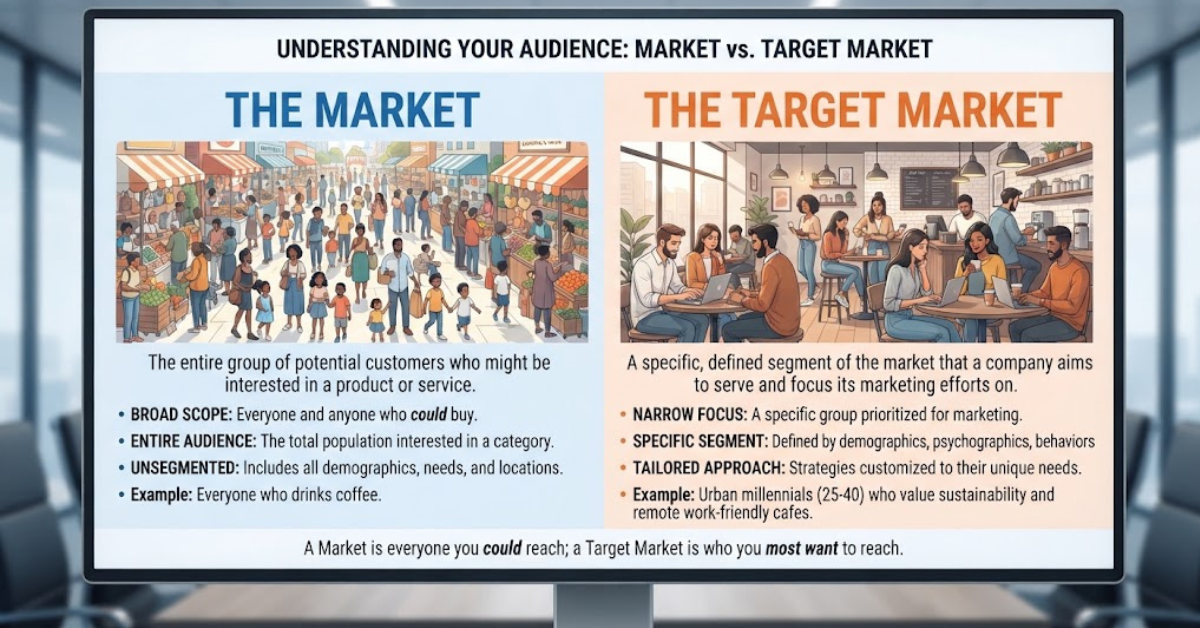
Imagine you sell running shoes. You could say your market is “people who buy footwear.” That’s technically true, but it doesn’t tell you much about whom you should actually focus on. This is where understanding the difference between a market and a target market becomes important. A market is the broader group of people who have a need, want, or potential demand for a product or service. A target market is the specific group within that broader market that a business chooses to focus its marketing efforts on.
The distinction may sound small, but it affects everything from product development and pricing to advertising and customer communication.
What Is a Market?
In marketing, a market refers to a group of potential buyers who share a particular need, problem, desire, or interest that a product or service can address.
A market can be broad or narrow.
For example, consider a company that sells coffee. Its broader market could include people who drink coffee, purchase coffee products, or are interested in coffee-related experiences.
That market might include:
- College students
- Office workers
- Parents
- Travelers
- Coffee enthusiasts
- Restaurant customers
- People who make coffee at home
Not everyone in that market will buy from the same company. They may have different budgets, preferences, habits, and reasons for purchasing.
That’s why businesses usually need to look more closely at the broader market.
What Is a Target Market?
A target market is the particular group of consumers a business decides to serve and reach with its marketing.
Instead of trying to appeal to everyone in a broad market, a company identifies a group whose needs and characteristics fit its product especially well.
For example, suppose the coffee company discovers that its specialty cold brew is particularly popular among college students who want convenient, ready-to-drink beverages.
The broader market might be coffee consumers.
The target market could be:
College students aged 18–24 who regularly buy convenient ready-to-drink coffee.
That’s much more specific.
A target market helps a company decide where to put its marketing resources and how to communicate with potential customers.
Difference Between a Market and a Target Market
So, what exactly is the difference between a market and a target market?
The simplest explanation is:
A market is the broader group of potential customers, while a target market is the specific portion of that market a business chooses to focus on.
Here’s a quick comparison:
| Market | Target Market |
| Broad group of potential customers | Specific group selected by a business |
| May include many customer segments | Focuses on one or more chosen segments |
| Describes overall demand | Guides marketing decisions |
| Can be large and diverse | Usually more clearly defined |
| Helps identify business opportunities | Helps determine who to reach and how |
For example, the market for fitness products could include anyone interested in exercise and wellness.
A company’s target market might be busy professionals looking for compact home workout equipment.
The target market is therefore a more focused part of the broader market.
Why Businesses Need a Target Market
It may seem logical to market a product to everyone who could possibly use it.
In practice, that’s often difficult and expensive.
Different customers respond to different messages. A teenager, a retired person, and a professional athlete may all buy athletic shoes, but their motivations can be completely different.
Defining a target market helps a business answer questions such as:
- Who is most likely to buy?
- What problem are they trying to solve?
- What features matter most to them?
- How much are they willing to spend?
- Where do they look for information?
- What kind of message will get their attention?
These answers can make marketing more focused and useful.
Market vs Target Market: A Simple Example
Let’s say a company launches a new meal-delivery service.
Its broad market might include:
People who purchase prepared meals or meal-delivery services.
But after researching customers, the company might identify a target market of:
Urban professionals aged 25–40 who have busy schedules and want convenient, ready-to-eat meals.
Notice how much more information the second description provides.
The broader market tells the business where the opportunity exists.
The target market helps explain who the business intends to reach within that opportunity.
How Market Segmentation Creates a Target Market
Businesses don’t usually choose a target market randomly.
They often use market segmentation, which means dividing a broad market into smaller groups with shared characteristics.
Common segmentation methods include demographic, geographic, psychographic, and behavioral segmentation.
Demographic Segmentation
Demographic segmentation groups customers based on characteristics such as:
- Age
- Income
- Gender
- Education
- Occupation
- Family size
- Life stage
For example, a company selling premium children’s educational products might focus on households with young children and relatively high disposable income.
Geographic Segmentation
Geographic segmentation divides customers based on location.
A business might focus on:
- A particular city
- A region
- A country
- Urban areas
- Rural communities
- Specific neighborhoods
Geography can influence customer needs because climate, culture, population density, and local purchasing habits can vary significantly.
Psychographic Segmentation
Psychographic segmentation looks at characteristics such as:
- Lifestyle
- Interests
- Values
- Attitudes
- Personality
- Preferences
For example, two people of the same age and income might have completely different attitudes toward sustainability, convenience, luxury, or fitness.
Psychographic information can therefore help businesses understand why people make certain purchasing decisions.
Behavioral Segmentation
Behavioral segmentation focuses on how customers interact with products or brands.
Businesses may examine:
- Purchase frequency
- Brand loyalty
- Product usage
- Benefits sought
- Buying occasions
- Customer engagement
For example, a business might distinguish between occasional buyers and customers who purchase a product every month.
A Market Can Have Multiple Target Markets
A business doesn’t necessarily have only one target market.
Large companies often serve several customer segments.
For example, a clothing company might sell:
- Children’s clothing
- Teen clothing
- Women’s clothing
- Men’s clothing
- Sportswear
- Formalwear
The overall market could be the clothing market, while each category represents a more specific customer segment.
A company may develop separate campaigns for different segments because each group has different needs and purchasing motivations.
Target Market vs Target Audience
These terms are often used interchangeably, but they aren’t always identical.
A target market generally refers to the customer group a business intends to serve with a product or service.
A target audience is often the specific group a particular marketing message or campaign is designed to reach.
For example, a company may have a broad target market of parents with young children.
For one advertising campaign, its target audience might be first-time parents searching online for educational toys.
The target audience is therefore often more closely connected to a specific marketing communication.
Target Market vs Market Segment
A market segment is a subgroup within a larger market that shares particular characteristics.
A target market is the segment or collection of segments that a business chooses to focus on.
For example:
Broad market: Fitness consumers
Market segments:
- Home exercisers
- Gym members
- Professional athletes
- Outdoor fitness enthusiasts
Target market:
Busy adults interested in convenient home workouts
The distinction is subtle but useful. Segmentation identifies groups; targeting involves deciding which groups to serve.
How to Identify a Target Market
Finding the right target market requires more than simply choosing an age group.
A practical process looks like this:
1. Define the Product or Service
Start by understanding exactly what you’re selling.
What problem does it solve?
What need does it address?
What makes it different?
2. Identify the Broader Market
Determine who could reasonably need or want the product.
Don’t narrow the audience too early.
3. Divide the Market Into Segments
Use demographic, geographic, psychographic, and behavioral characteristics to identify meaningful customer groups.
4. Research Customer Needs
Look for patterns in:
- Customer interviews
- Surveys
- Sales data
- Reviews
- Search behavior
- Competitor research
- Industry reports
5. Evaluate Each Segment
Consider factors such as:
- Size
- Growth potential
- Customer needs
- Competition
- Purchasing power
- Accessibility
- Fit with the business
6. Select the Target Market
Choose the segment or segments that best fit the company’s product, resources, and objectives.
7. Create a Clear Customer Profile
Turn the target market into a practical description of the people you’re trying to reach.
This makes marketing decisions much easier.
What Makes a Good Target Market?
A useful target market should be specific enough to guide decisions without becoming unnecessarily restrictive.
Businesses commonly evaluate target markets using characteristics such as measurability, accessibility, substantiality, and actionability.
In simple terms, the company should be able to:
- Identify the customers
- Estimate the opportunity
- Reach the customers effectively
- Create an appropriate offering
- Serve the group profitably or sustainably
A target market that sounds specific but cannot actually be reached or served isn’t very useful.
Why Market Research Matters
Good targeting depends on reliable information.
Businesses shouldn’t assume that people want a product simply because the business believes they should.
Market research can reveal differences between what customers say they want, what they actually purchase, and what alternatives they currently use.
Useful research methods include:
- Customer surveys
- Interviews
- Focus groups
- Sales data
- Website analytics
- Customer reviews
- Competitor analysis
- Industry research
The goal is to replace guesswork with evidence.
Common Mistakes When Choosing a Target Market
Trying to Sell to Everyone
“Everyone” isn’t usually a useful target market.
A message designed for everyone often becomes so general that it doesn’t strongly appeal to anyone.
Defining the Market Too Narrowly
The opposite problem can also happen.
A business may create such a narrow customer profile that the potential market becomes too small.
Relying Only on Demographics
Age and income can be useful, but they don’t tell the whole story.
Two customers with identical demographics can have completely different needs and buying motivations.
Ignoring Customer Behavior
What customers actually do can be more informative than what businesses assume they do.
Purchase history, product usage, and customer feedback can reveal valuable patterns.
Failing to Reassess
Markets change.
Consumer preferences, technology, competition, economic conditions, and cultural trends can all influence customer behavior.
A target market should therefore be reviewed periodically.
Market and Target Market in Digital Marketing
The distinction is especially important online.
Digital platforms give businesses access to huge numbers of potential customers. But having access to a large audience doesn’t mean every person is a valuable prospect.
A business might use customer research and platform analytics to identify a narrower group based on interests, behavior, location, or previous interactions.
This can influence:
- Search advertising
- Social media campaigns
- Email marketing
- Content strategy
- SEO
- Influencer partnerships
- Product recommendations
The broader market provides the context. The target market provides the focus.
Does a Target Market Stay the Same Forever?
Not necessarily.
A target market can change as a company, product, or industry changes.
For example, a product initially designed for college students might later become popular among working professionals.
A company may also deliberately reposition a product and pursue a different customer segment.
This is why customer research shouldn’t be treated as a one-time activity.
How the Difference Affects Marketing Strategy
Understanding the difference between a market and a target market influences several parts of a marketing strategy.
Product
Customer needs can influence product features, packaging, design, and positioning.
Price
Different segments may have different budgets and perceptions of value.
Promotion
The language, imagery, channels, and offers used in advertising can change depending on the intended audience.
Distribution
Businesses may choose different retail locations, websites, platforms, or delivery methods depending on where their target customers shop.
Together, these decisions form a more focused marketing strategy.
A Quick Way to Remember the Difference
If the terminology starts getting confusing, use this simple analogy.
Think about a large stadium.
The market is everyone who could potentially attend the event.
The target market is the particular group the event organizer is trying hardest to attract.
The first describes the larger opportunity.
The second describes the focus.
That distinction captures the basic relationship between the two terms.
Frequently Asked Questions
What is the difference between a market and a target market?
The difference between a market and a target market is scope. A market is the broader group of potential customers with a relevant need or demand, while a target market is the specific group a business chooses to focus on.
What is an example of a market and a target market?
The market could be people interested in fitness products. A target market within that group could be busy professionals looking for compact home exercise equipment.
Is a target market part of a market?
Yes. A target market is generally a specific segment or group within a broader market.
What is market segmentation?
Market segmentation is the process of dividing a broad market into smaller groups based on shared characteristics such as demographics, location, lifestyle, interests, or behavior.
What is the difference between a target market and a target audience?
A target market generally describes the customer group a business aims to serve. A target audience often refers to the specific people a particular marketing message or campaign is intended to reach.
Can a company have more than one target market?
Yes. A company may serve multiple customer segments and create different products, offers, or marketing campaigns for each one.
Why is identifying a target market important?
It helps businesses focus their resources, understand customer needs, develop relevant products, create effective messaging, and choose appropriate marketing channels.
How do businesses find their target market?
Businesses can use market research, customer surveys, sales data, website analytics, competitor research, customer reviews, and segmentation analysis to identify promising customer groups.
Can a target market change?
Yes. Customer preferences, competition, technology, economic conditions, and changes in a company’s products can all cause a business to reconsider its target market.
Conclusion: Market vs Target Market
The difference between a market and a target market is ultimately about breadth versus focus.
A market represents the broader group of people who may have a need, want, or demand that a product or service can address. A target market is the particular group within that broader market that a business decides to prioritize.
Think of it this way:
Market = the larger opportunity.
Target market = the specific customers you choose to focus on.
Understanding this distinction makes other marketing concepts easier to understand, including market segmentation, customer personas, positioning, advertising, and marketing strategy.
If you’re developing a product or planning a marketing campaign, start by identifying the broader market. Then break it into meaningful segments, research those groups, and determine which customers are the best fit for what you’re offering.
The clearer that focus becomes, the easier it is to create marketing that speaks to real customer needs rather than trying to appeal to everyone at once.